Chisnell Chatter Edition 10

If you are new to Chisnell Chatter, this publication has a range of hyperlinks embedded in the text. Where you spot an underline or highlighted text, click to find out more information. My back catalogue is available here:

Chisnell Chatter Edition 1. Chisnell Chatter Edition 2. Chisnell Chatter Edition 3. Chisnell Chatter Edition 4. Chisnell Chatter Edition 5 Chisnell Chatter Edition 6 Chisnell Chatter Edition 7 Chisnell Chatter Edition 8

If I can help you in any way then do get in touch, you can email me chisnellg@gmail.com or call / text me on 07825149535.

For more information about my consultancy offer, please visit my website here. My latest consultancy offer includes Coaching for Appraisal as a course that prepares leaders and staff for impactful appraisal. This course is co-facilitated with HR expert Gary Edwards. I will also be running two courses in 2025 with Gary and the details of these are outlined in this edition. Do get in touch if you are interested in training, consultancy or any other training or coaching support.

Ofsted MAT Summary Evaluations and DfE MAT Assurance Framework

The Ofsted Summary Evaluations (MATSE) are undertaken by Ofsted to check in on how Multi Academy Trusts to ‘recognise a trust’s positive impact on the quality of education in its academies, and to give the trust helpful recommendations on aspects of its work that could be improved’. Ofsted 2023.

Ofsted will consider inspections undertaken in MATs over two terms before visiting the trust. This means that inspections in a MAT may be clustered together to inform the MATSE. While these have been paused, it is plausible to think that the clustering of inspections in MATs may continue as this can inform MATSE from April 2024.

For more information about MATSE visit the Ofsted site here where you will find the latest MATSE document updated in March this year.

The MAT Assurance Framework is a tool provided by the DfE for trusts as a self evaluation tool. This is a super document that I had the privilege of appearing in as an exemplar practice. Here is a link to the framework’s criteria. This provides a really helpful set of prompts for MAT self-evaluation and asks you to RAG your current self assessment. I have used this tool with trusts and trustees to review the strengths and areas for development. If you are interested in developing the self assessment for your trust, then contact me.

Questioning

Questioning is one of the most powerful tools in the teachers’ toolbox. It can engage pupils, support their understanding, develop their vocabulary and strengthen their pace of recall. Questioning can also act as the most powerful form of formative assessment. However, I so often see questioning used as a bolt on to learning rather than a driver for learning.

Here is a link to an article by Kate Jones on questioning. In the link Kate provides a link to the Evidence Based Podcast with Michael Chiles. Mike talks about his book relating to questioning. The episode explores the purpose of questioning and the use of strategies to engage pupils in questioning. While this is a secondary focus, there is some useful points made.

The EEF have also produced a helpful information on feedback. The report outlines six key recommendations:

1 Lay the foundations for effective feedback

2 Deliver appropriately timed feedback that focuses on moving learning forward

3 Plan for how pupils will receive and use feedback

4 Carefully consider how to use purposeful, and time-efficient, written feedback

5 Carefully consider how to use purposeful verbal feedback

6 Design a school feedback policy that prioritises and exemplifies the principles of effective feedback 

Here is a link to a downloadable poster of the key recommendations.

The use of effectiv feedback is powerful for teachers in checking in on gaps in knowledge and understanding as well as purposeful for the pupils as a tool for learning and affirming their own understanding. Feedback is therefore a win-win scenario. Coupled with effective questioning, which is amongst the most powerful tools in a teachers’ toolbox.

If you would like further support for developing a culture of questioning then please get in touch.

Reflections on a good read – You’re not listening by Kate Murray

A colleague recommended Kate Murray’s book, ‘You’re not listening’ to me recently. The book is an easy read and makes some great points that resonate with so many roles within schools. The book starts with a super quote by Epicteus, a Greek philosopher:

Nature hath given man one tongue but two ears, that we may hear from others twice as much as we speak.’

Kate makes the point in her book that hearing is not the same as listening, and too often we engage in a passive process of hearing rather than an active process of listening. In my opinion, this can also resonate with our approach to teaching and questioning in the classroom. Kate urges us to listen to our own curiosity and become interested in the conversation you are undertaking. She talks of ‘assumptions as earplugs’. This is a great concept and links with cognitive bias. The idea here is that when you make an assumption that you know what someone is talking about, you can switch off. In ensuring that you remain open to truly listening to your colleagues, you can learn something new about them, the issue being discussed and yourself.

Kate makes another valuable point that there is merit in listening to opposing views. It is easy to slip into just speaking to colleagues that echo your own professional ideologies and practice. This may include connecting only with like minded colleagues on social media. Kate urges us to ‘accept the legitimacy of another person’s viewpoint’. A powerful message for any school leader as they strive to connect and understand their team and allows us all to pick up on the differing perspectives on offer by our colleagues. This can lead to staff’s strengths emerging and being valued and the team being strengthened.

If you want to read more, then follow this link to Kate’s book. (I don’t get commission for this, honest!).

The Diamond 9 – research methodolgy

When thinking about your research methodology, you can choose to collect data through a single research method, or combine a range of research methods. I have used the Diamond 9 research method in many research projects as it provides a really helpful tool to gain helpful data that unpacks your research question.

How does it work?

Research in schools should be engaging, simple and enjoyable for both the researcher and the participants. The Diamond 9 provides a resource that ticks all three boxes.

The Diamond 9 research tool encourages your research participants to order their preferences to a range of images or statements linked to your research question. The statements or images are given to an individual or group and they are asked to rank them using the Diamond 9 format to define which statement or image is the most and least important to them.

For example, consider a teacher researching the question, ‘Do children favour similar play-based interests in home as they do in school?’. She produced a range of 12 images on postcards and asked the children to rank them in a Diamond 9 pattern. The children placed their favourite activities at the top of the Diamond 9 and those with similar preferences were placed in the middle rows with the least preferred form of play at the bottom. Pictures that were not of interest were discarded as were any that remained after the Diamond 9 was complete.

The teacher talks to the child throughout the activity and encourages them to order their preferences. The teacher recorded the final Diamond 9 in a photograph, noting the comments made during the discussion with the child as they grappled and reasoned with their choices. The researcher can record both the final Diamond 9 but can also transcribe the children’s discussion as they consider where each image is placed, providing additional data for analysis.

Using the Diamond 9 with different respondents can also provide an interesting opportunity for analysis of data. With the example above, the researcher could select differing groups of pupils, perhaps selecting gender, disadvantage or ability; to see if there is any correlation between the choices made by the different groups.

The Diamond 9 activity builds a fascinating bank of data that when analysed, helps the researcher to move forward with their curriculum, pedagogy and practice.

Special Educational Needs and/or Disabilities

Here is a link to the recent announcements regarding the transition to the National Professional Qualification for Special Educational Needs Coordinators.

SENCOs who have already obtained the NASENCO will not need to complete the new NPQ.

From September 2024, all SENCOs and aspiring SENCOs will:

  • need to take the NPQ if they have not completed or started the NASENCO
  • still need to complete training within 3 years of appointment –  schools and SENCOs must ensure they enrol on training that will meet this requirement

SENCOs appointed before 1 September 2009 will not be required to take the NPQ but will be expected to ensure compliance with the regulations.

Here is the link to the SEND NPQ standards document published in September 2023. The document outlines a range of ‘learn that’ and ‘learn how to’ statements that can also provide a useful self-review on all SENCos in role.

Coaching skills for school leaders 1 & 15 March 2024

I have joined with HR expert Gary Edwards to offer a two day course to develop coaching skills for school leaders. The course draws on over 20 years of experience as professional coaching trainers, our wider knowledge of school and trust leadership, the Ofsted inspection framework and research into organisational change. Take a look at the flyer below. Places are restricted for this course to 15 participants to ensure this remains highly effective and practical, leaving delegates with the skills and attitudes to apply the skills learned in a wide range of leadership scenarios. Places are limited so don’t miss out! <a href="http://<iframe src="https://onedrive.live.com/embed?cid=42CDEDDD0E9681D5&resid=42CDEDDD0E9681D5%2111879&authkey=APiKJy1qr7syFRg&em=2&quot; width="476" height="288" frameborder="0" scrolling="no">Click this link for the flyer.

Headspace – 27 and 28 June 2024

Headspace is a two day conference for school and trust leaders. It is held in the beautiful setting of the Hythe Imperial Hotel and spa. The conference is centred on leader wellbeing and provides breathing space for your leadership thinking. <a href="http://<iframe src="https://onedrive.live.com/embed?cid=42CDEDDD0E9681D5&resid=42CDEDDD0E9681D5%2111877&authkey=AHNDcBO09jl2Eus&em=2&quot; width="476" height="288" frameborder="0" scrolling="no">For more information click here.

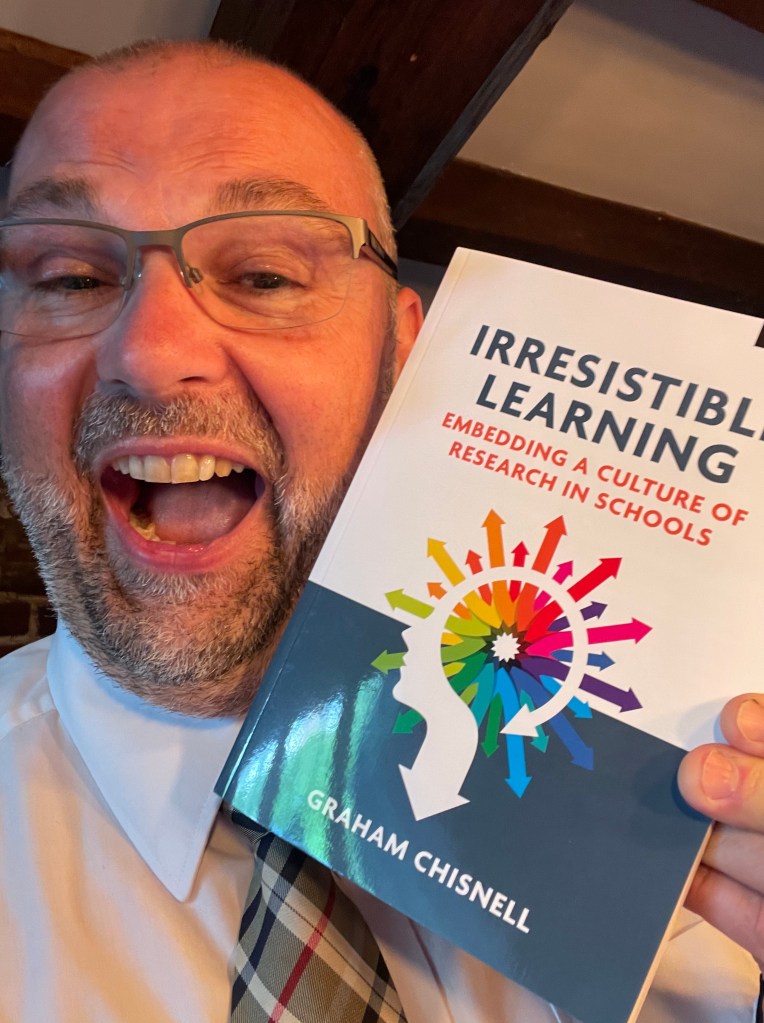
Irresistible Learning makes the short list!

I’m delighted to announce that Irresistible Learning: Embedding a culture of research in schools has made the shortlist of Learning Ladders’ ‘Best Books for Educators Summer 2021’ awards. 

I was shortlisted alongside 40 other books from a longlist of over 100 entries for our dedication to enriching the lives of educators with our writing. 

The awards panel featured teachers, school leaders, and EdTech entrepreneurs including Learning Ladders’ founder, Matt Koster-Marcon, who is also Chair of the EdTech Special Interest Group at BESA. 

Educational books are a great CPD resource, providing inspiration, entertainment, and new ways of thinking about education. 

I’m proud to be included in the list, and would also like to congratulate the other shortlisted books for their incredible work. 
Visit the full list of recommended books, which cover topics such as wellbeing, educational leadership, and diversity and inclusion in schools.

Follow this link to purchase your own copy of Irresistible Learning – embedding a culture of research in schools and power up the impact of your research.

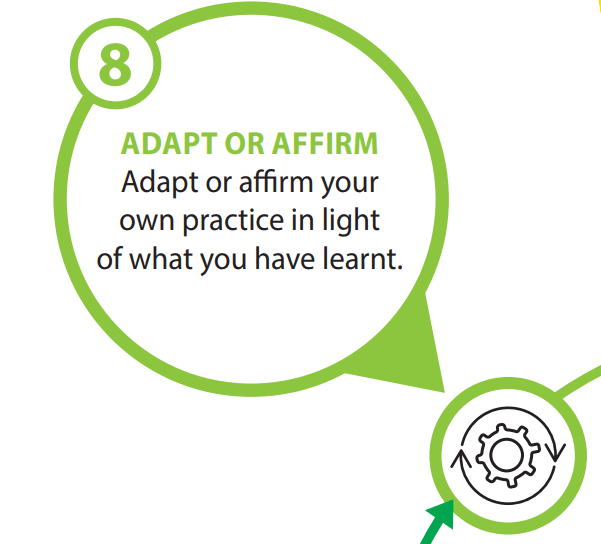
Step 8 – adapt or affirm

Research in schools empowers you to develop practice that can impact positively on your organisation. Whether you are part of the curriculum team working directly with students or the business teams working across a school or trust, research is affirming and can exemplify the effectiveness of new practice. Research can challenge existing practice and move the researcher to confront their own thinking and values. And it can also seek out fresh ideas to adapt current practice. Whatever the outcome, through research, you are led to carefully consider your next steps in adapting or affirming your own practice or influencing the wider practice of your teams.

In step 8 of the Research Cycle, now you have undertaken your research and shared it with others, you need to stop and ask yourself ‘So, what…?’

So, what…
• did you find out relating to your research question?
• did you not find out that you hoped to discover?
surprises did you discover along the way?
• did you find that challenged or changed your own practice?
• has changed in the progress of your students as a result of your research?
• has changed in the relationships you have with your colleagues as a result of your research?
• are the implications of your research for your team, school, organisation, network beyond the school?
• has changed in you as a person as a result of this research project?
• were the pitfalls in your research project that you will use to inform your next research cycle?
• will be your next research question, knowing what you now know?

This leads to the key question relating to step 8 of the Research Cycle:
• So, what will you do differently as a result of your research?

Return to the Research Cycle.

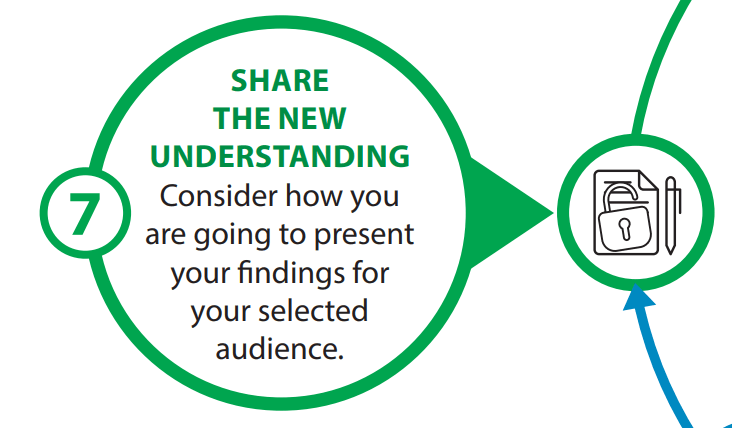
Step 7 – share the new understanding

Now you have completed the analysis of data at step 6 of the Research Cycle, you are ready to share the key points you have discovered. It is important to be aware of step 7 in the Research Cycle at the outset of the research journey. In knowing that you will be required to present your research findings, you embark on the Research Cycle with a potential audience in mind, encouraging you to maintain the quality and integrity of your research as it unfolds. In short, by keeping the end point in mind, you recognise the importance of making your research accessible to your potential audience, whether this is your team leader, appraisal lead, colleagues, senior staff or colleagues beyond your own organisation.

There are many ways to share your research findings, such as a structured article to be published in an organisational research journal, a digital presentation or notes to support a verbal presentation to a group of colleagues. It is important that you take ownership of this step in the Research Cycle; in doing so, you will become increasingly confident about sharing your research findings with others.

Here are my key messages about sharing your research findings at step 7 of the Research Cycle:

• Produce a journal write-up for your research and encourage your organisation to produce its own research journal.
• Use a blog as a vehicle to present your research findings and share new understanding.
• Use digital presentation tools such as Microsoft PowerPoint and Prezi to share your research. If you are less confident in presenting live, then record a narrated presentation.
Record your voice or a video to present your research findings to a wider audience.
• Present to a small group of colleagues if you are nervous presenting to larger groups in order to show what you’ve discovered and build your confidence in presenting.
• A research poster can be a fun and engaging way to connect research findings with an audience.

Return to the Research Cycle.

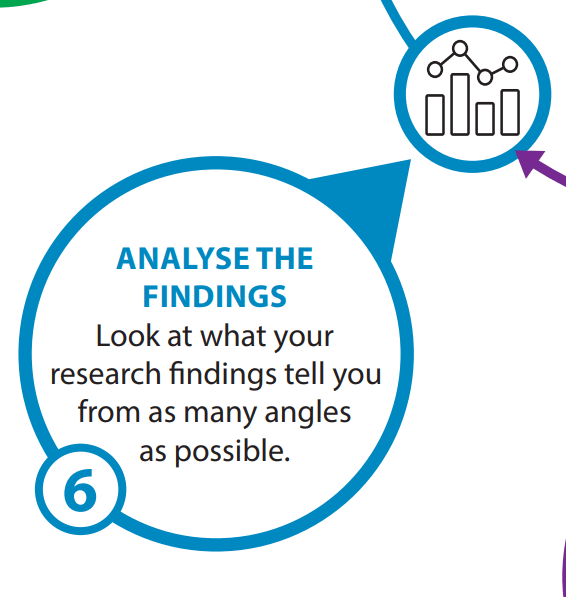
Step 6 – analyse the findings

Now you have gathered a rich array of data at step 5 of the Research Cycle, it is time to set to the task of analysing the findings. It is likely that you will have collected a wealth of raw data using your chosen research methodology. If you have used a range of research methodologies, your data may include transcripts from discussions or interviews, responses to questionnaires, recordings from class groups, diamond 9 pictures and accompanying notes. You now need to think carefully about deciding which data to analyse. You need to seek out the
data that is helpful in answering your research question. The analysis of findings helps you search for patterns within the data gathered. Patterns within the data may be presented as similarities or differences, common occurrences, abnormalities or points of interest.

There are a range of strategies to help you analyse your data. Each strategy depends on your ability to eyeball the data. Eyeballing is a technique that, with practice, helps you to seek meaning from the data that is presented whether in numerical, graphical, pictorial, auditory or written form.

In order to strengthen your ability to eyeball data, you can ask the following critical
questions as you examine the data and charts:
Stepping back from your data, what jumps out at you?
• What are the prominent similarities in the data presented and why
might this be the case?
• What are the prominent differences in the data presented and why
might this be the case?
• What didn’t you expect to see in this data?
• Does anything support your assumptions relating to your
research question?
• Does anything challenge your assumptions relating to your
research question?
• Is there anything in this chart that stands out as unusual or surprising?
• Does your wider evidence base support or challenge what you see in
this data?
• Can you trust this data? Why?
• Are there any other ways you can represent your data? Would a
different chart help you see something new?
• How does X affect Y?
• Is there anything that you would have changed in your methodology
now you have analysed this data

Here are my key points about analysis of data:

Analysis is the art of unpacking or breaking down the data for analysis in order to bring clarity to what the data is saying.
Synthesis is the art of drawing together the many elements of data in order to form a conclusion.
• Seek out data that is helpful in answering your research question.
• Help define cause and effect within research through the use of a flow map.
• Compare and contrast data using a double bubble map.
• The tree map helps you sort data into categories.
• While not essential in the analysis of data, words and images (qualitative data) can be turned into numbers (quantitative data) to broaden the analysis of the data.
Eyeballing is the process of reading and rereading data to seek for relevant patterns or anomalies in the data set.
Bar charts are helpful when comparing the frequency of a measurement
across a range of variables.
• The distribution chart uses a range rather than a single number in a data set, helping to group larger data sets into bite sized chunks of data that is easier to interpret.
Pie charts are helpful when presenting data relating to the frequency of one numerical variable against a categorical variable.
Percentage component bar charts compare percentage responses across multiple sets of data.
• A spider or radar chart presents data visually showing the relative scale of response on a common scale for a range of variables.
Line charts are helpful when interpreting data at a range of points in time.
Scatter charts group data to present patterns when looking at two scaled variables.
• When analysing the data, you must hold your assumptions lightly in order to allow the data to tell the story of research.
• Be alert to your own conscious or unconscious bias in your analysis and when answering your research question.

I explore these points in more detail in my book, Irresistible Learning – embedding a culture of research in schools.

Back to the Research Cycle.

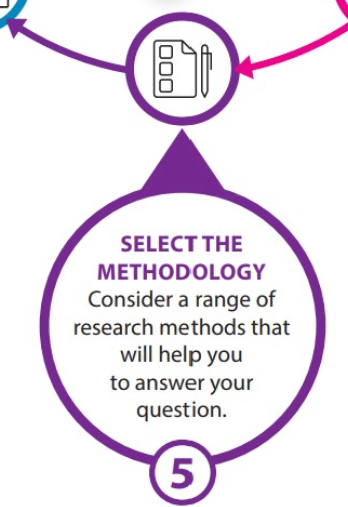
Step 5 – select the methodology

By step 5 of the Research Cycle, you have considered and refined your research question, building a broadening understanding of your research issue. It is now time to think about the most helpful research methodology to answer your research question. You need to develop an awareness of the range of research methods available to you in order to select the best method, or methods, to explore your research question.

In pursuing your research methodology, you can choose to collect data through a single research method, or combine a range of research methods. It is important to understand the theory behind research methodology. This will help you to define the type of methodology that will help to answer your research question. Theories such as qualitative and quantitative research, longitudinal research, single study research, microgenetic research, cross-sectional research, design experiments, action research and the mosaic approach. In understanding the theoretical basis for research, you can select your approach to research with confidence along with the practical tools for research.

Here are the key theories that underpin step 5 in the Research Cycle:

  • Qualitative research involves numerical data.
  • Quantitative research involves non-numerical data, this could include words or pictures/images.
  • Longitudinal research looks at how things change over time.
  • Single study research focuses on one participant (or sometimes a limited number of participants) in detail.
  • Microgenetic research is a form of study where the subject is observed during a period of rapid learning or change.
  • Cross-sectional research, unlike longitudinal research, collects data on students of different ages or developmental levels at the same time.
  • Design experiments allow the researcher to design their own parameters of research to test out their own hypothesis.
  • Action research critically examines one’s own practice and then make changes to practice based on the research findings.
  • The mosaic approach (Clark, 2005) was devised as a tool to gain the thoughts and perspectives of young children in research using a range of research tools.

References:

Clark, A. (2005). Beyond Listening: Children’s perspectives on early childhood services.
The Policy Press.

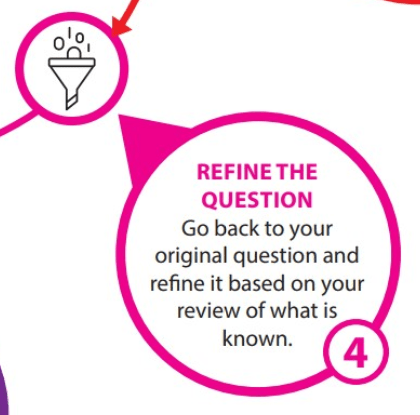
Step 4 – refine the question

In step 4 of the Research Cycle, you are encouraged to bring your knowledge of what is already known about your research issue to look afresh at the research question formed in step 1 of the Research Cycle. At this step in your research, you have defined an issue, built a research question then spent time reviewing what is already know about your research question. This will have moved your thinking forward and as such, it is a great point to stop and think about your original research question. With what you now know, is your question still the right question for you and your organisation or do you need to adapt it or completely change it?

Here are my top tips at step 4 of the Research Cycle as you think about reviewing your research question:

• Ensure the original research question is still relevant and will lead you to find out something new about your practice or the practice of others.
• Consider the end point of research and confirm that the research question will help you to this end.
• Ask again: is the research question relevant to your roles and responsibilities?
• Based on the new knowledge discovered at step 3, don’t be afraid to jump back to step 1 or step 2 of the Research Cycle to ensure the issue is clearly defined and the research question is purposeful for you and your organisation.

I explore these points in more detail in my book, Irresistible learning – embedding a culture of research in schools.

Back to the Research Cycle

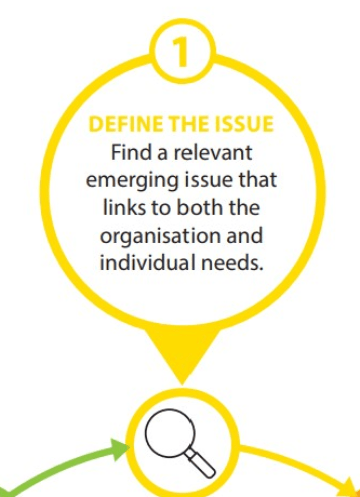
Step 1 – Define the issue

In the cacophony of our daily lives in school, there is often a great deal of distracting noise. Not simply from the students we teach but from the myriad of unresolved tasks that fill our minds. In order to take the first step on the research journey, we must try our hardest to reduce this noise. We need to help ourselves as researchers to focus on the issues we face and to move beyond what Daniel Kahneman would call ‘lazy’ or ‘fast thinking’ (Kahneman, 2011). It would be easy to think of an issue we face and accept our first and most present thought, especially if our working memory is filled to capacity. However, while this most pressing issue may be relevant to the moment, it may not be at the heart of the systemic issue that affects our practice.

In order to define the issue worthy of research, both the time and place for
thinking need to be considered. We need to subdue the distracting noise that we face in school, enabling our cognitive load to reduce and finding space in our working memory to think.

The starting point to help mute this organisational noise is to find a quiet spot, away from your usual routine, to have a coaching conversation. In creating the uninterrupted place to
have a conversation that goes beyond fast thinking, you are afforded the space to find a meaningful issue that could evolve into an engaging research question. This place should be beyond distraction, be a treasured time for you and your research coach, and be a regular entitlement for you and all staff in school.

Once you have found that space and time, here are my top tips for defining the right issue to help you form a purposeful research question:

• Find time to meet with a research coach to still the distracting noise, enabling you to think about the professional issues you face.
• Use appreciative inquiry to help you recognise strengths in your practice that can inform your research question.
• Think slow in order to go beyond your initial thoughts and ideas.
• Address your own assumptions and biases related to your research issue.
• Meet with a research coach who will ask questions to encourage you to think, while allowing you to own your issue without being strong-armed into research that may lack relevance to you.
• Funnel down the issues you face and focus on one relevant and accessible issue that is purposeful to your professional roles and responsibilities.

See my book, Irresistible Learning – embedding a culture of research in schools for further explanation of step 1 of the Research Cycle

References:

Kahneman, D. (2011). Thinking, fast and slow. Penguin.

Back to the Research Cycle

Step 3 – Review what is known

Once you have defined your research question, it is time to move on to discover what is already known in this area. Research comes more naturally to teachers in their early careers as they return to practice learnt while at university. For many school staff, however, this may not be a natural step, and some may need guidance in how to review relevant literature and information about their issue. If your research question is to have meaning and purpose in your organisation then you need to find out how your research question, or issues relating to it, has been raised by others. This will help you to deepen your understanding of the issues that orbit your research question and will help you to refine your question. During this step of the Research Cycle, you may learn about difficulties others had in researching in this area or you may confirm that there has been limited research around your issue. This step is really important but it is one that the researcher in school often omits as they are keen to get going on their research methodology. It is important to slow down and reach out to as many sources of information relating to your research question as possible.

As a researcher, you need patience, time and talk. Patience, as you don’t want to rush headlong into planning your research methodology before you know what you are doing. Time, as you will need to fit your review into your busy working week. Talk, as you will need to talk to your research coach about the issues that arise from your review of what is known. All this builds what Dimmock (2019) refers to as a ‘professional learning community’ where a school creates the space where patience, time and talk rests.

Here are my top tips for reviewing what is known about your field of research:

• Finding out what is known about an issue is not research, but rather one of eight important steps in the Research Cycle.
• In order to build a purposeful and helpful research question, you need to find out what is already known about your issue.
• Professional learning communities and research buddies can be really helpful in connecting with other researchers with similar research questions to share knowledge about what is known about the research question.
• Speaking to colleagues who have key knowledge and skills relating to the research question can provide a wealth of helpful context to the research, but be sure to plan the conversation carefully in order to ensure it helps you learn more about the context of your research question.
• Consider speaking to colleagues beyond your organisation in order to gain insight into the context of your research question • Books are a helpful resource to the researcher, but be alert to author bias.
• Approach journals that are relevant to your research question, read the abstract, read the conclusion, read the article and follow relevant references to broaden your knowledge of what is known.
• Use websites and social media to learn more of what is known about your research question, but be aware of the limitations as some published material will not have been subject to deep scrutiny.
• Consider joining relevant professional associations, particularly if they provide access to journals as a resource.
• Think critically when approaching what is known about your field of study. Remember to beware – think fair – take care or to think FIRST.
• Strive to understand the influence of conscious or unconscious cognitive bias in both yourself and the work of others.

For a wider explanation of these points, read my book Irresistible Learning -embedding a culture of research in schools.

Reference:

Dimmock, C. (2019). Leading Research-Informed Practice in Schools. In D. A. Godfrey,
An Ecosystem for Research-Engaged Schools. Routledge pp. 56-72.

Back to the Research Cycle

The research poster

A research poster is a simple yet engaging way to present research findings in a format that is easy to digest. Using the format of the journal article, the poster allows the researcher to present their findings in a way that can be browsed by colleagues. The poster can also be a reference tool for the researcher to use during a presentation to a small group of colleagues. I have used research posters as a marketplace of ideas during a presentation of research. In the marketplace, the research posters are mounted on easels around the room so that staff can wander amongst them and discuss their content.

I ran a research project with a group of middle leaders across ten primary schools. The final stage of the project was to share the research findings and the researchers gave a two-minute presentation to the delegates from their schools. This was followed with a marketplace of the ten research projects where the research posters were used as a talking point for each researcher as delegates wandered freely around the hall. The casual atmosphere of the marketplace allowed staff to pose questions to the researchers about their research posters and gain a deeper perspective about the research undertaken.

Here are some tips for creating an effective research poster, adapted from NYU
Libraries (2020):


• Think about your audience and design your poster with them in mind.
• Make your font size readable from a comfortable distance away from
your poster.
• Grab your readers with a clear title/research question.
• Limit your words to keep your reader engaged and to be precise in what
you are communicating Use bullets, numbering, and headlines to make it easy to read.
• Think about your graphics and colours to enhance your poster rather
than distract the reader.
• Include logos from your organisation.
• Remember to put your name on the piece.
• Include references used in step 3 of the Research Cycle.
• Share your poster with a colleague/coach to make sure it is easy to interpret.

Here is an example of a research poster produced by two teaching assistants
whose research question was, ‘Can a nurture approach support pupils with
complex needs to improve their behaviours?’:

While this poster does not share the detail of the research undertaken, it allowed the researchers to share the key steps in the Research Cycle. In displaying this in a research poster, the researchers were able to talk through each step with colleagues. While this poster is not a perfect example of a research poster, I have included it to give you an idea of the form a research poster could take. My advice is to be playful and use the Research Cycle to help structure your poster.

Staff often enjoy creating research posters as it allows for creative flair. The posters can be produced digitally using programs such as Microsoft Publisher or PowerPoint or by a simple cut-and-paste onto A1 card backing.

Reference:

NYU Libraries. (2020, July). NYU Libraries. Retrieved from How to create a research
poster: http://www.bit.ly/3eGuG5N Accessed: March 2021