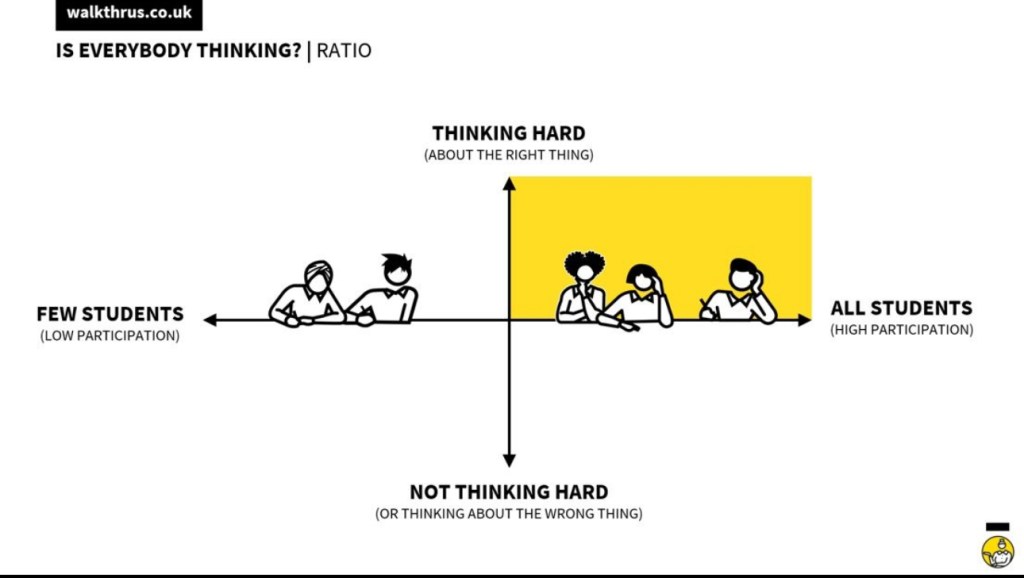
Ratio is a guiding concept that describes how much thought is taking place in your classroom. In his article on ratio, Adam Boxer reflects on how the work of Rob Coe has influenced his teaching. The idea is simple yet powerful. Take a look at the quadrant below and consider whether your lesson places your students in the top right quadrant.
In short, learning happens when you think hard. The key to moving all students into the top right quartile is to craft questions that engage all pupils in thinking. So much questioning that I see in classrooms focuses on a teacher asking a fantastic question that only one student responds to. The key is not, therefore, simply to ask a great question but to ensure that the pedagogical approach to questioning empowers all students to engage in thinking and responding to this question.
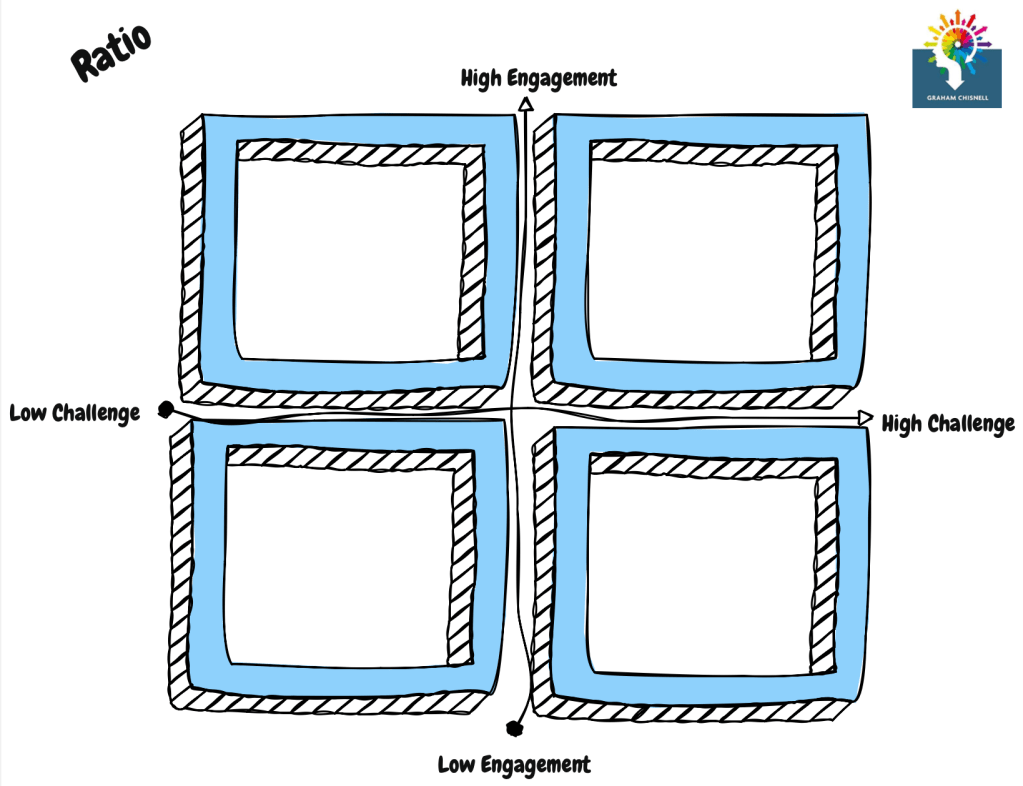
You can use the ratio grid below to monitor the quality of education. Select your lowest performing students in class and place them on the ratio quartile that matches their level of engagement and level of challenge. You. can then compare this with students who perform exceptionally well. This provides a simple but effective focus for your monitoring activity and could help in unpacking any potential blocks to learning for your students.
In this edition, I explore Ofsted’s thematic reviews, lethal mutations, SEND and governance and the return from absence interview.
Intrigued? Then read on….
Ofsted thematic reviews
Ofsted published their approach to future thematic reviews of local authorities. These are joint reviews with Ofsted and the Care Quality Commission.
The visits will explore: – how local area partnerships are working to meet the needs of these children – the availability of universal and specialist health services – the reasons why these children are not in full-time education and what is being done to support them to attend school – the extent to which information is shared with key partners – the barriers facing local areas when trying to support these children.
The visits will not result in judgements about individual local areas. Instead, Ofsted will publish an overarching report in autumn 2025 highlighting examples of good practice and any systemic concerns.
Governors, trustees and inclusion – a blog by ModernCassie
Cassie is an inclusion lead for Our Community MAT (OCMAT). In a recent blog, she outlines a helpful checklist for governors and trustees in their diligence of reviewing the offer for pupils with SEND in their schools. The checklist outlines evidence that assures the following:
The school promotes an inclusive culture evidenced in the school vision, classroom practice and whole school CPD records.
There is effective communication and engagement between the school and parents of pupils with SEN and disabilities evidenced in feedback from parents, EHCP co-production and minutes from parent forum.
Parents are involved in reviewing the school’s general SEN and disability policy and practice evidenced through parent advisory groups, SEND policies and responses to parental feedback and complaints.
The pupil voice is central to decisions about support for those with SEN and disabilities, at both individual and school levels evidenced through pupil feedback, school councils and pupil surveys.
Funding, including SEN funding, is allocated and spent effectively evidenced through impact analysis of SEND spends, pupil premium reviews and costed provision maps.
The school works effectively with the local authority in reviewing SEN and disability provision evidenced through the SEND information report, meeting notes with outside agencies and engagement with local SEND networks.
Staff have the expertise needed to support pupils with SEN and disabilities and access external specialist skills where required, evidenced through SENCo training records and deployment of external specialists.
Governors and trustees should be satisfied with how the school identifies pupils with SEN or disabilities and applies the ‘graduated approach’ evidenced through clarity in the SEND policy, examples of plan-do-review in action and progress meeting records.
Governors and trustees should be satisfied with how the schoolmonitors the progress and development of pupils with SEN and disabilities, evidenced through SEND tracking data, pupil progress meetings and EHCP annual reviews.
Governors and trustees should be satisfied with how the school supports pupils in preparing for adulthood at each age and stage, evidenced through curriculum planning and transition plans for secondary transition or transition to post-16 education.
Governors and trustees of mainstream schools should ensure that the SENCo achieves the relevant mandatory qualification within 3 years of appointment, evidenced through SENCo acreditations or plans for training if newly qualified.
Governors and trustees of mainstream schools should ensure that the SENCo has sufficient administrative support and time away from teaching to fulfil responsibilities, evidenced through the SENCo’s timetabling of dedicated time and administrative support.
Governors and trustees of mainstream schools should ensure that the SENCo is empowered to support high-quality outcomes for pupils with SEN and disabilities, evidenced through whole school improvement plans and performance management objectives.
Schools have a duty to prepare and regularly update: A SEN Information Report, Equality information (to demonstrate compliance with the Public Sector Equality Duty) and Equality objectives. This can be evidenced through the website, annual reviews and published equality objectives.
An accessibility plan (outlining how the school plans to increase access for disabled pupils) can be evidenced through a published accessibility plan and records of curriculum adaptations.
Governors and trustees should also ensure that the school’s SEN and disability policy is reviewed regularly, evidenced through timely updates to the policy, minutes from policy review meetings and parental consultation.
The DfE and Mencap have produced a super easy-to-read guide to SEND for parents. While a little dated now (however, it still adheres to the SEND Code of Practice), this is a great document to share on your school websites (or to adapt as your own), especially for parents who may find it hard to navigate your SEND policy and Information Report. Here is a link to the document.
Lethal Mutations – Kate Jones
In her blog for Evidence Based Education, Kate Jones explores the importance of being alert to lethal mutations. The term ‘lethal mutation’, coined by Ed Haertel (Brown and Campione, 1996), refers to the danger of educational research that outlines a particular pedagogical approach being misinterpreted and altered by the practitioner. An example given in the article is the use of retrieval practice—the act of recalling something previously learned from long-term memory. The benefits of retrieval practice for long-term learning are among the most secure findings in educational psychology (Brown, Roediger, & McDaniel, 2014), so it is not surprising that many schools have enthusiastically embraced retrieval practice. However, in some cases, this has led to teachers being required to use some form of retrieval practice in every lesson, whatever the material being taught and whatever the age of the students. Any evidence-informed strategy or technique is potentially vulnerable to the curse of lethal mutations.
Kate suggests the following methods of minimising the risk of a lethal mutation:
1.Teachers need to understand the research supporting evidence-based practices.
2. Don’t rush to embed evidence-based practices; take time to ensure that the practice is embedded as intended.
3. Context over consistency, namely being clear that research undertaken of a particular pedagogical approach may change in differing context, this may relate to factors such as age ranges of students or the cultural context of the organisation.
Ratio and classroom practice
Ratio is a guiding concept that describes how much thought is taking place in your classroom. In his article on ratio, Adam Boxer reflects on how the work of Rob Coe has influenced his teaching. The idea is simple yet powerful. Take a look at the quadrant below and consider whether your lesson places your students in the top right quadrant.
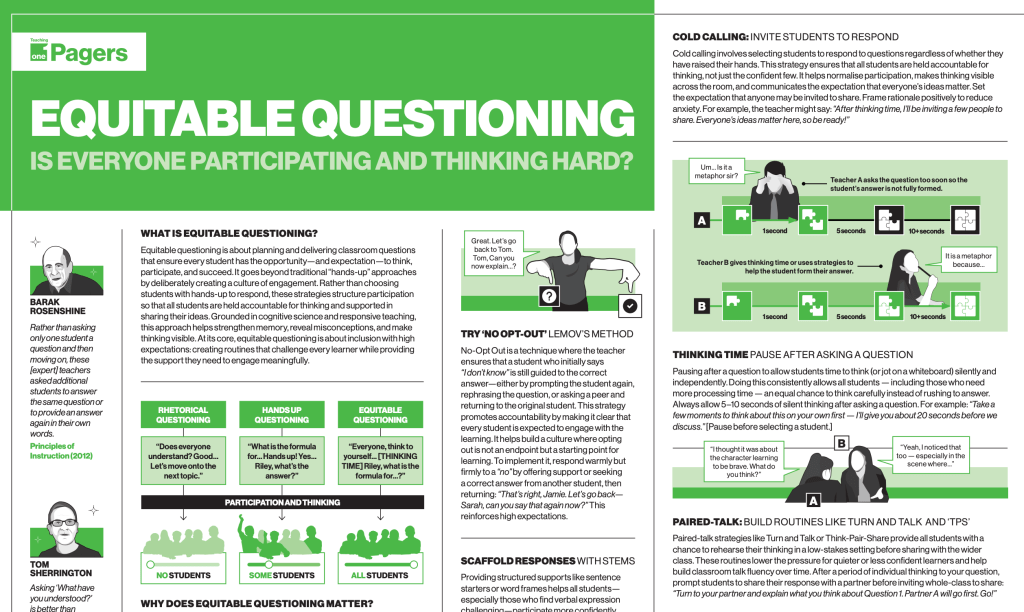
In short, learning happens when you think hard. The key to moving all students into the top right quartile is to craft questions that engage all pupils in thinking. So much questioning that I see in classrooms focuses on a teacher asking a fantastic question that only one student responds to. The key is not, therefore, simply to ask a great question but to ensure that the pedagogical approach to questioning empowers all students to engage in thinking and responding to this question.
There are a host of questioning strategies that support high participation:
Cold Call
Wait time
Call and response
Mini-whiteboards
Think-pair-share
Say it again better
Whatever your strategy for questioning, you can use ratio to determine the impact of questioning on your students.
AI – Reducing Workload
Artificial Intelligence is here. We are learning in education that there can be benefits from the technology that is emerging for both us as school leaders and our staff and students. Here are some really helpful pointers in how to ask the right questions of AI platforms such as ChatGPT. These were taken from a LinkedIn article by Mehedi Hassan.
1. Project Planning Prompt: I need to plan a project for [insert project type]. Please create a detailed project plan including objectives, milestones, timelines, required resources, and risk management strategies.
2. Solve Hard Problems Using First Principle Thinking Framework Prompt: I am having difficulty learning [Insert Topic]. Help me understand it better by using first-principles thinking.
3. Resume Optimisation Prompt: Can you help optimise my resume for a [insert job title] position at [insert company]? Highlight my relevant skills, experience, and achievements to make my application stand out.
4. Use Stories And Metaphors To Help You Remember Things Better Prompt: I am currently learning about [Insert Topic]. Covert the key lessons from this topic into engaging stories and metaphors to aid my memorization.
5. Learn And Develop Any New Skill Prompt: I want to learn [Enter desired skill]. I am a complete beginner. Create a 30 days learning plan that will help a beginner like me to learn and develop this skill.
6. Behavioral Interview Questions Prompt: “Create a set of behavioral interview questions relevant to the [job] role at [company]. Include a brief guide on how to structure answers using the STAR (Situation, Task, Action, Result) method, tailored to my needs.” experiences.
7. Accelerate Your Learning With 80/20 Principle Prompt: I want to learn about [Insert Topic]. Identity and share the most important 20% of the learnings from this topic that will help me understand the 80% of it.
Absence – the return from absence interview
I love workshopping ideas with school leaders. 👍
I spent the day at a wonderful school in Sittingbourne, where the headteacher and I reflected on their strategies to improve the attendance of pupils. We looked at strategies for return-to-work interviews with staff and wondered if this model could be applied to pupils returning after an absence. 💡
We are now trialling this idea to see if a return from absence meetings with pupils can help them catch up and keep up and also improve their future attendance.
Step 1. Unpack the reason for absence and how this (if possible) could be avoided in the future. Step 2. Check if the student has any unresolved issues that could impact on learning or engagement. Step 3 & 4.Clarify key learning missed and check which lesson or curriculum area the student feels they will struggle with the most because of missed learning. Step 5. Select from a menu of action or plan your own adaptation to best support missed learning.
In this edition, I explore the Children’s Wellbeing and School Bill, Ofsted’s consultation on the new report card system and what great governance looks like. Intrigued? Then read on….
The Children’s Wellbeing and Schools Bill
The Children’s Wellbeing and Schools Bill is a proposal for new laws that aims to improve children’s welfare and education. The bill aims to address issues like safeguarding gaps, disparities in education, and challenges for vulnerable students.
Key features
SafeguardingThe bill introduces enhanced safeguarding measures, including:
A unique identifier for each child
A register for children who are not in school
Multi-agency safeguarding panels that include education and childcare agencies
EducationThe bill aims to improve education standards and ensure every child has access to a good school. This includes:
Free breakfast clubs for primary school pupils
Limiting the number of branded uniform items required
Social care: The bill aims to improve social care and reduce the number of children missing education. This includes:
Requiring local authorities to offer families a group decision-making meeting before taking a child into care
Allowing the Secretary of State to cap the profits of children’s homes providers
The bill also aims to:
Make sure families can get help when they need it.
Remove the automatic right for parents to educate children at home in certain circumstances.
Allow local authorities to intervene if a child’s home environment is unsafe.
Great governance – reciprocity when challenging attendance.
a continued focus on tackling low attendance of pupils, especially our pupils with SEND and disadvantage;
a growing interest in decisions around part-time timetables;
recruitment and retention of staff and staff wellbeing;
high ambition for pupils with SEND.
So, what does this mean for effective governance? It is our role as school leaders to ensure that our governors are provided with information that empowers them to hold the school to account. With this in mind we need to consider the reciprocity in governance. By reciprocity, I mean that information flows up to governors and also back to the school, providing a feedback loop where a professional discussion takes place that benefit both governance and school with equal poise. Let us consider the power of great governance reciprocity with regard to attendance:
Provide governors with data that outlines trends in attendance so that they can clearly view the groups of pupils whose attendance is vulnerable and challenge where improvements are not being made;
Ensure governors are clear about the actions being taken to challenge low attendance and know the language and pivot point for defining persistent absence;
Be clear about how the school ensures that pupils at risk of safeguarding concerns whose attendance is also low are carefully monitored and supported to be safe;
Question the decision-making for any pupil on a part-time timetable. Ask if this poses a greater risk to the pupil and what the school is doing to mitigate these risks. Check that there is a keen interest in increasing the time spent in school and that both the family and the Local Authority agree that this is in the best interest of the child.
Engage in visits to the school to speak with leaders involved in attendance and ask to see practice undertaken, this may include joining a Flo on an attendance visit, observing an attendance interview with a parent, or visiting an assembly that celebrates positive attendance.
Write up the evaluation of your visit or monitoring activity with clear action agreed by school staff. Share this at the governing body meeting and report back when action has been met or not met.
OFSTED – Report cards and toolkits – a new broom sweeps through the sector.
Ofsted’s chief inspector initiated the consultation on the new report card proposal.
The TES has written a really helpful summary of the proposals and you can take a look here. The article affirms that Ofsted is planning to inspect schools on a new five-point grading scale relating to 11 areas in which schools could receive a judgment when it launches its report cards later this year.
Ungraded inspections will also be dropped and subject deep dives will be scrapped.
In addition, no inspections will take place for the first half-term of the next academic year to allow for training. Inspections are planned to start in November.
As part of the proposals, OFSTED states that they are renewing their approach to inspections and improving how they share what they find on inspection, with four key improvements:
New ‘toolkits’ to help leaders understand their strengths and areas for improvement.
More transparent and collaborative relationships with the sectors we inspect.
Better consideration of local context and circumstances.
Different approaches for different types of education providers.
Festive greetings for the December Chisnell Chatter. This is the fourth edition of Chisnell Chatter for the academic year 2024-25.
In this edition, I explore Ofsted’s annual report, top tips on supporting pupils with SEND, ensuring validity in assessments and how to assure great behaviour in your classroom. Intrigued? Then read on….
Supporting SEND and Diversity
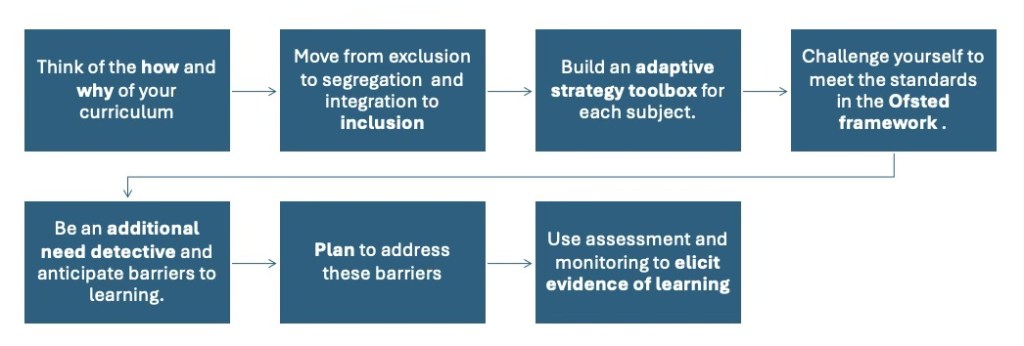
I had the pleasure of delivering a keynote and workshops with the inspirational Audrey Pantellis of Elevation Coaching this month for Concordia Alliance in Canterbury. My keynote focused on being the SEND subject leader superhero. This was followed up with a workshop on refining the adaptive practices used in a range of subject disciplines. Here are some key points from the presentation if you are thinking about developing a culture of high engagement and achievement for pupils with SEND.
If you are thinking about powering up your approach to inclusion and diversity then get in touch to talk to Audrey and me about a bespoke training day for your organisation.
Education and care providers struggling to recruit and retain skilled staff, which impacts on children’s learning and well-being.
School absence rate remains higher than before the pandemic and more children experiencing unorthodox patterns of education.
SEND system is under huge strain as number of children with an identified need continues to grow.
The report also highlights the following:
In schools, the absence rate has risen since the pandemic, with disadvantaged and vulnerable children more likely to be persistently or severely absent.
A growing number of children are now on part-time timetables, while a mix of online and in-person education is increasingly being used for children with SEND and behaviour or health needs. A small number of schools also now allow flexi-schooling, where parents home educate their children for part of the week. Along with a growth in home–schooling and an unknown number of children attending unregistered schools, this means a very significant number are experiencing unorthodox patterns of education.
So, what does this mean for our schools? There is a continued focus on tackling low attendance of pupils, especially our pupils with SEND and disadvantage. Along with this, it would appear that there is a growing interest in decisions around part time timetables. We need to be really clear about the decision making process and how to best support pupils on part time timetables. Co-production in the decision making with families and agencies and a keen desire to move back to full time education.
Four Pillars of Assessment – Validity
In my earlier Chisnell Chatter, I outlined the EBE’s four pillars of assessment. Namely; purpose, validity, reliability and value. The EBE has published a useful description of the approach to gaining validity in assessment.
The EBE states that there is no such thing as a valid assessment. Quite a claim! They state that validity is a word which, in assessment, refers to two things:
The ability of the assessment to test what it intends to measure;
The ability of the assessment to provide information which is both valuable and appropriate for the intended purpose.
There are two key questions to ask regarding validity of assessment:
Is the test or assessment activity any good as a measure of the students progress towards their learning end points?
Should the test be used for its present purpose?
They go on to state that there are two key reasons that assessments end up not quite hitting their target:
Construct under-representation: is where the assessment fails to capture important aspects of the the target of the assessment.
Construct-irrelevant variance: the assessment outcomes are influenced by things other than just the construct.
In short, when thinking about the validity of assessments undertaken, we need to be clear that our assessments capture the steps in learning (component knowledge) that lead to our curriculum end points (composite knowledge).
What is good behaviour and how can teachers encourage it – EBE
Here is a second reference in this edition to an article by Evidenced Based Education. The article outlines the importance of activating ‘hard thinking’. The article outlines four key steps to strengthening the behaviour of students:
Understand the content – being clear about what you are teaching, having fluent knowledge and flexible understanding of the content of the subject and clarity on the misconceptions that may appear.
Creating a supportive environment – where students can thrive, feel positive within a culture of mutual respect and emotional warmth.
Maximise opportunities to learn – by managing time and resources and ensuring rules and routines are established and consequences are explicitly known.
Activating hard thinking – by structuring, explaining and questioning in order to engage students in the activity whilst providing the adaptations needed for them to access their learning. Finally by interacting (engaging with students and providing helpful and plentiful feedback), embedding (providing tasks that enable the student to apply their learning) and activating learning (helping students to plan, regulate and monitor their own learning).
Welcome to the third edition of Chisnell Chatter for the academic year 2024-25. Life in education continues to move at a sterling pace, as such here is the second edition this month!
In this edition, I will explore changes to Ofsted’s ungraded inspections, how to produce a purposeful Pupil Premium document, the four pillars of assessment and how to provide ambition for pupils with SEND. Interested? Then read on….
Pupil Premium – an EEF guide
The Department for Education (DfE) requires every school to review and publish an updated Pupil Premium strategy statement every academic year before 31 December.
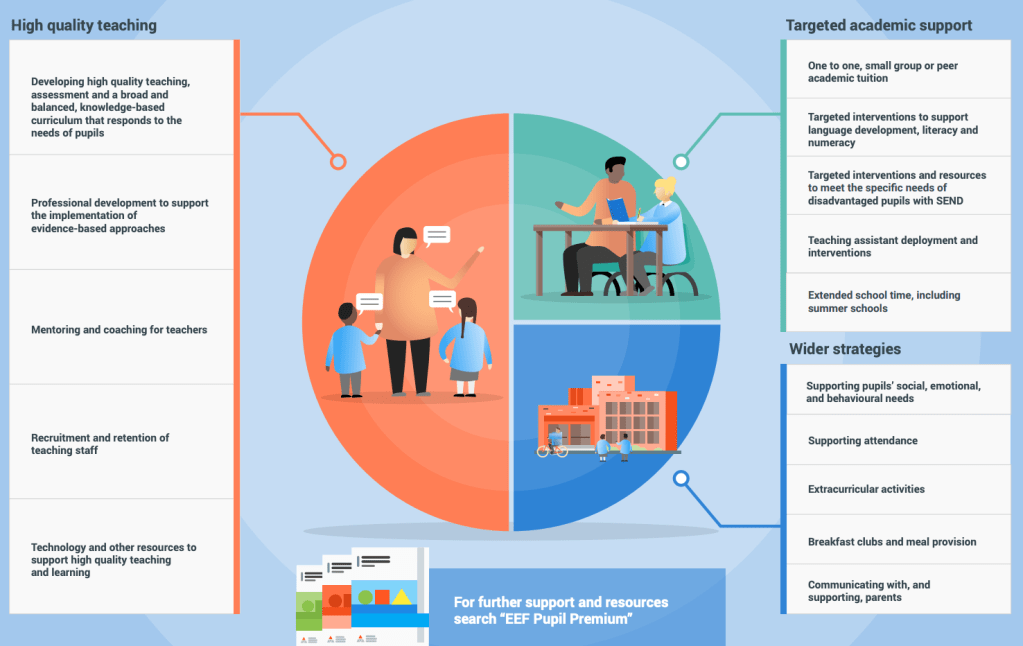
The Education Endowment Agency (EEF) has released a suite of evidence informed documents related to the Pupil Premium. The guidance includes:
The EEF Guide to the Pupil Premium
Evidence brief: Using research evidence to support your spending decisions
Discussion prompts for governors and trustees
Poster: The tiered model and ‘menu of approaches’.
The documents provide a really helpful set of questions for oversight and scrutiny by governors. Share this with them to power up their oversight of the impact of your document.
The tiered model is outlined below and can be downloaded here. The model focuses on the importance of high quality teaching, targeted academic support and wider strategies such as a focus on the attendance of disadvantaged pupils.
Four Pillars of Assessment
Evidence Based Education (EBE) provide a useful synopsis of the four pillars of assessment, in this article they focus on the pillar of purpose. The full article can be found here.
The four pillars of assessment are purpose, validity, reliability and value. The Chartered College of Teaching explain the four pillars of assessment as:
Purpose: What function do we want this assessment to serve? Has it been planned in a way which elicits the highest-quality information possible towards the intended end use?
Validity: To what extent does this assessment measure what we intended it to? How relevant and appropriate are the inferences made from the assessment outcomes, towards our purpose?
Reliability: How precise and consistent are the measurements we generate from this assessment? How precise and consistent are the inferences we make from these?
Value: Is the outlay of time and resources (for both pupil and teacher) justified in relation to the quality of information gained from this assessment? Is it being used to improve pupil learning and progress?
These are important starting points to a discussion with subject leaders when thinking about assessment in their subject.
Ofsted has updated the Education Inspection Framework handbook. This outlines key changes to the process of inspecting schools, in particular relating to the removal of the overall effectiveness judgement and the manner in which schools will be inspected for ungraded inspections, also known as Section 8 inspections. A key change to the methodology in an ungraded inspection is that deep dives in individual subjects will no longer take place. This releases the pressure and focus on subject leaders with the intensity of a full sub-judgement graded inspection. Rather than deep dive areas, inspections will have up to four focus areas. The first two focus areas will look at the quality of education and the remainder will consider relevant focus that may include areas such as behaviour and attendance.
The first focus area in primary schools will focus on English and maths and the lead inspector will also consider a lens through which to consider these subjects. For example,. the lens could include a look at disadvantaged boys, EAL or provision for SEND pupils within the subjects. The lens will be decided upon by the lead inspector being guided by the evidence presented in the preparatory work and initial call to the school.
The second focus area will consider a cluster of subjects and again, will consider a lens appropriate for the school. For example, the lead inspector may want to consider science, history and music as three subjects with a lens of considering how effectively the school adapts learning for pupils with SEND in these subjects.
Ofsted – Curriculum and subject leadership
Here is a link to a recording of Ofsted’s webinar on curriculum and subject leadership. In the video, Lee Owston HMI shares the approach to deep dives in forming judgements about the quality of education and reflects on current research reviews and how these can inform practice.
Special Educational Needs in mainstream schools – EEF
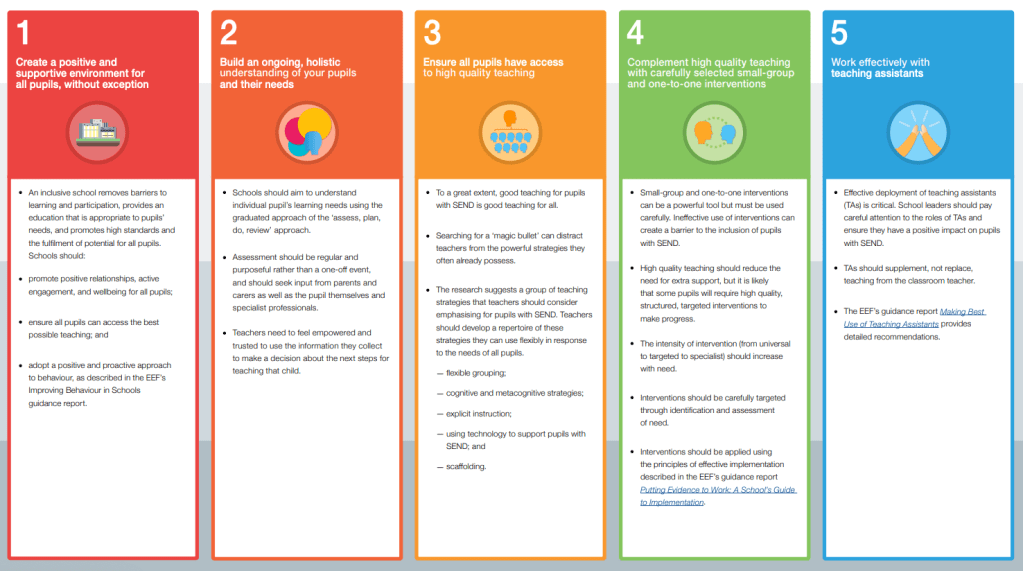
The report outlines five key elements to effective practice:
1 Create a positive and supportive environment for all pupils, without exception.
2. Build an ongoing, holistic understanding of your pupils and their needs.
3. Ensure all pupils have access to high quality teaching.
4. Complement high quality teaching with carefully selected small-group and one-to-one interventions.
5. Work effectively with teaching assistants.
Here is a link to the poster shown below. In addition there are some super tools available, one considers how to consider overlapping needs relating to cognition and learning, sensory/physical needs communication and interaction and SEMH needs.
Welcome to the second edition of Chisnell Chatter for the academic year 2024-25. Life in education continues to move at a sterling pace, as such here is the second edition this month!
In this edition, I will explore Bridgette Phillipson’s plans for education, DfE curriculum and assessment review, Ofsted’s updated handbook, juicy EEF guidance reports and resources and much more.
Bridgette lays out her education stall
In this TES article, Bridgette Phillipson explains her vision for education. This gives us a helpful steer as to the direction of political travel in our schools and trusts. The full article can be accessed here. Therein, she talks of a quiet revolution in education. While being honest about the financial challenges of reform, she does make clear commitments regarding SEND provision, early intervention.
Ensuring a smooth start to a lesson – the wisdom of Kate Jones
In this article, Kate Jones writing for Evidence Based Education, explores the importance of the first steps in a great lesson. She reflects on the merits of a ‘do now’ approach, quizzing, think-pair-share, free recall and entrance tickets. If you are interested in powering up your children’s memory and recall, this is worth a read.
The Scout Mindset
Having read the Scout Mindset by Julia Galef, it was great to come across a TED talk on the topic. Julia explores the importance of having an honest and open-minded perspective towards information in order to make better decisions. It teaches readers to abandon biases and approach situations with curiosity to see what’s really there. For an easy walk through this concept, follow this link to her the TED talk.
DfE Curriculum and Assessment Review
On Friday 19 July 2024 the DfE launched the wide ranging Curriculum and Assessment Review to help drive high and rising school standards. The independent review will be chaired by Professor Becky Francis CBE, supported by an expert panel.
The review will look closely at the key challenges to attainment for young people, and the barriers which hold children back from the opportunities and life chances they deserve – in particular those who are socioeconomically disadvantaged, or with special educational needs or disabilities (SEND).
Specifically, the Review will seek to deliver:
• An excellent foundation in core subjects of reading, writing and maths.
• A broader curriculum, so that children and young people do not miss out on subjects such as music, art, sport and drama, as well as vocational subjects.
• A curriculum that ensures children and young people leave compulsory education ready for life and ready for work, building the knowledge, skills and attributes young people need to thrive. This includes embedding digital, oracy and life skills in their learning.
• A curriculum that reflects the issues and diversities of our society, ensuring all children and young people are represented.
• An assessment system that captures the strengths of every child and young person and the breadth of curriculum, with the right balance of assessment methods whilst maintaining the important role of examinations.
Ofsted Updates
Ofsted have now released the updated Education Inspection Framework handbook. This outlines key changes to the process of inspecting schools, in particular relating to the removal of the overall effectiveness judgement and the manner in which schools will be inspected for ungraded inspections, also known as Section 8 inspections.
DfE release key documents for the Early Years
Some key documents have also been produced by the DfE relating to the Early Years and are worthy of a read by all school leaders, subject leaders, governors with responsibility for early years and early years practitioners. Click on the following links to read these documents:
Strong foundations in the first years of school – this document outlines the most current thinking and research into the foundations of early knowledge acquisition. Therein you will see key information about foundational knowledge, get to know this terminology and share this with your teams. Foundational knowledge refers to the knowledge that children need to be able to retrieve accurately and automatically in order to carry out complex tasks.
Best start in life: a research review for the early years – this series of documents outlines the importance of the four specific areas and three prime areas of learning int he early years. Here are the headlines from the reports:
The specific areas of learning are connected. They give the context for much learning in the prime areas. Learning in the specific areas should prioritise vocabulary and language comprehension. It should give children opportunities to develop their executive function.
To deliver a high-quality curriculum in their settings, practitioners need to know how children develop and learn. They need to have a clear understanding of the possible next steps in children’s development and learning. They need to know how to teach young children and how to assess their learning. This requires ongoing guidance and professional development.
All children need a fair opportunity to learn. The quality of the curriculum is especially important for children who have less help at home with their early learning.
Early literacy development gives children lifelong benefits. Stories, rhymes and songs help with children’s language and vocabulary development. They also develop children’s emotional understanding. Early literacy is linked to better academic achievement, mental well-being and empathy.
Effective early mathematical learning combines deliberate teaching with opportunities for learning through play. Understanding both number and spatial reasoning is crucial to later achievement, as is encouraging positive attitudes to maths.
Understanding the world is a broad area that includes the foundational knowledge for many later curriculum subjects. It is not helpful to think of this area as a number of later subjects ‘squashed’ together under one heading. For babies and young children, learning in these areas needs to connect. Children learn new things, and the vocabulary to talk about them, in a range of interesting contexts. This helps children to develop deeper knowledge and conceptual understanding.
Expressive arts and design (EAD) should give children opportunities to learn new skills, appreciate the arts and use this knowledge to be creative. These activities give practitioners opportunities for quality interactions with children. Talking with children about their art can help practitioners understand what children think about the arts and the world around them.
Improving Social and Emotional Learning in Primary Schools -EEF
The EEF have continued to ramp up their research papers this month. They have produced three helpful documents that explore issues relating to SEMH needs in pupils. It is worth noting that the report authors include Jonathan Baggaley from the PSHE Association. Nevertheless, I have seen the PSHE Association materials for primary schools used really well, particularly when contextualised for the school by leaders. The report is fronted by Sir Kevin Collins, former lead of the EEF and a favoured advisor to the DfE. As such, the report is likely to influence government policy and is well worth a read by any leaders in school with a responsibility for PSHE and pupil wellbeing.
Here is a really helpful guide by Schools Week on the key changes to the updated Ofsted handbook. If you are due an inspection over the coming months, this will update you to the changes afoot.
Welcome to the first edition of Chisnell Chatter for the academic year 2024-25. I hope this finds you well-rested after the summer break. As we return to life in school, our education landscape continues to undulate under our feet. One change of note has been the key announcements from Ofsted about the single word outcome judgement removal, time will tell as to the impact of this on our profession.
In this edition, I will explore the implications of the Ofsted Big Listen, socratic thinking and exit tickets.
Ofsted – a new direction
In my last edition, I shared a link to Ofsted’s new direction for ungraded inspections. Their article can be found here. As we move forward, Ofsted’s trial runs of this new format of inspection during the summer term appear to have confirmed that the shift from deep dive methodology for ungraded inspections have been received well by schools. For further details on how ungraded inspections will look like, read my previous blog here.
We will consult on creating a reformed inspection framework for schools, early years and FE and skills. This will take the best of the current approach (such as the curriculum focus) but account for lessons we have learned through the Big Listen.
We will work with the government to remove the overall effectiveness grade (often referred to as the ‘single-word judgement’). We will replace it with a report card, or a similar tool, across all the sectors we inspect.
We will consult on introducing a new inspection criterion for inclusion. This will increase our focus on, and scrutiny of, how education providers support vulnerable children and young people, such as those who are disadvantaged or who have SEND.
We will work with the government to make sure children are kept safe and learning wherever they receive their education or care. We will do this by using safeguarding, attendance and off-rolling reviews for schools, enhancing social care regulation and area SEND inspection, tackling illegal schools and children’s homes, and calling for unregistered alternative provision to be regulated.
In order to foster a culture of integrity where the inspectorate treat people with professionalism, courtesy, empathy and respect:
We will launch the Ofsted Academy. This will be the single place that draws together all of our induction, training, learning, development and good practice work.
We have delivered mental health training to every inspector. This now forms part of our regular core training for all inspectors.
We will set up an inspection welfare, support and guidance hub to make sure our inspectors and providers have access to supportive information, and to offer any other assistance during inspection.
In order to develop transparency:
We will improve how we engage with children, learners, parents and carers, across all the areas we inspect. We will build on Parent View and our other engagement tools, learning from what we heard.
We are centralising Ofsted’s processes and practices to create greater consistency in how we work.
We will have a culture of transparency across all our work. This will include being clear about what we look at on inspection, making our training materials openly available, allowing Big Listen data to be accessible to researchers, and sharing more of our data, evidence and insights.
We are further improving our complaints investigations. Inspectors assessing complaints will always be from a different region to the one from which the complaint originated.
So, what does this all mean in practice for our schools?
It is clear that change is afoot in the inspectorate and that we will be seeing a new framework emerge by the end of this academic year. It also suggests that there will continue to be a tenacious focus on the quality of education, provision for pupils with disadvantage and SEND. As the development of a report card is clarified, the lens that the inspection takes may also evolve.
Socratic Thinking
As a mentor-coach, I often use Socratic questioning as a tool to engage my clients in deepening their thinking and self-reflection. I have also used the techniques in the classroom with students to encourage philosophical thinking. Here is a great little video explaining what Socratic thinking is and how to use this to encourage dialogue, debate and critical thinking.
Exit Tickets
I delivered a training session for a fabulous infant school in Kent this week. I always enjoy delivering training at the start of the school year as there is often a sense of anticipation and aspiration as we embark on new possibilities that are presented. The training focussed on the science of learning and I shared a range of theories related to how students learn and the strategies that we can use to support their working memory and transference of knowledge to long-term memory.
During the session, I was asked what an exit ticket was? Here is a synopsis of a super article by Peps Mccrea, Director of Education at Steplab:
Effective teaching is underpinned by effective assessment. The teacher needs to regularly check for understanding. The more often the teacher checks for understanding, the greater clarity they have of student knowledge and understanding; leading to clarity in the adaptations needed to best support further learning.
As student understanding is always in flux and the more often we check for understanding, the less time we make available for learning; the teacher needs to check for understanding diligently at the most critical points during the lesson.
Some of the most obvious critical points are during explanations or just before we set our students off on independent practice. But another equally important point is at the end of the lesson.
The teacher may well have covered everything, and their students may well have been working hard but these proxies don’t always help the teacher to confidently infer what has been learned.
Checks for understanding at the end of a lesson are can be called ‘exit tickets’.
Exit tickets can take a wide variety of forms, but typically they:
→ Attempt to assess the main learning intentions of the lesson → Reasonably quickly → In a way that provides useful data for making course-corrections to future lessons.
EXAMPLE
The teacher might give my students two minutes to answer 3 multi-choice questions (or a single open-ended question), on their own, on a sticky note which they hand to me as they walk out of the classroom.
Compared to in-lesson assessment, exit tickets give the teacher more time to analyse answers.
Eg: When the teacher plans their next lesson, exit tickets are then grouped from the previous lesson into various piles (such as correct vs mistakes vs misconceptions)… and then future lessons are informed by the results.
It is worth noting that exit tickets don’t need to be marked and returned. If everyone answers correctly, the teacher can move on. If there were some common mistakes or misconceptions, these can be tackled with the whole class, with groups or individuals.
BONUS
Designing an exit ticket as part of your planning is a great way to get crystal clarity on the most important things you want your students to learn.
There is a CAVEAT to the use of exit tickets:
Exit tickets often check in on short term or working memory. They confirm what students have learned in the lesson, not what they recall over time. As such, they are not great for summative assessment.
They cannot tell us if students have learned in ways they will be able to remember and transfer to their long-term memory. As such, we just need to be careful not to over-extend the reach of exit tickets.
SUMMARY
• A critical point to check for understanding is the end of a lesson is an ‘exit ticket’. • This works best when we assess core learning intentions, within a set timeframe. • Exit tickets also help drive clarity about what you want to teach.
Slow Thinking – seizing the power of cognitive bias
Many years ago, I read the wonderful book Thinking Fast, Thinking Slow by Daniel Kahnamann. This led me to write a blog on the journey to become increasingly aware of cognitive bias as a school leader. Here is a link to the blog, Slow Leadership, I hope it resonates with your role in school leadership.
I deliver a full training session on cognitive bias and how to harness its power and spot its perils as a school leader. If you are interested in this, lets talk!
Get in touch
If you are interested in booking me for a keynote, training event, twilight training or leadership coaching then let’s talk. I can deliver my tried and trusted programmes or work with you to create a bespoke package to enhance your organisation and strengthen your leadership.
As an example, here is a synopsis of my deep dive coaching package
As we move to the end of a long summer term, our educational landscape continues to undulate beneath our feet. Since my last edition, we have appointed a new government and our newly appointed education minister, Bridget Phillipson, who was appointed Secretary of State for Education on 5 July 2024 and Minister for Woman and Equalities on 8 July 2024. In this edition, I will explore what the new government may mean for education in the years ahead and also share helpful research and amendments to the Ofsted framework that we are likely to see over the summer recess.
A new hope…
The King’s speech highlighted a number of shifts in the government’s lens for education. While the specificity of this remains to be seen, there were indeed some helpful pointers as to the direction of travel. The DfE have helpfully unpacked this for us here.
What was announced for education?
A Children’s Wellbeing Bill and a Skills England Bill were announced in the King’s Speech. This is likely to focus on the heightened SEMH needs seen in our children and the urgency in improving the care and support for our children and students.
What is included in the Children’s Wellbeing Bill?
The Children’s Wellbeing Bill will put children and their wellbeing at the centre of the education and children’s social care systems, and make changes to ensure children are safe, healthy, happy and treated fairly.
There are a range of changes which the government will aim to pass through the bill, to remove barriers to opportunity and make sure that the school system is fair for every child, no matter their background.
Limiting the number of branded uniform items that a school can require, to bring down costs for parents.
Creating Children Not in School registers to support home-educating parents and to help local authorities keep track of pupils, so that children don’t slip under the radar.
Giving Ofsted more powers to investigate unregistered schools and tackle patterns of poor care in children’s homes to keep children safe.
What is included in the Skills England Bill?
Skills England will bring together businesses, providers, unions and other bodies to try to boost skills training and tackle skills shortages to support sustained economic growth.
A Skills England Bill will work towards this, simplifying the skills system by transferring responsibilities from the Institute for Apprenticeships and Technical Education (IfATE) to a new Skills England organisation, to make skills sector more efficient.
When will the education bills be introduced?
Before becoming law, the education bills will be debated by Parliament. Both bills are planned to be introduced in the first session of Parliament.
What else was alluded to in the King’s Speech?
There is a drive to recruit 6,500 new expert teachers for our schools and colleges
A comprehensive strategy for post‐16 education,
Strengthened work with local government to provide loving, secure homes for children in care.
Provide support for children with SEND and their families
Create higher-quality training and employment paths by empowering local communities to develop the skills people need.
Secure the future of our world class universitiesas engines of growth, ambition and opportunity for all.
Ofsted – a new direction with ungraded inspections
Ofsted confirmed on social media today that there will be a change to the way that schools are inspected for ungraded (Section 8) inspections. Their article can be found here.
Trying out the new approaches
Ofsted have been trialling a new approach to ungraded inspections, with the removal of the deep dive methodology. They visited a range of schools to try out parts of the inspection or do a ‘walk through’ of a whole inspection. Changes will take effect with a new way of working on inspection ready to go in the autumn term.
How will a new ungraded inspection begin?
As you would expect, the day before the on-site inspection begins, we’ll have an extended phone conversation with the headteacher, so no change there. As headteacher, you are encouraged to decide who else sits with you on the call so think abut your strategy and rehearse this with your team.
Through this conversation, the lead inspector will agree with the headteacher several areas of focus for the inspection. These will take account of things that the inspector wants to look at and things that are particularly important to the school – for example something the school has been working on, or something related to its particular context.
What will ungraded inspections look like when inspectors are in school?
The areas of focus will influence what inspectors do when they’re in school. At least a couple of these areas will be related to the quality of education, as you might expect. But they won’t focus on one subject and they won’t be deep dives. Ofsted state that inspectors will look at a group of subjects together. So, in a primary school, they’re likely to look at early English and early mathematics together as a group so they can make sure that schools are getting these important basics right. Or they might look at a group of subjects from the wider curriculum. In a secondary school, there could be a focus on the core subjects and another focus on, for example, vocational subjects. A further lens may be on an element of practice such as assessment.
And there will usually be one or two other areas of focus too. These might be related to personal development, behaviour, attendance, or something that includes all of these. These will be decided during the initial phone conversation and will be tailored to the school.
Ofsted state that as a result of the changes, the intent is that the intensity of ungraded inspections on subject leaders will be diminished. Ofsted will publish the updated inspection handbooks in September 2024 and will also provide videos for schools to expand on the changes and how these will be enacted in school.
How limited is working memory capacity, and how can we optimise its use? Evidence Based Education article by CJ Rauch.
In his article, CJ explores the capacity of working memory in students.
He surmises that our capacity for working memory increases with age over the course of childhood and that an adult’s capacity is more than twice that of a four year-old.
He suggests that a child can think of a small piece of information (item) and link this to others (chunking).
CHUNKING is where a number of items can be combined; in so doing, the combined items seem to behave as a single item thus managing cognitive load in the working memory.
He asks the reader to consider the following alphanumeric sequence:
M I 6 0 0 7 K G B C I A
Could you quickly memorise it if you needed to? Maybe, but it would probably be a lot easier if you broke the string up into more meaningful “chunks”:
MI6 007 KGB CIA
What can we do to increase the capacity of our working memory?
As far as we know, working memory capacity cannot be increased by training. However he does suggest that learning can be strengthened by understanding two key features of working memory:
It is content-limited: we can only process a relatively small number of individual items or chunks at the same time; and
It is time-limited: we can only hold information in working memory for a very short amount of time before it begins to decay (around 2-3 seconds, in some circumstances). Once the information decays, it’s gone until we are given the information again.
In your monitoring of lessons, therefore, keep a watchful eye out for the cognitive load put upon your students and check in that your teachers are building opportunities to chunk key items of information to make this easily digestable by the students.
Welcome to my latest edition of Chisnell Chatter. Here we are at the point of a general election. As the political landscape unfolds, there is no doubt that our education system will once more be put under pressure for change. Change can be both inspiring and challenging with equal poise. Let’s do this together to ensure our political and departmental leads hear a clear and resounding voice from school leaders!
The guide reflects on the Evidence Based Education’s guide to great teaching. The guide outlines the following key steps:
Understand the content of what you teach, how this is sequenced to build knowledge and schema, how and what to assess that is essential to knowledge, and a clarity on student misconceptions.
Maximise the opportunity to learn by managing time and resources, clarity of expectations and consequences for behaviour and reinforcing positive behaviours in your class.
Activating hard thinking through structuring and scaffolding learning, explaining new ideas with clarity and purpose, using highly effective questioning, interacting with pupils to provide powerful feedback about their understanding, providing task that embed learning and helping pupils regulate and monitor their own learning.
The guide offers a really helpful theoretical basis to these points. In particular the guide explores the two forms of long-term memory:
Declarative memory is memory of facts, events, and concepts; they’re the items in our memory we can explicitly declare or say that we know. We can further divide declarative memory into episodic memory and semantic memory. The former refers to our ability to remembers specific events or episodes. Semantic memory describes general knowledge—that is, concepts, facts, or ideas that can be explicitly communicated.
Nondeclarative, or implicit, memory is knowledge that is based on prior experiences: procedures and processes that we can draw on without the relevant information entering our consciousness. In fact, one significant type of nondeclarative memory is procedural memory: knowing how to do things.
Headspace – a time to reflect and re-connect
I was delighted to host the Headspace conference with Gary Edwards this year. Delegates met and deepened their knowledge of research informed practice, engaged in a journal club, and heard Nadia Hewstone talk about strategies for effective school leadership. All with the backdrop of the beautiful Hythe Imperial Hotel. Providing time and space to reflect, reconnect and re-energise.
If you are a school or trust leader and would like to hear more about our plans for Headspace 2025, message me.
Learn how to fail
Dr Ourania M Ventista has written an interesting article on the concept of student failure. She draws on Carol Dweck’s growth mindset and Malcolm Gladwell’s book, ‘Outliers: The Story of Success’.
The article offers two suggestions to creating a safe space for failure in our classrooms.
1. Feedback (including use of praise) in a classroom can be one of the most powerful tools to support the learning process. Teacher feedback can suggest that learning is a continuum; it can be an opportunity to introduce the growth mindset in a classroom, and to help students become resilient. Interpretation of assessment results should not facilitate the perception of failure as permanent, but it should use failure as a learning event.
2. Always focus on making one thing clear to your students: assessments and feedback can help you to become better. There is no such a thing as a failure. Only a ‘not yet’ mindset.
EEF – Behaviour
Here is a link to the EEF guide to improving behaviour in school. The guide outlines six key steps to this end, and while some may appear obvious, a truthful and objective appraisal of these in the light of your current practice may be helpful. Here they are:
Know and understand your pupils and their influence.
Stuart Andrews, a leadership coach, has devised an interesting lens on leadership using the children’s animated film Inside Out. I have seen schools use this to support pupil behaviour regulation but this is the first time I have seen this applied to leadership.
Here’s how each character from “Inside Out” can guide us in our leadership journey:
1. Joy: Embrace Positivity and Optimism – As leaders, cultivating a positive outlook can inspire our teams, foster resilience, and drive innovation. Remember, a positive leader is a beacon of hope, encouraging their team to achieve great things.
2. Sadness: Value Empathy and Reflection – Sadness teaches us the importance of empathy and reflection. Leaders who acknowledge and validate their team’s challenges build trust and create a supportive work environment. Embracing vulnerability allows for deeper connections and more meaningful interactions.
3. Anger: Channel Passion into Purpose – Anger can be a powerful motivator when harnessed correctly. It signifies a deep commitment to values and goals. Effective leaders channel this passion into constructive actions, advocating fiercely for their vision while maintaining composure and respect.
4. Fear: Prepare and Protect – Fear often gets a bad rap, but it plays a crucial role in risk management and preparation. Leaders who listen to their fears can foresee potential pitfalls and develop strategies to mitigate risks, ensuring their organization’s stability and longevity.
5. Disgust: Uphold Standards and Integrity – Disgust helps navigate the environment, rejecting what is harmful or inappropriate. Similarly, leaders must set and maintain high standards of integrity and ethics. By doing so, they cultivate a culture of respect and excellence.
“Inside Out” reminds us that all emotions are essential and that emotional intelligence is key to effective leadership. By understanding and integrating these diverse emotional insights, leaders can create a balanced, empathetic, and dynamic approach to leading their teams.
Stuart then asks how do you see these characters showing up in your leadership style or the leadership styles of your team?
See you on the other side of the General Election!
For more information about my consultancy offer, please visit my website here. My latest consultancy offer includes Coaching for Appraisal, a course that prepares leaders and staff for impactful appraisals. This course is co-facilitated with HR expert Gary Edwards.
Do get in touch if you are interested in training, consultancy or coaching support.
Welcome to my latest edition of Chisnell Chatter. In my meanderings across the South East of England, life in school continues to be both joyful and challenging with equal poise. Our educational landscape is changing as swiftly as ever and the summer term always brings key updates and changes along with some interesting research updates as practitioners consolidate their new thinking from the past year.
KCSIE 2024 Draft published
Keeping children safe in Education 2024 – Draft Document 11 points to look at in terms of changes from 2023. Remember, while this is a draft document this becomes statutory from 1 September 2024, as such it is important to ready your practice and adjust your annual training in good time before the 1 September.
Definition of Safeguarding: The definition of ‘safeguarding and promoting the welfare of children’ has been amended to reflect the updated ‘Working together to safeguard children 2023’.
Early Help: The section on ‘Early help’ has been updated to reflect the revised ‘Working Together’ guidance.
Abuse and Neglect: The heading ‘Abuse and Neglect’ now includes ‘exploitation’, and this addition is reflected throughout the document as applicable.
Indicators of Abuse and Neglect: New text has been added to the section on ‘Indicators of Abuse and neglect’ to include observations related to domestic violence, specifying instances where children see, hear, or experience its effects.
Safeguarding Issues: The term ‘deliberately missing education’ has been updated to reflect the revised definition of ‘unexplainable and/or persistent absences from education’.
Data Protection: New content regarding compliance with the Data Protection Act 2018 and UK GDPR has been added.
Alternative Provision: Text has been added to clarify that schools remain responsible for the pupils they place in alternative provision.
Support for Specific Groups: Links and advice have been added concerning protecting children with special educational needs (SEN) and those who are deaf/disabled. – There is also additional text and a disclaimer added concerning children who are lesbian, gay, bisexual, or questioning their gender identity.
Child-on-Child Sexual Violence and Sexual Harassment: Modifications have been made to the section on ‘Early help’ to reflect the latest guidance.
Further Information: Additional age-appropriate guides for supporting children involved in the court system are now included. Also, updates on the prevention of radicalisation reflect minimal changes aimed at clarifying schools’ duties.
Role of the Designated Safeguarding Lead: Expanded guidance on holding and sharing information, specifically on the rationale behind decision-making.
Headspace – a time to reflect and re-connect 27 & 28 June 2024
Headspace – there are limited spaces left on the residential course but day delegates are able to attend either or both days at a reduced rate. Let me know if you would like to attend.
The guide aims to support school leaders in implementing a change in the day-to-day work of people in schools, colleges, and early years settings.
This guidance on effective implementation – and its accompanying resources – offer a helpful guide to help you make sure new approaches or practices have the biggest possible impact on children and young people’s outcomes.

Based on a new review of the evidence, the updated guidance is focused on three key elements:
The behaviours that drive effective implementation.
The contextual factors that facilitate implementation.
A structured, but flexible, process to enact implementation.
The process is designed to support you to do implementation, while the behaviours and contextual factors help you to do it well.
EEF – Retrieval quizzing
I am a fan of retrieval quizzing, in particular using low stakes quizzes in class that draw on meaningful prior knowledge to best support pupils in their understanding of new ideas or concepts. While often seen in school classrooms, the precision and purpose can sometimes be less well thought through.
The EEF have published a blog on this very issue and therein, Rachel Cattrall provides four core components to consider when quizzing:
Core components to consider include:
1. Activities must engage the long term memory. 2. Balance challenge with opportunities for success. 3. Retrieval should not be a single, separate learning activity. 4. Provide some form of feedback.
In order to enact these four components, she suggests the use of existing activities that can be aligned to these. in the blog she suggests the following:
Think Pair Share. This questioning strategy has been utilised for a number of years to encourage whole class participation. As it is important to engage individuals’ long term memories, we can view the “think” stage of this strategy as an opportunity to allow for individual recall, and the pair stage as a way of prompting the knowledge pupils struggle to recall.
Whole class participation. Noting the importance of feedback, consider how you might use your current strategies (mini whiteboards for example) to capture the retrieval attempts of all students and identify misconceptions to address.
Brain dumps. By asking students to record everything they can remember about a topic, we can identify knowledge that is easily recalled compared to knowledge that is not. It can also provide an opportunity for students to recall more complex concepts in addition to factual recall.
Questioning. Coe (2019) identified the possible problem that teachers may design tasks that focus solely on factual recall. By considering how we plan probing questions, we can build on initial factual recall to demonstrate depth of conceptual understanding.
I am really pleased to share a recent article that I have published in the Chartered College of Teaching’s journal Impact. Here is the link for those who are members of the CCT. The article outlines an approach taken by Pilgrims’ Way Primary School in Kent to use the theory of dialogic teaching to enhance pupil engagement.
Dialogic teaching involves the following five principles.
Collective – the teacher and student address learning activities together rather than in isolation. Helping the dialogue to become a human, shared experience.
Reciprocal – students and teachers listen carefully to one another and respond by sharing their own ideas, viewpoints and challenges.
Supportive – contributions are valued and respected by all participants with the goal being collective understanding.
Cumulative – talk is ongoing and builds on prior knowledge and understanding, encouraging shared problem solving between teacher and student.
Purposeful – the teacher clearly defines learning goals to ensure the dialogic talk is well planned, implemented and skilfully facilitated with due regard to time, space, organisation and relationships.
These principles are underpinned by effective questioning, assessment and feedback techniques.
In my article, I conclude that dialogic teaching offers a framework in which teachers can encourage students to engage in purposeful classroom talk. While it does not provide a panacea for improved outcomes for students, it does have the potential to develop a climate in school where teachers and students act as co-creators in their learning and students feel empowered and engaged in class. From lessons learned about introducing a culture of dialogic teaching, here are some key steps in the process:
Train
Share the theoretical basis to dialogic teaching and help staff to understand the key principles and practice that underpin this approach.
Construct and deliver a training programme to support teachers and support staff to move from theory to practice. Using this as an opportunity to develop the talents of staff.
Coach
Provide time to enact and refine what is learned in staff training sessions using a peer coaching model.
Build in designated time for peer coaching to strengthen practice and learn from colleagues.
Review
Encourage staff to engage in research practice to reflect on the impact of dialogic teaching on targeted student groups.
Learn from your mistakes and share your research findings to embed practice that works.
I hope this edition has been of interest to you. Please feel free to share this with colleagues.
Working together to improve school attendance – new guidance published.
Greater clarity on the link between improving attendance and wider school culture, including the importance of working in partnership with families to find supportive routes to improve attendance.
Changes to the law on keeping school attendance and admission registers including a revised set of codes, granting leaves of absence and access to, and sharing of, attendance information introduced through the School Attendance (Pupil Registration) (England) Regulations 2024.
Set out the new National Framework for issuing penalty notices and reflect changes to the law introduced through the Education (Penalty Notices) (England) (Amendment) Regulations 2024.
Change ‘parenting contracts’ for attendance to ‘attendance contracts’ to better reflect the agreement between parents, schools and/or local authorities.
The expectations of schools have been updated to:
Update the section on pupils who are prevented from attending school due to physical or mental ill health to be clear where schools’ role starts and ends, provide further clarification around medical evidence, additional support for pupils with special educational needs and disabilities and part-time timetables.
Explain the new requirements for schools on data sharing introduced through the Education (Information about Individual Pupils) (England) (Amendment) Regulations 2024.
Provide clarification of the expectations of schools’ senior attendance champions.
Expect schools to inform a pupil’s youth offending team worker of any unexplained absences.
The document is a helpful read for those grappling with attendance and persistent absence. It outlines a six step approach to tackling these issues. Expect – Aspire to high standards of attendance from all pupils and parents and build a culture where all can, and want to, be in school and ready to learn by prioritising attendance improvement across the school. Monitor – Rigorously use attendance data to identify patterns of poor attendance (at individual and cohort level) as soon as possible so all parties can work together to resolve them before they become entrenched. Listen and understand – When a pattern is spotted, discuss with pupils and parents to listen to and understand barriers to attendance and agree how all partners can work together to resolve them. Facilitate support – Remove barriers in school and help pupils and parents to access the support they need to overcome the barriers outside of school. This might include an early help or whole family plan where absence is a symptom of wider issues. Formalise support – Where absence persists and voluntary support is not working or not being engaged with, partners should work together to explain the consequences clearly and ensure support is also in place to enable families to respond. Depending on the circumstances this may include formalising support through an attendance contract or education supervision order. Enforce – Where all other avenues have been exhausted and support is not working or not being engaged with, enforce attendance through statutory intervention: a penalty notice in line with the National Framework or prosecution to protect the pupil’s right to an education.
My back catalogue for school leaders is available in my edu-blog here.
For more information about my consultancy offer, please visit my website here. My latest consultancy offer includes Coaching for Appraisal, a course that prepares leaders and staff for impactful appraisals. This course is co-facilitated with HR expert Gary Edwards. I will also be co-facilitating Headspace, a residential recharge for school and trust leaders on 27 and 28 June 2024 at the beautiful venue of Hythe Imperial Hotel in Kent (flyer for this later in this edition). Let me know if you would like to secure a place for you and your team.
Do get in touch if you are interested in training, consultancy or coaching support.