Welcome to my latest edition of Chisnell Chatter. In my meanderings across the South East of England, life in school continues to be both joyful and challenging with equal poise. Ofsted has a new Chief Inspector, Sir Martin Oliver, who is undertaking a ‘big listen’; let’s hope he has big ears! It would appear that the pace of inspections in the region is catching up, and as a result, many of my partner schools have received a visit.
I am thrilled to be supporting CATs International Schools NPQ programme and have been asked to speak at the Northern Rocks education event in Leeds this summer about embedding research practice in schools. I hope to catch up with you soon.
Questioning – the catalyst of learning
Adopting a pedagogical approach to questioning that empowers pupils to think, deepens the rehearsal of disciplinary vocabulary, engages pupils in active learning, and supports teachers to assess learning can be the catalyst for helping pupils to know more and remember more. In my travels, I see teachers and support staff asking questions of individual pupils that explore their thinking well. While this is great, using questioning in a way that deeply explores the thinking of all pupils in a class is the holy grail of pupil success. When used effectively, questioning that is dialogic and creates a culture where pupils become both teacher and student can have transformational qualities.
Here is a link to a podcast on questioning where Kate Jones meets with Michael Chiles to discuss great questioning. The podcast explores:
why questioning hasn’t always received the attention and focus it deserves but why it should be a priority for all teachers and schools.
Mini white boards and cold calling techniques, as well as discussing the role of ‘hands up’ questioning strategies in the classroom.
The purpose of questioning.
The design, use and implementation of multiple choice questions and how the data provided can be insightful and helpful for teachers.
Question design and delivery is discussed, both written and oral.
Finally, how can teachers support students to encourage reluctant learners to participate and ask questions in the lesson.
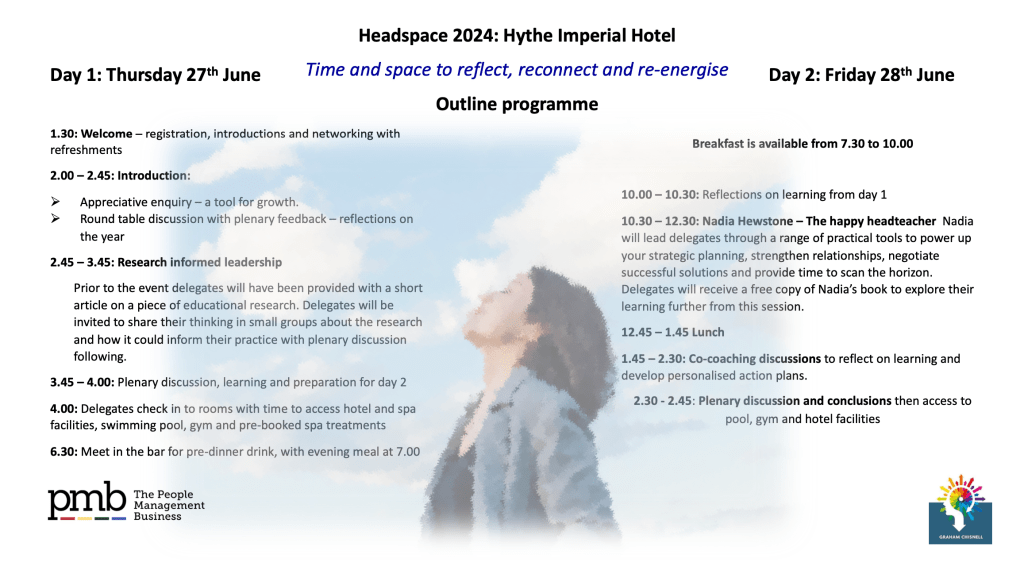
Headspace – a time to reflect and re-connect 27 & 28 June 2024
Headspace is a two-day conference for school and trust leaders. It is held in the beautiful setting of the Hythe Imperial Hotel and spa. The conference is centered on your well-being and provides a breathing space for your leadership thinking. You will be left with a range of fresh leadership ideas that can be added to your professional toolbox. Nadia Hewstone, author and educational coach, will be speaking at the event and sharing her top tips for school leadership. Spaces are limited so please get in touch quickly to secure a space.
Avoid unnecessary information that is not essential to the learning.
Provide clear and concise explanations that break down complex concepts into smaller, manageable parts.
Use visual aids to supplement verbal explanations and enhance students’ understanding.
Activate prior knowledge:
Understanding the forgetting curve and how pupils forget more over time if they do not return to what they have learned.
Develop cognitive schema – build in opportunities for retrieval practice.
Habitually include opportunities to activate prior knowledge in the lessons.
Intentionally interleave concepts within and across lessons – this could include opportunities to rehearse graphical representation learned in maths lessons in a science lesson.
Make knowledge ‘sticky’ –use strategies such as examples and analogies to promote the development of knowledge that is more easily retrievable and transferable to new contexts.
Build schemas strategically
Have a clear system to lessons that build and connect knowledge.
Sequencing essentialdisciplinary and substantive knowledge carefully in lessons and across a sequence of lessons.
Teachers then allow for consolidation,elaboration and interconnection of learning experiences.
Reference: Lightening the load: Integrating cognitive load, schema theory and progression mapping in the primary classroom Written by: Alex Reynolds, Hannah Heron, Kirstin Mulholland, Louise Jackson and Nicola Cherry. Published on: September 26, 2023.
Ofsted webinars and podcasts
Here is a link to an Ofsted webinar produced by Ofsted that explores how schools are inspected. This may be a useful link to share with governors and subject leaders. Ofsted has also produced a podcast on the subject reports for music, PE, and geography. Again, a really helpful listen for subject leaders.
Here is a link to an earlier Chisnell Chatter where I share research reviews for science and art.
I hope this edition has been of interest to you. Please feel free to share this with colleagues.
If I can help you in any way then do get in touch, you can email me chisnellg@gmail.com or call / text me on 07825149535.
For more information about my consultancy offer, please visit my website here. My latest consultancy offer includes Coaching for Appraisal, a course that prepares leaders and staff for impactful appraisals. This course is co-facilitated with HR expert Gary Edwards. I will also be co-facilitating Headspace, a residential recharge for school and trust leaders on 27 and 28 June 2024 at the beautiful venue of Hythe Imperial Hotel in Kent (flyer for this later in this edition). Let me know if you would like to secure a place for you and your team.
Do get in touch if you are interested in training, consultancy or coaching support.
If you are new to Chisnell Chatter, this publication has a range of hyperlinks embedded in the text. Where you spot an underline or highlighted text, click to find out more information. My back catalogue is available here:
If I can help you in any way then do get in touch, you can email me chisnellg@gmail.com or call / text me on 07825149535.
For more information about my consultancy offer, please visit my website here. My latest consultancy offer includes Coaching for Appraisal as a course that prepares leaders and staff for impactful appraisal. This course is co-facilitated with HR expert Gary Edwards. I will also be co-facilitating Headspace, a residential recharge for school and trust leaders on 27 and 28 June 2024 at the beautiful venue of Hythe Imperial Hotel in Kent. Let me know if you would like to secure a place for you and your team.
Do get in touch if you are interested in training, consultancy or coaching support.

Ofsted updates
The Inspection Handbook has been updated in January in response to the findings of the inquiry into the death of Ruth Perry. The key changes are published here. For ease here is a synopsis of changes relating to school inspections (changes in bold):
Regarding conduct: ‘Inspectors will uphold the highest professional standards in their work. They will treat everyone they meet during inspections fairly and with the respect and sensitivity they deserve. Inspectors will work constructively with leaders and staff, demonstrating professionalism, courtesy, empathy and respect at all times.
Regarding monitoring inspections: Schools judged inadequate solely due to ineffective safeguarding will have an early monitoring inspection. This will normally take place around 3 months (12 school weeks, where a school week is any week in which there is at least one school day) from when the graded inspection took place, but can take place at any point. within 3 months of the publication of the graded inspection report.
There is a new keeping leaders informed section: At the heart of our inspections is a professional dialogue between inspectors and leaders and so the lead inspector will agree a process for keeping leaders informed of progress throughout the inspection. This will normally mean regular meetings with the headteacher and/or any other previously agreed school leader(s) to:
provide updates on emerging issues, including initial general findings and to enable further evidence to be provided
allow the headteacher to raise any issues or concerns, including related to the conduct of the inspection or of individual inspectors, or to seek clarification.
alert the headteacher to any serious concerns.
Feedback at the end of an inspection now includes a bullet: make clear that, in addition to being able to raise concerns at any stage during the inspection, the school has an opportunity to raise any issues, concerns or to seek clarification about the inspection, and can also contact Ofsted on the working day after the end of the inspection, if necessary.
Also, the headteacher can elect any person the headteacher or CEO wants present to assist and support them at the final feedback meeting.
If the feedback is likely to be challenging or is likely to raise difficult issues, the lead inspector will be sensitive to any implications arising from this feedback and will therefore discuss with the headteacher which other people may attend the meeting to ensure the necessary support for school leaders.
Also the handbook now states: Attendance at the feedback meeting is voluntary and any attendee may leave at any time, including leaving for a short time and then returning.
During the final feedback meeting of a monitoring inspection, the lead inspector will ensure that leaders, governors/trustees and all attendees are clear:
that the judgements are provisional and so may be subject to change as a result of quality assurance procedures or moderation. We expect leaders to share the inspection outcome and findings with whoever they deem appropriate. The outcome and findings should be shared with governors/trustees, irrespective of whether they attended the meeting, and irrespective of what other role they may hold (for example, a teacher governor). Leaders may also share inspection outcomes, in confidence, with others, not involved in the school, provided the information is not made public or shared with parents. This may include leaders’ colleagues, family members, medical advisers, and/or their wider support group
that, in addition to being able to raise concerns at any stage during the inspection, the school has an opportunity to raise any issues or concerns or to seek clarification about the inspection, and can contact Ofsted on the working day after the end of the inspection, if necessary
Updated wording added to the ‘Requests for inspections to be deferred or cancelled’ section:
While it is important that we carry out our planned inspections wherever possible, sometimes there may be reasons that a planned inspection may not go ahead and so a school may request a deferral of an inspection. A school may make a request during the initial notification phone call, or at the earliest opportunity afterwards, before the start of the inspection. Inspections may also, exceptionally, need to be paused once inspectors have arrived onsite. We will not normally consider deferrals if we receive them after 4.30pm on the day the school is notified. The lead inspector must immediately contact the regional duty desk. We will decide whether this should be granted in accordance with our deferral policy.
Updates on the notification call:
make it clear that the headteacher is encouraged to have at least one other senior leader present during the call to assist and support them. This will usually be staff who typically deputise for them (or a member of trust staff) and who can understand and discuss the educational content of the call. The headteacher may also wish to have someone present to take notes.
check on the headteacher’s well-being, and find out whether any steps need to be taken to ensure that any issues or concerns are addressed, including that appropriate support is available. The lead inspector should ascertain how to contact whoever is responsible for the headteacher’s well-being on a day-to-day basis (normally the local authority or trust), so that they can pass on well-being concerns when appropriate and necessary.
agree a process for keeping leaders informed of progress throughout the inspection. This will normally mean regular meetings with the headteacher and/or any other previously agreed school leader(s) see Keeping leaders informed.
give the school the opportunity to raise any issues or concerns or to seek clarification before the inspection.
explain how the school will be able to raise any matters during the inspection itself.
When engaging with inspectors:
Staff (including leaders at all levels) may always be accompanied by another person when speaking to inspectors. However, it is important that staff are able to express their views freely to inspectors.
Inspectors should take careful account of the well-being of leaders and staff and adjust their approach or activity, as appropriate, as they go about their inspection work, in the best interests of pupils. If inspectors see or suspect that a staff member (including all leaders and the headteacher) is upset or distressed at any point during the inspections, inspectors should respond sensitively. Where appropriate, inspectors will consider suitable adjustments to enable the staff member to continue. Where appropriate, inspectors will inform those responsible for the person’s well-being. The lead inspector should contact the duty desk to discuss what action to take.
In exceptional circumstances, inspectors may need to consider pausing the inspection.
Meetings with pupils or parents must take place without the presence of any leaders or staff, unless there are exceptional circumstances.
There is also a new section on pausing inspections:
There may be exceptional occasions when a pause to inspection needs to be considered. We will consider these on a case-by-case basis according to our published guidance. This policy sets out in detail how to request a pause in inspection, the importance of leader and staff welfare, the role of the responsible body, and how leaders, responsible bodies and others can contact a senior leader in Ofsted directly if they have issues they do not feel they can raise directly with the lead inspector.
Updated wording added to the inadequate schools that are subject to special measures:
This judgement is not subject to moderation. We expect leaders to share the inspection outcome and findings with whoever they deem appropriate. The outcome and findings should be shared with governors/trustees, irrespective of whether they attended the meeting, and irrespective of what other role they may hold (for example, a teacher governor). Leaders may also share inspection outcomes, in confidence, with others who are not involved with the school. This may include leaders’ colleagues, family members, medical advisers and/or their wider support group. However, the information should not be made public or shared with parents.
Regarding who the headteacher can share inspection outcomes: Leaders may also share inspection outcomes, in confidence, with others not involved in the school, provided the information is not made public or shared with parents. This may include leaders’ colleagues, family members, medical advisers, and/or their wider support group.
In the Quality Assurance and Complaints section the following updates include:
The great majority of our work is carried out smoothly and without incident. If concerns do arise during the inspection, they should be raised with the lead inspector as soon as possible, in order to resolve issues before the inspection is completed. Any concerns raised, and actions taken, will be recorded in the inspection evidence. If there are any concerns that are not possible to resolve with the lead inspector during the inspection, the headteacher, another senior leader, the local authority or a trust representative can contact a senior Ofsted leader using the number provided as part of the notification process.
If an issue remains unresolved, the school or responsible body can contact Ofsted on the working day after the end of the inspection. This will be an opportunity for the school to raise informal concerns about the inspection process or outcomes, ask about next steps or highlight information that they feel was not fully considered during the inspection. This will be directed to an inspector who is independent of the inspection to discuss and to resolve, where appropriate, at the earliest opportunity.
So, what do these updates mean to you as a school leader? There is a recognition that you and your staff’s wellbeing is a valid consideration in every inspection. If you or your staff feel concerned about the conduct of inspectors or how the inspection is making you feel, then you have every right to raise this concern with the lead inspector or member of the wider Ofsted support team. Inspectors have also received additional training from Mental Health England and as such should be increasingly alert and aware of the signs and symptoms of distress. There is, however, no getting away from the fact that school inspections create heightened pressure in school for leaders, staff, students and governance. Being clear about the updates in the inspection handbook, coupled with the Ofsted Code of Conduct will give you the lever to ensure that any concerns that arise can be raised swiftly and professionally during the inspection process.
DFE Recruitment and Retention
The DFE announced their new measures to enhance recruitment and retention this week. New guidance is due in the Spring 2024, on how to tackle bullying and harassment of school staff.
Also, the Workload Reduction Taskforce has agreed early recommendations to help reduce teacher workload and encourage education staff wellbeing to support the department’s aim to reduce teachers’ and leaders’ working week by five hours within the next three years. Again, further recommendations will be published in the Spring 2024.
Research Posters
If you are thinking about sharing your research findings, a research poster is a simple yet engaging way to present in a format that is easy to digest. Using the format of the journal article, the poster allows the researcher to present their findings in a way that can be browsed by colleagues. The poster can also be a reference tool for the researcher to use during a presentation to a small group of colleagues. I have used research posters as a marketplace of ideas during a presentation of research. In the marketplace, the research posters are mounted on easels around the room so that staff can wander amongst them and discuss their content.
I ran a research project with a group of middle leaders across ten primary schools. The final stage of the project was to share the research findings and the researchers gave a two-minute presentation to the delegates from their schools. This was followed with a marketplace of the ten research projects where the research posters were used as a talking point for each researcher as delegates wandered freely around the hall. The casual atmosphere of the marketplace allowed staff to pose questions to the researchers about their research posters and gain a deeper perspective about the research undertaken.
Here are some tips for creating an effective research poster, adapted from NYU Libraries (2020):
• Think about your audience and design your poster with them in mind. • Make your font size readable from a comfortable distance away from your poster. • Grab your readers with a clear title/research question. • Limit your words to keep your reader engaged and to be precise in what you are communicating Use bullets, numbering, and headlines to make it easy to read. • Think about your graphics and colours to enhance your poster rather than distract the reader. • Include logos from your organisation. • Remember to put your name on the piece. • Include references used in step 3 of the Research Cycle. • Share your poster with a colleague/coach to make sure it is easy to interpret.
Here is an example of a research poster produced by two teaching assistants whose research question was, ‘Can a nurture approach support pupils with complex needs to improve their behaviours?’:
While this poster does not share the detail of the research undertaken, it allowed the researchers to share the key steps in the Research Cycle. In displaying this in a research poster, the researchers were able to talk through each step with colleagues. While this poster is not a perfect example of a research poster, I have included it to give you an idea of the form a research poster could take. My advice is to be playful and use the Research Cycle to help structure your poster.
Staff often enjoy creating research posters as it allows for creative flair. The posters can be produced digitally using programs such as Microsoft Publisher or PowerPoint or by a simple cut-and-paste onto A1 card backing.
Reference:
NYU Libraries. (2020, July). NYU Libraries. Retrieved from How to create a research poster: http://www.bit.ly/3eGuG5N Accessed: March 2021
If you are new to Chisnell Chatter, this publication has a range of hyperlinks embedded in the text. Where you spot an underline or highlighted text, click to find out more information. My back catalogue is available here:
If I can help you in any way then do get in touch, you can email me chisnellg@gmail.com or call / text me on 07825149535.
For more information about my consultancy offer, please visit my website here. My latest consultancy offer includes Coaching for Appraisal as a course that prepares leaders and staff for impactful appraisal. This course is co-facilitated with HR expert Gary Edwards. I will also be co-facilitating Headspace, a residential recharge for school and trust leaders on 27 and 28 June 2024 at the beautiful venue of Hythe Imperial Hotel in Kent. Let me know if you would like to secure a place for you and your team.
Do get in touch if you are interested in training, consultancy or coaching support.

Prevent Duty
The Prevent Duty guidance has been updated in December 2023. The key changes to the guidance are:
Changed objective: ‘Tackle the ideological causes of terrorism‘
New theme: ‘reducing permissive environments’
Updates on the risks and threats of terrorism.
Updated terminology.
An emphasis on proportionality.
New section on information sharing.
Training requirements.
Updates on managing external speakers for FE and HE.
Ofsted inspections will take account of the school’s approach to Prevent as part of the school’s safeguarding culture and that the school has due regard to Prevent in a proportionate way. The local context may also determine the focus on Prevent in inspection. As a school leader, it is important to ensure you have considered, assessed and mitigated the risks to pupils. As always, the importance of staff training and effective record keeping relating to incidents remains important in assuring that pupils remain safeguarded.
Teacher Talk Radio – tackling educational hot potatoes
I came across Teacher Talk Radio a few years ago. Podcasts in their archive offer some interesting listening about a range of educational hot potatoes. Here is a link to their 2023 top ten podcasts. They include topics such as the use of artificial intelligence in schools, Ofsted reform and direct instruction.
In addition here is a link to the Ofsted podcast regarding the geography PE and music subject reports. A useful listen for subject leaders to consider the lens that Ofsted have on these subjects.
I coach a range of school leaders in their research practice. One of the essential steps in this process is to ensure that the researcher defines a purposeful and interesting key issue for research.
Asad Naveed, a researcher in the field of medicine at the University of Toronto, suggests that identifying ‘research gaps’ is key to engaging in purposeful research. He suggests that identifying research gaps is essential to help you assess the current state of knowledge and determine where further research is needed.
Research gaps refer to areas in the existing literature with unanswered questions, inconsistencies, contradictions, or limitations.
Asad suggests seven types of research gaps to consider:
𝗘𝘃𝗶𝗱𝗲𝗻𝗰𝗲 𝗴𝗮𝗽: A lack of empirical data or research evidence in a particular area of study.
𝗞𝗻𝗼𝘄𝗹𝗲𝗱𝗴𝗲 𝗴𝗮𝗽: A gap in the existing knowledge or understanding of a particular topic or phenomenon.
𝗣𝗿𝗮𝗰𝘁𝗶𝗰𝗮𝗹 𝗸𝗻𝗼𝘄𝗹𝗲𝗱𝗴𝗲 𝗴𝗮𝗽: A gap in practical knowledge, such as how to apply theoretical knowledge to real-world situations.
𝗠𝗲𝘁𝗵𝗼𝗱𝗼𝗹𝗼𝗴𝘆 𝗴𝗮𝗽: A gap in the methods or approaches used in previous research studies in a particular area.
𝗘𝗺𝗽𝗶𝗿𝗶𝗰𝗮𝗹 𝗴𝗮𝗽: A gap in the empirical evidence, such as a lack of studies or data in a particular area of research.
𝗧𝗵𝗲𝗼𝗿𝗲𝘁𝗶𝗰𝗮𝗹 𝗴𝗮𝗽: A gap in the theoretical understanding or conceptual framework of a particular topic or phenomenon.
𝗣𝗼𝗽𝘂𝗹𝗮𝘁𝗶𝗼𝗻 𝗴𝗮𝗽: A gap in the population studied, such as a lack of representation of certain demographics or groups in research studies.
Through identifying and addressing research gaps the researcher can help to define a key issue for further research that can shine a light on pedagogy or practice in school.
In their article Addressing the Disadvantage Gap: The Unavoidable Link between Poverty and Learning Outcomes, Rob Gruijters and Natalie Perera from the University of Cambridge share some interesting points about the deficit of early intervention services and impact of socio-emotional skills development in schools.
In light of recent Education Policy Institute and American Sociological Association analyses, it is evident that the education landscape is grappling with the enduring impact of poverty and a lack of early intervention services. The challenges faced by educators are unimaginably tough, and we cannot turn a blind eye to the intricate link between destitution and educational achievement. The struggle has become even more pronounced post-pandemic, with a widening gap in attainment across all educational phases.
➡️ By the end of secondary school (key stage 4), disadvantaged pupils lag behind their peers by over 18.8 months, marking the widest gap since 2012.
➡️ Persistently disadvantaged pupils are nearly two years behind by the end of secondary school, with no progress in closing the gap over the past decade.
➡️ Disadvantaged 16-19 year olds were 3.5 grades behind their peers, the widest gap since 2017.
➡️ A study reveals that teaching character, grit, and resilience, while valuable, might not be the panacea for closing the attainment gap. Data from the 2018 Pisa assessment indicates that socio-emotional skills alone have a modest impact on the overall achievement gap.
Addressing the educational crisis requires a holistic approach. While character education is valuable, it is not a silver bullet. The focus must shift towards tackling structural issues, including school quality, resource disparities, and limited out-of-school opportunities. Poverty should not be a barrier to educational success, and it is imperative that we develop a comprehensive plan to address both destitution and educational disparities.
SEND – helpful links
On my travels in the South East, I meet a range of consultants doing good work. Here are two links who can support with your SEND needs.
Daniel Zaccheo who is committed to help schools to develop a culture of positive inclusion. Daniel works with Senior Leadership Teams to develop a strategy for culture change towards more inclusive, child centred and positive working practices. In addition he supports SENCOs to meet the needs of complex children, delivers training in positive behaviour support and inclusion and can conduct whole school SEN review and provide supportive feedback and support. His contact details are:
Stacey Mitchell and Angela Harding from SEN Connect offer a range of services to help to engage parents and carers in understanding a variety of learning, sensory, language or emotional needs that their children may be experiencing. They offer bespoke training packages for schools.
As we charge towards the mayhem of Christmas productions and scatter glitter across our classroom floors with merry abandon; I wish you all every joy and happiness this Christmastide. Here is my final Chisnell Chatter for 2023 with a roundup of all things education and research. I hope you find this interesting and insightful.
If you are new to Chisnell Chatter, this publication has a range of hyperlinks embedded in the text. Where you spot an underline or highlighted text, click to find out more information. My back catalogue is available here:
If I can help you in any way then do get in touch, you can email me chisnellg@gmail.com or call / text me on 07825149535.
For more information about my consultancy offer, please visit my website here. My latest consultancy offer includes Coaching for Appraisal as a course that prepares leaders and staff for impactful appraisal. This course is co-facilitated with HR expert Gary Edwards. I will also be running two courses in 2025 with Gary and the details of these are outlined in this edition. Do get in touch if you are interested in training, consultancy or any other training or coaching support.
Ofsted Publishes its Annual Report 2022/23
His Majesty’s Chief Inspector has published her final annual report. It is heartening to see the many positives picked out in this report. Here are the headlines from the report:
In schools the curriculum focus of inspections has really encouraged schools to think about the quality of their education.
Subject reports show that curriculum has improved in nearly all the subjects. Schools are now placing a higher value on subjects beyond English, mathematics and science than was the case at the time of our previous subject reports.
Giving proper time and thought to curriculum has also helped in the early years. This has been particularly important for a generation that missed out on socialising and early education, as a result of the pandemic.
The teaching of reading in primary schools is also significantly better. More pupils learn to read fluently as quickly as possible.
There’s been a noticeable rise in attention and policy focus on further education. The introduction of T levels was a step in this direction, and although there have been initial challenges, the determination to reshape further education is clear. The emphasis on skills has also brought new energy to discussions about education after the age of 16.
Some local authorities have made substantial improvements in social care, with 60% now rated good or outstanding and many sustaining their progress. I hope that the additional scrutiny from the new judgement in ILACS looking at the experience and progress of care leavers and our joint targeted area inspections (JTAIs), which look at the multi-agency response to children and families who need help, will support further rapid improvements for some of our most vulnerable and disadvantaged children and young people.
The report, however also outlines some challenges ahead:
The persistent gaps in children’s learning, issues of recruitment and retention, and escalating demands on services that are already stretched thin, especially in SEND and mental health.
A worrying change in how parents and schools work together since the pandemic. The unspoken contract between parents and schools, where parents make sure their children go to school every day and follow school rules in exchange for a good education, has been broken. The report states that inspection work has highlighted more children missing school and behaving badly. Re-establishing this social contract is crucial for keeping up the progress made after the pandemic, but it will probably take a long time to fix it fully.
Persistent absenteeism has also impacted the number children who drop completely from sight of the system. This remains one of the biggest concerns to Ofsted.
Beyond Ofsted report by UCL
Ofsted have been in the news over the past week as the enquiry into the death of Ruth Perry concluded. As the current Chief Inspector ends her tenure this month there is the hope that the lessons learned will resonate with the inspectorate.
UCL have published their review ‘Beyond Ofsted’ and this presents an alternative to the inspectorate’s quality assurance model. The full report is available here.
The report outlines the following recommendations:
Every school will conduct its own self- evaluation – the school performance review (SPR) – which it will report to stakeholders. The government will work closely with the whole sector to develop guidance on what the SPR should comprise, which might include mandatory and optional elements. Accountability will then be principally to parents and the wider community.
Schools will work with an external school improvement partner (SIP), delivering on an action plan, informed by the SPR. Schools in a trust might have a SIP appointed from within that trust. Others would use a SIP provided by their local authority (LA). Some funding may be needed to increase LA capacity for this work.
While they are working on the SPR, schools will engage in an ongoing dialogue with their SIP who will typically be experienced in school leadership and improvement. They would include serving head teachers.
SIPs will validate the SPRs.
The purposes of the SPRs are to enhance schools’ capacity for self-improvement and to provide information to stakeholders. It would not be the means by which a school would be held accountable by the Department for Education (DfE) or by Ofsted.
Safeguarding audits will be conducted annually by a separate body, under the oversight of a national safeguarding body. LAs will be able to take over the annual safeguarding visits when deemed ready by the national safeguarding body. The public sector equality duty would apply, for both pupils and school staff.
The role of inspectors will change so that they focus on the governance of, and capacity for, school improvement and respond to any challenges faced, including the relationship between the school and the SIP. They would not routinely inspect teaching practice and pupil outcomes. For schools in a multi-academy trust (MAT), the inspection would focus on the capacity and approach of the trust to evaluating its schools’ SPRs.
The inspectorate will be reformed so that inspectors develop and maintain appropriate training and expertise in the area of school improvement, to be able to build the capacity of the school leadership team. This must include understanding the context of the school, including relevant expertise for specialist settings such as special schools and alternative provision. It must also include a thorough understanding of good school governance.
Crucially, the inspectorate will be fully independent of government so that it can hold the Government, its policies, and the effects of these policies, to account through system- wide thematic inspections, including sufficiency of teacher supply.
Our final recommendation is for an immediate pause of routine inspections to allow time to reset and regain the trust of the profession. Duty of care to the profession in order to develop collaborative learning cultures, which generate excellent professional skills and competencies, should be at the heart of any reform.
Inclusion
In her recent blog on inclusion, Cassie Young shares a super graphic from Seainclusion that explains the difference between exclusion, segregation, integration and inclusion. This is a powerful prompt for our school curriculum to consider if this is truly inclusive and demonstrates ambition for all. When thinking of the curriculum through the lens of SEND, Cassie provides us with several points to consider:
Is the curriculum taught well enough by all staff?
Do some subjects offer a better experience?
Does there need to be more support for key teachers or support staff
What approaches do you use to ensure all children can access the curriculum?
How do you monitor and evidence this?
What subject specific scaffolding, adaptations and approaches do you use? (E.G. Maths Manipulatives, Music using adaptive instruments, P.E using specialist equipment)
How do subject leaders use their outcomes to plan next steps for pupils with SEND?
How do you know as SLT that your curriculum is meeting need?
Within the article by Reynolds et al, the authors remind us of the importance of streamlining the content of lessons to manage the cognitive load of our pupils.
Avoid unnecessary information that is not essential to the learning;
Provide clear and concise explanations that break down complex concepts into smaller, manageable parts;
Use visual aids to supplement verbal explanations and enhance students’ understanding.
The next step is to that the teacher activates prior knowledge:
Build in opportunities for retrieval practice
Intentionally interleave concepts within and across lessons
Make knowledge ‘sticky’
Target Memory
Kate Jones has written an interesting article on target memory. The article defines target memory as, ‘A target memory is what students are required to recall from long-term memory and is also referred to in cognitive psychology as the ‘target trace.’ Target memories can include facts, vocabulary, ideas, concepts, or content to be retrieved after the initial stages of learning have taken place.
Kate explores the following key reflections on the use of target memory in curriculum design:
When designing a curriculum and planning lessons, teachers need to be aware of the content that will form the target memories for learners.
During a lesson, the key points should be highlighted and signalled so students understand what the core content is. This can be done during explanations, through slide and resource design, with targeted and specific questioning, and during the consolidation phase of the lesson to check for understanding.
Retrieval tasks should be designed to initially quiz learners on specific target memories; after retrieval success, students can then progress onto free recall without cues and prompts.
Improving primary science
The EEF have released a useful guide to strengthening your science curriculum offer. The resource outlines six recommendations for improving primary science, including developing vocabulary and working scientifically.
Develop pupils’ scientific vocabulary;
Encourage pupils to explain their thinking, whether verbally or in written form;
Guide pupils to work scientifically;
Relate new learning to relevant, real-world contexts;
Use assessment to support learning and responsive teaching;
Strengthen science teaching through effective professional development, as part of an implementation process.
Mental Health for pupils
I have come across a super offer by the Happy Confident Company who offer support for the mental health and wellbeing of pupils. Kate works with pupils from EYFS to KS3 and offers a social and emotional literacy programme. If you are interested take a look at these video links for more information.
If you are new to Chisnell Chatter, this publication has a range of hyperlinks embedded in the text. Where you spot an underline or highlighted text, click to find out more information. My back catalogue is available here:
If I can help you in any way then do get in touch, you can email me chisnellg@gmail.com or call / text me on 07825149535.
For more information about my consultancy offer, please visit my website here. My latest consultancy offer includes Coaching for Appraisal as a course that prepares leaders and staff for impactful appraisal. This course is co-facilitated with HR expert Gary Edwards. I will also be running two courses in 2025 with Gary and the details of these are outlined in this edition. Do get in touch if you are interested in training, consultancy or any other training or coaching support.
Ofsted MAT Summary Evaluations and DfE MAT Assurance Framework
The Ofsted Summary Evaluations (MATSE) are undertaken by Ofsted to check in on how Multi Academy Trusts to ‘recognise a trust’s positive impact on the quality of education in its academies, and to give the trust helpful recommendations on aspects of its work that could be improved’. Ofsted 2023.
Ofsted will consider inspections undertaken in MATs over two terms before visiting the trust. This means that inspections in a MAT may be clustered together to inform the MATSE. While these have been paused, it is plausible to think that the clustering of inspections in MATs may continue as this can inform MATSE from April 2024.
For more information about MATSE visit the Ofsted site here where you will find the latest MATSE document updated in March this year.
The MAT Assurance Framework is a tool provided by the DfE for trusts as a self evaluation tool. This is a super document that I had the privilege of appearing in as an exemplar practice. Here is a link to the framework’s criteria. This provides a really helpful set of prompts for MAT self-evaluation and asks you to RAG your current self assessment. I have used this tool with trusts and trustees to review the strengths and areas for development. If you are interested in developing the self assessment for your trust, then contact me.
Questioning
Questioning is one of the most powerful tools in the teachers’ toolbox. It can engage pupils, support their understanding, develop their vocabulary and strengthen their pace of recall. Questioning can also act as the most powerful form of formative assessment. However, I so often see questioning used as a bolt on to learning rather than a driver for learning.
Here is a link to an article by Kate Jones on questioning. In the link Kate provides a link to the Evidence Based Podcast with Michael Chiles. Mike talks about his book relating to questioning. The episode explores the purpose of questioning and the use of strategies to engage pupils in questioning. While this is a secondary focus, there is some useful points made.
The use of effectiv feedback is powerful for teachers in checking in on gaps in knowledge and understanding as well as purposeful for the pupils as a tool for learning and affirming their own understanding. Feedback is therefore a win-win scenario. Coupled with effective questioning, which is amongst the most powerful tools in a teachers’ toolbox.
If you would like further support for developing a culture of questioning then please get in touch.
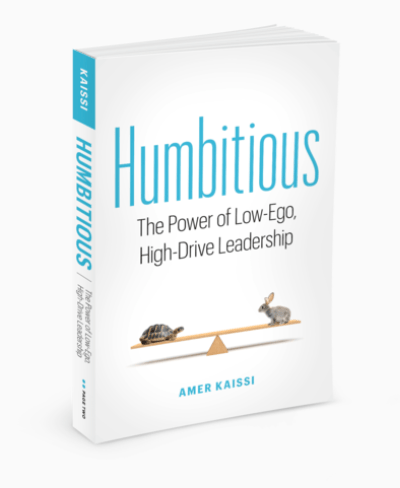
Reflections on a good read – You’re not listening by Kate Murray
A colleague recommended Kate Murray’s book, ‘You’re not listening’ to me recently. The book is an easy read and makes some great points that resonate with so many roles within schools. The book starts with a super quote by Epicteus, a Greek philosopher:
‘Nature hath given man one tongue but two ears, that we may hear from others twice as much as we speak.’
Kate makes the point in her book that hearing is not the same as listening, and too often we engage in a passive process of hearing rather than an active process of listening. In my opinion, this can also resonate with our approach to teaching and questioning in the classroom. Kate urges us to listen to our own curiosity and become interested in the conversation you are undertaking. She talks of ‘assumptions as earplugs’. This is a great concept and links with cognitive bias. The idea here is that when you make an assumption that you know what someone is talking about, you can switch off. In ensuring that you remain open to truly listening to your colleagues, you can learn something new about them, the issue being discussed and yourself.
Kate makes another valuable point that there is merit in listening to opposing views. It is easy to slip into just speaking to colleagues that echo your own professional ideologies and practice. This may include connecting only with like minded colleagues on social media. Kate urges us to ‘accept the legitimacy of another person’s viewpoint’. A powerful message for any school leader as they strive to connect and understand their team and allows us all to pick up on the differing perspectives on offer by our colleagues. This can lead to staff’s strengths emerging and being valued and the team being strengthened.
If you want to read more, then follow this link to Kate’s book. (I don’t get commission for this, honest!).
The Diamond 9 – research methodolgy
When thinking about your research methodology, you can choose to collect data through a single research method, or combine a range of research methods. I have used the Diamond 9 research method in many research projects as it provides a really helpful tool to gain helpful data that unpacks your research question.
How does it work?
Research in schools should be engaging, simple and enjoyable for both the researcher and the participants. The Diamond 9 provides a resource that ticks all three boxes.
The Diamond 9 research tool encourages your research participants to order their preferences to a range of images or statements linked to your research question. The statements or images are given to an individual or group and they are asked to rank them using the Diamond 9 format to define which statement or image is the most and least important to them.
For example, consider a teacher researching the question, ‘Do children favour similar play-based interests in home as they do in school?’. She produced a range of 12 images on postcards and asked the children to rank them in a Diamond 9 pattern. The children placed their favourite activities at the top of the Diamond 9 and those with similar preferences were placed in the middle rows with the least preferred form of play at the bottom. Pictures that were not of interest were discarded as were any that remained after the Diamond 9 was complete.
The teacher talks to the child throughout the activity and encourages them to order their preferences. The teacher recorded the final Diamond 9 in a photograph, noting the comments made during the discussion with the child as they grappled and reasoned with their choices. The researcher can record both the final Diamond 9 but can also transcribe the children’s discussion as they consider where each image is placed, providing additional data for analysis.
Using the Diamond 9 with different respondents can also provide an interesting opportunity for analysis of data. With the example above, the researcher could select differing groups of pupils, perhaps selecting gender, disadvantage or ability; to see if there is any correlation between the choices made by the different groups.
The Diamond 9 activity builds a fascinating bank of data that when analysed, helps the researcher to move forward with their curriculum, pedagogy and practice.
SENCOs who have already obtained the NASENCO will not need to complete the new NPQ.
From September 2024, all SENCOs and aspiring SENCOs will:
need to take the NPQ if they have not completed or started the NASENCO
still need to complete training within 3 years of appointment – schools and SENCOs must ensure they enrol on training that will meet this requirement
SENCOs appointed before 1 September 2009 will not be required to take the NPQ but will be expected to ensure compliance with the regulations.
Here is the link to the SEND NPQ standards document published in September 2023. The document outlines a range of ‘learn that’ and ‘learn how to’ statements that can also provide a useful self-review on all SENCos in role.
Coaching skills for school leaders 1 & 15 March 2024
I have joined with HR expert Gary Edwards to offer a two day course to develop coaching skills for school leaders. The course draws on over 20 years of experience as professional coaching trainers, our wider knowledge of school and trust leadership, the Ofsted inspection framework and research into organisational change. Take a look at the flyer below. Places are restricted for this course to 15 participants to ensure this remains highly effective and practical, leaving delegates with the skills and attitudes to apply the skills learned in a wide range of leadership scenarios. Places are limited so don’t miss out! <a href="http://<iframe src="https://onedrive.live.com/embed?cid=42CDEDDD0E9681D5&resid=42CDEDDD0E9681D5%2111879&authkey=APiKJy1qr7syFRg&em=2" width="476" height="288" frameborder="0" scrolling="no">Click this link for the flyer.
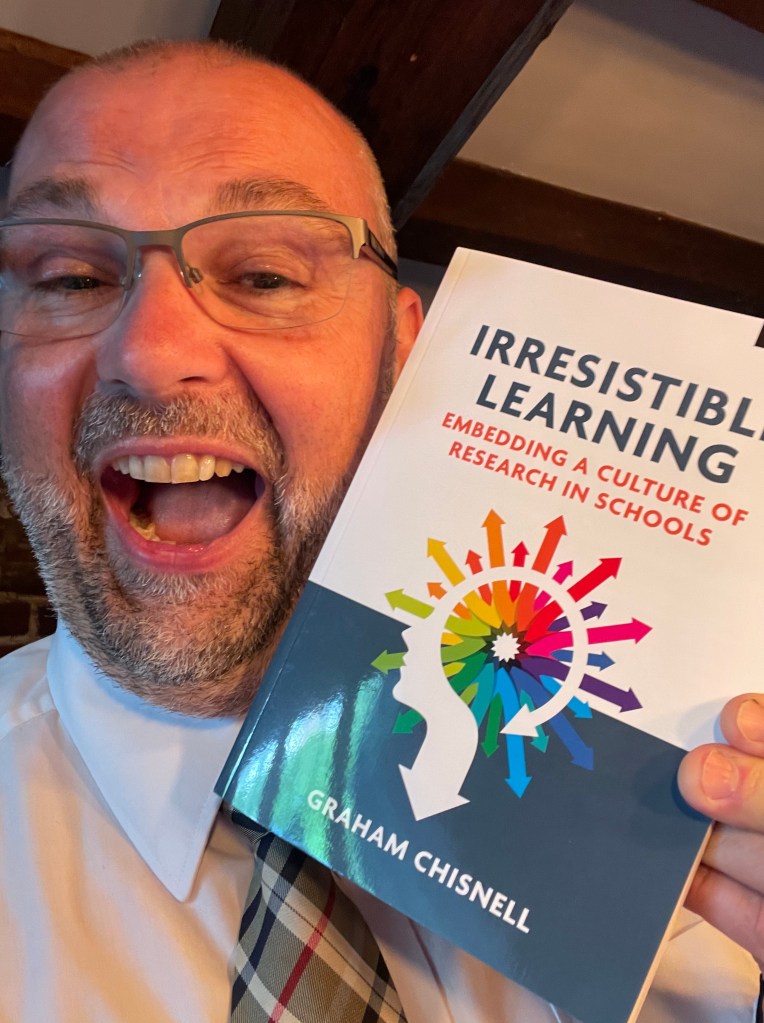
I’m delighted to announce that Irresistible Learning: Embedding a culture of research in schools has made the shortlist of Learning Ladders’ ‘Best Books for Educators Summer 2021’ awards.
I was shortlisted alongside 40 other books from a longlist of over 100 entries for our dedication to enriching the lives of educators with our writing.
The awards panel featured teachers, school leaders, and EdTech entrepreneurs including Learning Ladders’ founder, Matt Koster-Marcon, who is also Chair of the EdTech Special Interest Group at BESA.
Educational books are a great CPD resource, providing inspiration, entertainment, and new ways of thinking about education.
I’m proud to be included in the list, and would also like to congratulate the other shortlisted books for their incredible work. Visit the full list of recommended books, which cover topics such as wellbeing, educational leadership, and diversity and inclusion in schools.
Research in schools empowers you to develop practice that can impact positively on your organisation. Whether you are part of the curriculum team working directly with students or the business teams working across a school or trust, research is affirming and can exemplify the effectiveness of new practice. Research can challenge existing practice and move the researcher to confront their own thinking and values. And it can also seek out fresh ideas to adapt current practice. Whatever the outcome, through research, you are led to carefully consider your next steps in adapting or affirming your own practice or influencing the wider practice of your teams.
In step 8 of the Research Cycle, now you have undertaken your research and shared it with others, you need to stop and ask yourself ‘So, what…?’
So, what… • did you find out relating to your research question? • did you not find out that you hoped to discover? • surprises did you discover along the way? • did you find that challenged or changed your own practice? • has changed in the progress of your students as a result of your research? • has changed in the relationships you have with your colleagues as a result of your research? • are the implications of your research for your team, school, organisation, network beyond the school? • has changed in you as a person as a result of this research project? • were the pitfalls in your research project that you will use to inform your next research cycle? • will be your next research question, knowing what you now know?
This leads to the key question relating to step 8 of the Research Cycle: • So, what will you do differently as a result of your research?
Now you have completed the analysis of data at step 6 of the Research Cycle, you are ready to share the key points you have discovered. It is important to be aware of step 7 in the Research Cycle at the outset of the research journey. In knowing that you will be required to present your research findings, you embark on the Research Cycle with a potential audience in mind, encouraging you to maintain the quality and integrity of your research as it unfolds. In short, by keeping the end point in mind, you recognise the importance of making your research accessible to your potential audience, whether this is your team leader, appraisal lead, colleagues, senior staff or colleagues beyond your own organisation.
There are many ways to share your research findings, such as a structured article to be published in an organisational research journal, a digital presentation or notes to support a verbal presentation to a group of colleagues. It is important that you take ownership of this step in the Research Cycle; in doing so, you will become increasingly confident about sharing your research findings with others.
Here are my key messages about sharing your research findings at step 7 of the Research Cycle:
• Produce a journal write-up for your research and encourage your organisation to produce its own research journal. • Use a blog as a vehicle to present your research findings and share new understanding. • Use digital presentation tools such as Microsoft PowerPoint and Prezi to share your research. If you are less confident in presenting live, then record a narrated presentation. • Record your voice or a video to present your research findings to a wider audience. • Present to a small group of colleagues if you are nervous presenting to larger groups in order to show what you’ve discovered and build your confidence in presenting. • A research poster can be a fun and engaging way to connect research findings with an audience.
Now you have gathered a rich array of data at step 5 of the Research Cycle, it is time to set to the task of analysing the findings. It is likely that you will have collected a wealth of raw data using your chosen research methodology. If you have used a range of research methodologies, your data may include transcripts from discussions or interviews, responses to questionnaires, recordings from class groups, diamond 9 pictures and accompanying notes. You now need to think carefully about deciding which data to analyse. You need to seek out the data that is helpful in answering your research question. The analysis of findings helps you search for patterns within the data gathered. Patterns within the data may be presented as similarities or differences, common occurrences, abnormalities or points of interest.
There are a range of strategies to help you analyse your data. Each strategy depends on your ability to eyeball the data. Eyeballing is a technique that, with practice, helps you to seek meaning from the data that is presented whether in numerical, graphical, pictorial, auditory or written form.
In order to strengthen your ability to eyeball data, you can ask the following critical questions as you examine the data and charts: • Stepping back from your data, what jumps out at you? • What are the prominent similarities in the data presented and why might this be the case? • What are the prominent differences in the data presented and why might this be the case? • What didn’t you expect to see in this data? • Does anything support your assumptions relating to your research question? • Does anything challenge your assumptions relating to your research question? • Is there anything in this chart that stands out as unusual or surprising? • Does your wider evidence base support or challenge what you see in this data? • Can you trust this data? Why? • Are there any other ways you can represent your data? Would a different chart help you see something new? • How does X affect Y? • Is there anything that you would have changed in your methodology now you have analysed this data
Here are my key points about analysis of data:
• Analysis is the art of unpacking or breaking down the data for analysis in order to bring clarity to what the data is saying. • Synthesis is the art of drawing together the many elements of data in order to form a conclusion. • Seek out data that is helpful in answering your research question. • Help define cause and effect within research through the use of a flow map. • Compare and contrast data using a double bubble map. • The tree map helps you sort data into categories. • While not essential in the analysis of data, words and images (qualitative data) can be turned into numbers (quantitative data) to broaden the analysis of the data. • Eyeballing is the process of reading and rereading data to seek for relevant patterns or anomalies in the data set. • Bar charts are helpful when comparing the frequency of a measurement across a range of variables. • The distribution chart uses a range rather than a single number in a data set, helping to group larger data sets into bite sized chunks of data that is easier to interpret. • Pie charts are helpful when presenting data relating to the frequency of one numerical variable against a categorical variable. • Percentage component bar charts compare percentage responses across multiple sets of data. • A spider or radar chart presents data visually showing the relative scale of response on a common scale for a range of variables. • Line charts are helpful when interpreting data at a range of points in time. • Scatter charts group data to present patterns when looking at two scaled variables. • When analysing the data, you must hold your assumptions lightly in order to allow the data to tell the story of research. • Be alert to your own conscious or unconscious bias in your analysis and when answering your research question.
By step 5 of the Research Cycle, you have considered and refined your research question, building a broadening understanding of your research issue. It is now time to think about the most helpful research methodology to answer your research question. You need to develop an awareness of the range of research methods available to you in order to select the best method, or methods, to explore your research question.
In pursuing your research methodology, you can choose to collect data through a single research method, or combine a range of research methods. It is important to understand the theory behind research methodology. This will help you to define the type of methodology that will help to answer your research question. Theories such as qualitative and quantitative research, longitudinal research, single study research, microgenetic research, cross-sectional research, design experiments, action research and the mosaic approach. In understanding the theoretical basis for research, you can select your approach to research with confidence along with the practical tools for research.
Here are the key theories that underpin step 5 in the Research Cycle:
Qualitative research involves numerical data.
Quantitative research involves non-numerical data, this could include words or pictures/images.
Longitudinal research looks at how things change over time.
Single study research focuses on one participant (or sometimes a limited number of participants) in detail.
Microgenetic research is a form of study where the subject is observed during a period of rapid learning or change.
Cross-sectional research, unlike longitudinal research, collects data on students of different ages or developmental levels at the same time.
Design experiments allow the researcher to design their own parameters of research to test out their own hypothesis.
Action research critically examines one’s own practice and then make changes to practice based on the research findings.
The mosaic approach (Clark, 2005) was devised as a tool to gain the thoughts and perspectives of young children in research using a range of research tools.
References:
Clark, A. (2005). Beyond Listening: Children’s perspectives on early childhood services. The Policy Press.