November 2026

I hope that the autumn term 2026 is unfolding well for you. Here is the 42nd edition of Chisnell Chatter, packed with a smattering of all things education leadership. In this edition I explore the DfE new speech, language and communication research, inclusion bases advice and a Japanese model for purposeful improvement. Intrigued? You betcha!
If you are new to Chisnell Chatter, hello! There is a back catalogue of 41 editions packed with leadership tips, legislative updates and research practice. Grab a strong coffee (other beverages of choice available), pop your out of office notification on your email and brace yourself.
DfE releases research into Speech, Language and Education

Can every pupil access the language of your classroom?
A pupil who appears distracted, withdrawn or unwilling to follow instructions may be struggling to understand them. The speech, language and communication evidence summary asks schools to examine that possibility carefully.
Its central message: clear classroom communication helps pupils access learning today; deliberately teaching language builds their capacity for tomorrow. Both matter in primary and secondary classrooms.
Five key actions for school leaders
- Develop staff understanding. Help teachers and teaching assistants recognise difficulties with understanding language as well as expressing ideas. Explore patterns before assuming deliberate non-compliance.
- Improve everyday explanations. Use concise instructions, manageable steps and relevant visual cues. Check understanding by asking pupils to explain what comes next.
- Plan language across subjects. Identify essential vocabulary and sentence structures, model them explicitly and revisit them. Maintain ambitious curriculum expectations.
- Make talk purposeful. Build in structured discussion, sentence stems and rehearsal time so every pupil can practise explaining, questioning and reasoning.
- Review support and its impact. Use professional development and classroom review to strengthen practice. Seek specialist input where needed; universal teaching does not replace individual support.
The leadership challenge: make communication accessible while helping pupils become more capable communicators.
Here is a link to the DfE document: speech, language and communication evidence summary, developed with Ambition Institute.
Inclusion Bases in Schools – turning advice into action
Inclusion bases – start with the strategy
A room, a timetable and a new sign on the door will only take you so far. The real question is: what will this inclusion base help children to achieve, and how will it strengthen their experience of school?
I have been supporting schools to think through their inclusion strategies. As I explored in Chisnell Chatter 41, coherence matters: understanding pupils’ barriers, aligning resources, sharing responsibility and checking impact. An inclusion base should sit within that strategy.
The DfE’s Inclusion bases in schools guidance is non-statutory. It describes provision within mainstream schools, including school-commissioned support bases and local-authority-commissioned specialist bases. It is explicit that bases should not be used as sanctions or classroom removal spaces.
Its six principles cover inclusion, curriculum, assessment, workforce, partnerships and the physical environment. Here is how I would turn those principles into a leadership conversation.
1. Define the purpose before designing the space
Identify the intended cohort, barriers, provision and outcomes. Agree entry and review arrangements.
My suggested test: can leaders explain, in one paragraph, who the base serves and what difference it should make? If answers vary around the table, pause and resolve them.
2. Keep curriculum ambition visible
Plan base teaching alongside mainstream subjects. Make adaptations purposeful and preserve access to a broad, ambitious curriculum.
Ask subject leaders: “What will this pupil learn, who will teach it, and how will we know?” Put their answers alongside the timetable.
3. Make expertise travel
Use skilled, teacher-led provision and share effective approaches across the school.
Protect joint planning time. Ask what classroom colleagues will learn from the base and how that learning will influence everyday teaching.
4. Build belonging into the plan
Plan participation in mainstream lessons and wider school life. Some pupils will appropriately need long-term base access; a fixed exit deadline will not suit everyone.
Ask pupils where they feel included, what they miss and what would help. Check friendships, clubs, trips and ordinary daily routines.
5. Give families a genuine role
Agree support and review progress with pupils, families and relevant professionals.
In Chisnell Chatter 26, I highlighted the importance of pupil voice, parental involvement and informed governance. Apply that here: explain decisions clearly and show how feedback changes provision.
6. Review the difference
Track progress from clear starting points and adjust provision accordingly.
My suggested review question is: “What can this child now understand, do or participate in that was previously difficult?” Bring learning, attendance, independence and pupil experience together. A quieter corridor alone tells us very little.
Your next leadership meeting
Bring the SENCo, curriculum, pastoral and attendance leads together. Map one pupil’s week. Examine the learning, relationships, transitions and support they actually experience. Agree one improvement, an owner and a review date.
An effective inclusion base should make your inclusion strategy tangible in children’s daily lives. Judge its success through their learning, participation and belonging.
The Kaizen Loop — small changes, purposeful improvement
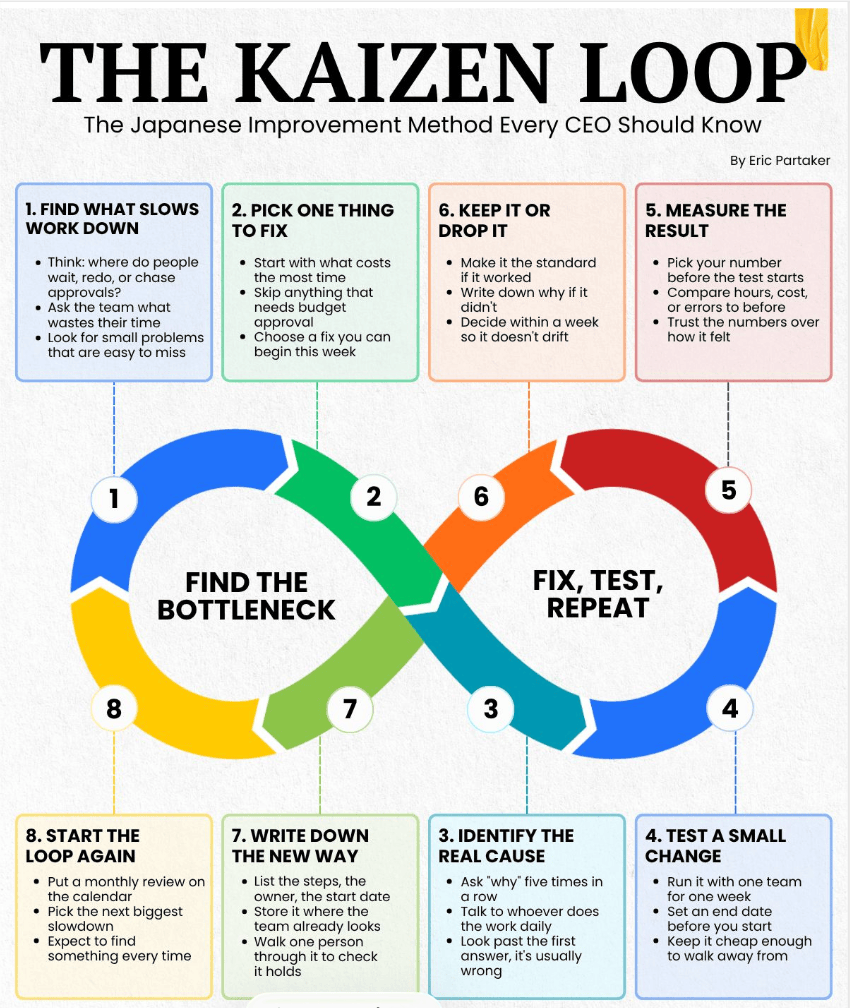
I came across a super post by Eric Partaker, a CEO coach regarding the Kaizen Loop, a Japanese improvement system. School improvement can become crowded with initiatives. The Kaizen approach encourages a more manageable habit: identify a problem, test a small change, examine the impact and use what you learn to improve again.
For school and Trust leaders:
- Choose one recurring difficulty. Be specific: pupils taking too long to start a task, rather than “poor engagement”.
- Understand what sits behind it. Listen to staff and pupils, observe practice and test your assumptions. Watch out for lethal mutations and cognitive bias (see Lethal Mutations — Chisnell Chatter 26, March 2025 and Slow leadership — the art of thinking slow when making important decisions, May 2021).
- Try one manageable change. Agree who will act, what support they need and what improvement should look like.
- Review the evidence. Did pupils benefit? What happened to staff workload? What needs adjusting?
- Keep, adapt or stop. Embed what works, share the learning and repeat the process.
Start with a short team conversation: “What is one difficulty we could understand better and improve this week?”
The value lies in making thoughtful improvement a routine and checking that small changes make a meaningful difference.

If you would like me to work with you then do get in touch. We can have a coffee and a chat. The graphic below shares some of the ways that school and trust leaders have used me in the past year. As always, happy to engage in bespoke work that suits your needs.
My work is gained by word of mouth so my final humble plea is that if you have valued my work then please share this with colleagues.
In light of recent changes to the inspection framework, safeguarding and inclusion; I now offer Pupil Premium, Attendance and Safeguarding school audits and workshops. If this is of interest to you, you know what to do.