September 2026

Welcome back! I hope that the autumn term 2026 is unfolding well for you. Here is the 41st edition of Chisnell Chatter, packed with a smattering of all things education leadership. In this edition I address seven key changes to the Ofsted Framework from September 2026, EEF guidance on inclusive teaching, wholesome leadership and top tips on forming an inclusion strategy.
If you are new to Chisnell Chatter, hi! There is a back catalogue of 40 editions packed with leadership tips, legislative updates and research practice. Grab a strong coffee (other beverages of choice available), pop your out of office notification on your email and brace yourself.
Inclusion Strategy OCMAT’s strategic approach
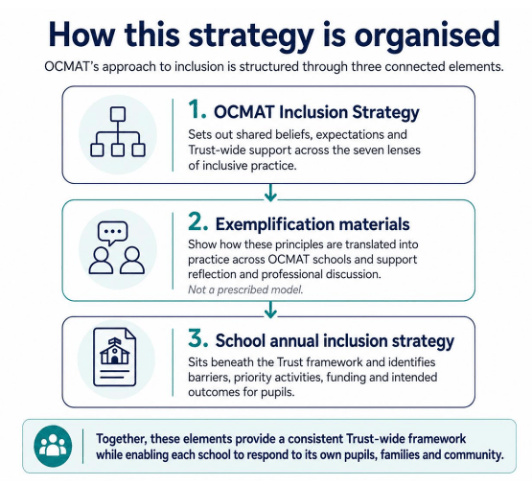
I have been working with schools in developing their inclusion strategy. Inclusion is a centerpoint to the current Ofsted inspection framework and high on the DfE’s agenda. Having a coherent strategic approach to inclusion is therefore key for success but more importantly, essential for your students.
If you are thinking creating or refining your inclusion strategy then Our Community Multi Academy Trust have shared a really helpful model. It follows a simple three step process:
- inclusion is reflected in school improvement priorities
- leaders understand the needs and barriers within their cohort
- governors receive meaningful information about inclusion and outcomes
- responsibilities are shared across leaders, teachers, SENCos and subject leaders
- staffing and funding decisions are linked to identified need
- leaders monitor whether provision is having impact
Wholesome Leadership – advice from Tom Reece

I have had the pleasure and privilege to meet with a group of inspirational school leaders at the final stage of their NPQ programme in the beautiful setting of the Guildhouse School in Bloomsbury.
During the session we thought about theories of school leadership.
School improvement plans rarely suffer from a shortage of coloured boxes. The challenge is what happens after we’ve filled them in. Tom Rees’s Five Fives, from Wholesome Leadership, offers a simple way to turn good intentions into action:
⏱️ Five minutes: What first step can you take now?
📅 Five days: What will you do this week to get started?
🔄 Five weeks: What will you review, discuss or adjust?
🌱 Five months: What will help the change stick?
🔭 Five years: What lasting difference are you working towards?
For school leaders, try it with ONE priority: improving attendance, strengthening inclusion or making feedback more useful. Work through the five timescales with your team. Add an owner, the support needed and how you’ll know pupils are benefiting. Put the reviews in the diary.
The five-year ambition gives direction. The five-minute action gets things moving. The five-month check helps prevent your excellent idea becoming a folder called “September launch FINAL v7”.
What’s your first five-minute move?
DFE publishes the Lead Child Protection Practitioner Standards
The DfE has published the Lead Child Protection Practitioner (LCPP) Standards, providing the first clear framework for the specialist knowledge, skills and leadership expected of practitioners leading child protection activity where there are concerns about actual or likely significant harm.
For school leaders, these standards explain what to expect from the specialist social workers leading child protection—and how schools can contribute effectively. They are standards for LCPPs, rather than a replacement for the school’s DSL role. Published in June 2026, they are currently non-statutory, with multi-agency child protection teams expected in every area by March 2027.
The framework covers four areas: recognising significant harm, engaging children and families during Section 47 enquiries, analysing the likelihood of harm, and coordinating protective action. It emphasises testing assumptions, understanding the child’s daily experience and checking whether intervention actually improves safety.
Practical implications for headteachers and DSLs include:
- Bring patterns, not just incidents. Explain what changes in attendance, behaviour, presentation and relationships might collectively indicate.
- Make the child’s experience visible. Record their words and communication needs; avoid interpreting possible signs of harm simply as SEND or challenging behaviour.
- Challenge and follow through. Ask who is responsible, when action will happen and what evidence will demonstrate increased safety. Escalate unresolved concerns through local arrangements.
- Prepare for local changes. Clarify how your school will work with the MACPT and use safeguarding supervision to examine assumptions and uncertainty.
So, what do school leaders need to do now to prepare for the introduction of the standards?
Start with a short DSL briefing and a check of your local arrangements. There’s no need to create a school LCPP post: this is a specialist social work role. The standards themselves are currently non-statutory. DfE guidance
My suggested actions for school leaders are:
- Contact your local safeguarding partnership. Ask when the multi-agency child protection team will be operational, how education will be represented, and whether referral, communication or escalation routes are changing.
- Review a small sample of safeguarding cases with your DSL. Do records show patterns over time, the child’s experience, what action followed and whether their safety improved?
- Check follow-through on current protection plans. Make sure the school knows its responsibilities, deadlines and escalation route when actions stall or concerns persist.
- Use a staff briefing to reinforce professional curiosity. Explore how changes in attendance, behaviour or presentation might indicate harm. Include the risk of attributing concerns to SEND without considering safeguarding.
- Protect time for DSL supervision and professional challenge. Give safeguarding staff space to test assumptions, discuss uncertainty and challenge decisions across agencies.
- Brief governors or trustees. Explain the local changes and seek assurance about capacity, training and partnership working. Update procedures when confirmed arrangements require it.
Attendance & Safeguarding
The September attendance amendments sharpen the link between absence, vulnerability and safeguarding. The July 2026 update to Working Together to Improve School Attendance makes the practical expectations clearer. So, what does that mean for out attendance and safeguarding leads? Ultimately, we need to encourage a harmonised approach across these two disciplines in our school.
Nine checks for your leadership team:
✅ Synchronise registers. Take them at the same time for all pupils.
✅ Identify young carers. Record their circumstances and include them in attendance monitoring.
✅ Review adjustments. Consider what pupils with SEND, disabilities or health needs require.
✅ Keep remote education a last resort. Link it to a clear reintegration plan.
✅ Challenge part-time timetables. Keep them exceptional, temporary and regularly reviewed.
✅ Look beneath the headline figure. Analyse vulnerable groups, persistent absence and severe absence.
✅ Share unexplained absence promptly. Inform social workers or youth offending team workers where relevant.
✅ Give governors the full picture. Report risks, actions and impact.
✅ Train every member of staff. Make the safeguarding significance of absence explicit in induction and ongoing training.
Many changes strengthen existing expectations but ensure these are translated to your policies, daily practice, training and oversight.
A rising attendance percentage can hide a child becoming less safe.
Ask what sits behind the absence: unmet health needs, caring responsibilities, neglect, exploitation; or another barrier requiring action.
A key question is: Can your team explain whose absence concerns them most and what they are doing about it?
EEF Report into Inclusive Teaching – fresh perspectives for the new year.
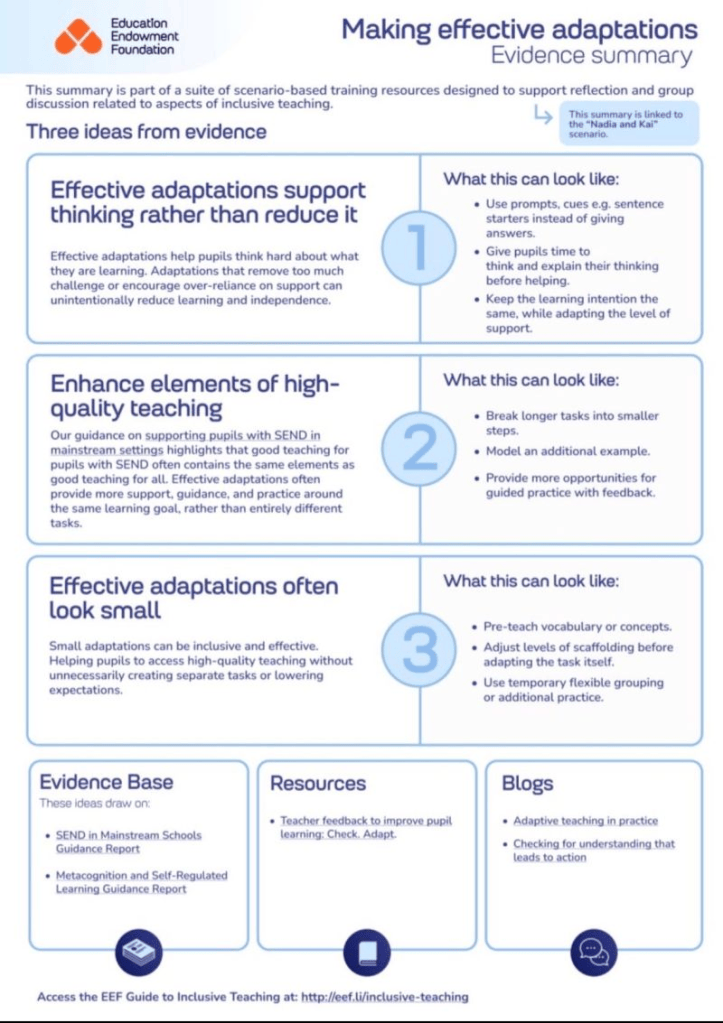
The EEF guide into inclusive teaching provides school leaders with helpful guidance in helpful adaptations that best support their children. Adaptive practice supports all pupils, but should form part of key documents in your school including your Pupil Premium Report, Inclusive Strategy and SEND Information Report. The Guide to Inclusive Teaching, published on 6 July 2026, brings together existing evidence to support mainstream primary and secondary schools. It addresses SEND, disadvantage and the overlapping barriers pupils can face.
The EEF’s central message for school leaders is clear: strengthen everyday teaching, provide carefully chosen additional support, and check whether pupils are learning more.
Five messages matter most:
- Make strong classroom practice the foundation. Clear explanations, effective feedback, scaffolding, positive relationships and predictable environments benefit everyone and can be particularly important for pupils with additional needs. Consistency matters. Universal approaches
- Plan adaptations alongside whole-class teaching. The guide’s two-part model combines universal provision with individual adaptations and additional support. These work together; pupils should not have to wait for universal teaching to be “perfect” before receiving support. The two-part model
- Check that support helps rather than hinders. More adaptations do not automatically produce more learning. Oversimplified tasks can reduce thinking, and support should preserve challenge while enabling access. Interventions should connect closely to classroom learning. Adaptations and additional support
- Understand the pupil beyond the diagnosis. Pupils with the same diagnosis may need different approaches. Decisions should draw on ongoing assessment of their strengths, difficulties and response to teaching. Myth-busting
- Give implementation time and attention. Choose a small number of priorities, provide sustained professional development and opportunities for staff discussion, and review impact. Existing monitoring can support this; a new tracking system is not automatically necessary. Implementation guidance
A practical next step for school leaders: review one priority with your SENCo and teaching leaders. Identify the barrier, agree the classroom approach and any additional support, then decide what evidence would show improved learning and independence.
The leadership question is: “How do we know this support is helping this pupil succeed?”
7 Changes in the Ofsted Inspection Framework from September 2026
Building Equity in Education have produced a helpful synopsis of the key amendments to the Ofsted Inspection Framework from September 2026. Read the full article here.
Here are the seven most significant changes to the guides for inspectors:
Ofsted’s updated inspection guidance: seven changes school leaders need to know
The September 2026 guidance sharpens the focus on accountability, inclusion and what happens in practice. Here’s what’s changed—and where to focus.
1. Governance: show how accountability works
Inspectors will look more closely at how responsibilities are shared and exercised, particularly across trusts. Expect greater engagement with governance professionals, trustees, chairs and CEOs.
Your priority: Make sure everyone can explain their role, how they challenge and support leaders, and how they check that policies make a difference.
2. Safeguarding: show the follow-through
Expect closer scrutiny of safeguarding audits, review processes and discussions with the DSL and other relevant leaders. Inspectors will want evidence that weaknesses are identified and addressed.
Your priority: Keep a clear trail from audit findings to action and improvement. Your DSL should be able to explain how leaders check that safeguarding works.
3. Alternative provision: justify every placement
AP will feature explicitly in inclusion discussions. Inspectors will explore pupils’ best interests, safeguarding, due diligence, registration, attendance, progress and next steps—including reviews at least half-termly.
Your priority: Be ready to explain why each placement is right for the pupil, how you know it is working, and the plan for reintegration or transition.
4. Off-rolling: decisions must serve the pupil
The guidance clarifies that off-rolling can include inappropriate part-time timetables, sending pupils home and pressuring families to leave. Where inspectors determine that off-rolling has occurred, leadership and governance is likely to be graded Urgent Improvement.
Your priority: Review pupil movements, managed moves and part-time timetables. Decisions must be properly documented, follow statutory guidance and serve pupils’ best interests.
5. Attendance: recording integrity matters
Inspectors will challenge inaccurate coding, registration changes that artificially improve figures and inappropriate part-time timetables. Suspected manipulation is likely to lead to an Urgent Improvement grade for leadership and governance.
Your priority: Audit coding and registration practices. Make sure attendance leaders can explain how figures are recorded as well as what they show.
6. Equality: policies must translate into practice
Inspectors have clearer guidance on concerns involving statutory relationships, sex and health education, teaching about protected characteristics and potentially unlawful separation of pupils.
Your priority: Check that curriculum and everyday practice reflect equality duties. Be ready to show how leaders identify and tackle discrimination, harassment and victimisation.
7. Learning walks: prepare for professional dialogue
Learning walks will gather evidence across several evaluation areas. Schools can nominate an appropriate leader to join inspectors, who should share emerging findings for discussion. Reading remains a specific focus in both primary and secondary schools.
Your priority: Prepare leaders to discuss typical practice, explain how reading gaps are identified and addressed, and show how pupils gain the reading skills needed to access the curriculum.

If you would like me to work with you then do get in touch. We can have a coffee and a chat. The graphic below shares some of the ways that school and trust leaders have used me in the past year. As always, happy to engage in bespoke work that suits your needs.
My work is gained by word of mouth so my final humble plea is that if you have valued my work then please share this with colleagues.
In light of recent changes to the inspection framework, safeguarding and inclusion; I now offer Pupil Premium, attendance and safeguarding school audits and workshops. If this is of interest to you, you know what to do.