April 2026

Welcome to my next edu-blog post. In this post I explore attendance, the Inclusive Teaching Framework and advice on adaptive practice from the EEF. I hope you find this useful to your role. As always, please share with colleagues who may find this helpful.
This read will take you around 5 minutes; grab a coffee and a chocolate digestive (other choccy biccies are available).
Attendance – A fierce focus for inspection
Are you grappling with attendance in your school?
With the new Ofsted framework rolling into our schools; I have found that with the behaviour and attendance judgements being amalgamated, it is often seen that while behaviour is strong in a school, poor attendance limits the judgement evaluation to at best ‘needs attention’.
If your school is not at or above national expectations in attendance, what can you do?
The truth is, you are most probably doing a great deal already. The common error is addressing the outcome rather than swimming upstream to see where the root of the issues lie. Whether this is your curriculum design, engagement with parents, distributive leadership, approach to adaptive practice, pupil voice or whatever; there could be a core element of practice or pedagogy that could make a difference to your attendance.
Here is a recording of a my webinar on attendance. I hope this helps.
Let me know if you are interested in me visiting your school for an attendance review day. Powerful coaching for leaders and an analysis that will amplify your strategic vision for attendance.
Inclusive Teaching Framework
The Ambition Institute has published the Inclusive Teaching Framework (2026).
1. Inclusion is Everyone’s Responsibility
The framework positions inclusion as a whole-school priority, not a specialist function.
- Every teacher is a teacher of SEND and vulnerable learners
- Leadership, curriculum, teaching and culture must align around inclusion
- Inclusion is judged through what pupils actually experience, not just provision on paper
👉 For leaders: Inclusion must be visible in classrooms, not just policies.
2. High-Quality Teaching is the First Lever
The framework reinforces that adaptive, high-quality teaching is the most impactful support for all learners.
- Teaching should be responsive, not diluted
- Same ambitious curriculum, different routes to access
- Over-reliance on intervention is discouraged
👉 For leaders: Prioritise great teaching over bolt-on interventions.
3. The “Five Pillars” of Inclusive Practice
Most versions of the framework centre around consistent classroom principles:
a. Clear Explanations
- Break learning into manageable steps
- Reduce cognitive overload
- Use modelling and worked examples
b. Scaffolded Support
- Temporary supports (sentence stems, visuals, prompts)
- Enable independence—not dependency
c. Flexible Grouping
- Avoid fixed ability grouping
- Use dynamic, responsive grouping strategies
d. Explicit Vocabulary Teaching
- Pre-teach key vocabulary
- Support language development for access
e. Checking Understanding
- Frequent formative assessment
- Adapt teaching in real time
👉 For leaders: These should form the non-negotiables of classroom practice.
4. Removing Barriers, Not Lowering Expectations
The framework is explicit:
- Maintain high expectations for all pupils
- Focus on removing barriers to learning, not simplifying content unnecessarily
Examples of barriers:
- Weak working memory support
- Poorly structured tasks
- Limited vocabulary access
- Lack of prior knowledge
👉 For leaders: Shift the narrative from “can’t do” to “what’s getting in the way?”
5. Precision Over Generalisation
Support must be diagnostic and specific:
- Understand why a pupil is struggling
- Match strategies carefully (e.g. scaffolds, pre-teaching, modelling)
Avoid:
- Generic differentiation
- Over-scaffolding without purpose
👉 For leaders: Build staff expertise in identifying need, not just applying strategies.
6. The Role of Teaching Assistants
The framework reframes the role of TAs:
- Supplement, not replace, teacher instruction
- Support independence—not create reliance
- Be deployed strategically (e.g. pre-teaching, guided practice)
👉 For leaders: TA deployment should be intentional and evidence-informed.
7. Inclusive Curriculum Design
Inclusion starts at the planning stage, not as an afterthought:
- Curriculum sequencing must support all learners
- Knowledge is broken into logical steps
- Prior knowledge is deliberately revisited
👉 For leaders: Inclusion = curriculum design + teaching, not intervention alone.
8. Oracy and Language as Gateways
Language is central to inclusion:
- Pupils need structured opportunities to speak and think
- Sentence stems, talk routines and vocabulary supports are essential
👉 For leaders: Develop a whole-school oracy strategy.
9. Belonging and Relational Practice
Inclusion is also about culture and relationships:
- Pupils must feel seen, safe and valued
- Strong relationships reduce barriers to learning
👉 For leaders: Inclusion is as much about how pupils feel as what they learn.
10. Leadership Implications
To implement effectively, leaders should:
- Define clear, observable classroom expectations
- Align CPD to inclusive teaching strategies
- Use monitoring to focus on pupil experience
- Integrate inclusion into performance management and coaching
- Use data (e.g. Insight) to sharpen focus on groups
Adaptive teaching – advice from EEF
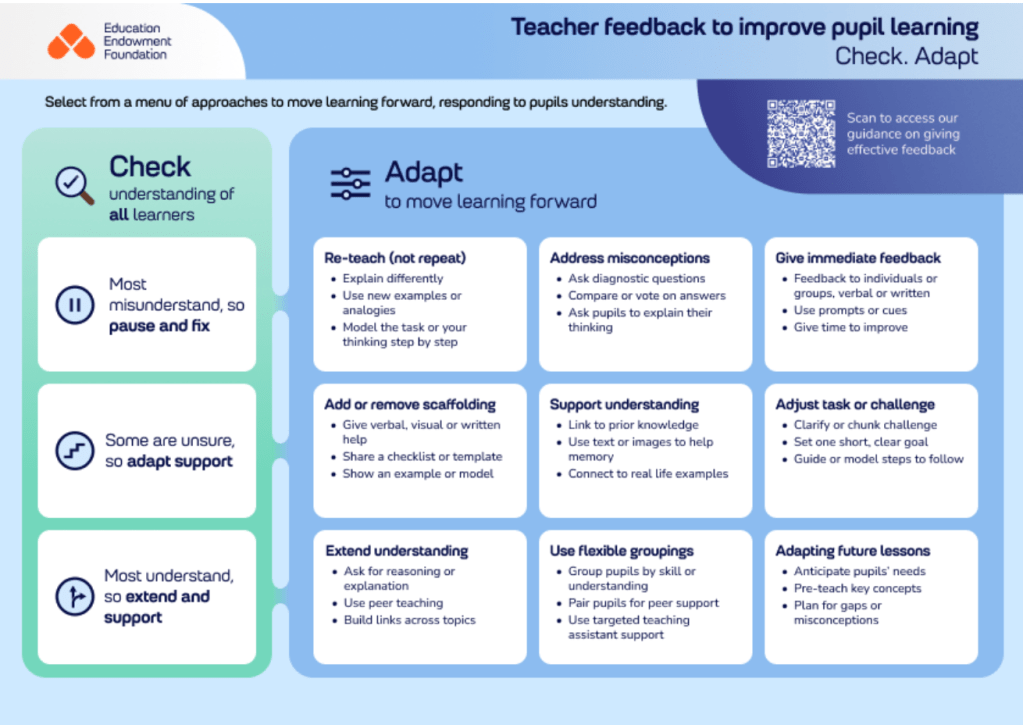
The Education Endowment Foundation have produced a really helpful document exploring the importance of checking for understanding relating to adaptive teaching.
Checking for Understanding… but then what?
👉 Checking for understanding only matters if it leads to action.
Too often in classrooms, we see:
✔️ Questions asked
✔️ Hands up
✔️ Answers given
…but teaching doesn’t shift.
So what does effective practice look like?
The article highlights three key shifts:
1. Check all pupils, not just the confident few: Use strategies such as cold calling, mini whiteboards, hinge questions—these give a truer picture of learning.
2. Diagnose, don’t just detect: It’s not enough to know that pupils don’t understand. We need to understand why. Look out for: misconception, vocabulary gaps, cognitive overload.
3. Act in the moment: This is where adaptive teaching lives. We need to re-explain differently, model again, provide (and strategically remove) scaffolds, adjust the task. Finally, we need to remember that feedback loops must be tight and immediate.
The leadership takeaway
This isn’t about adding more strategies. It’s about sharpening one of the most powerful levers we already have: responsive teaching.
In the strongest classrooms:
- Assessment is continuous
- Teaching is flexible
- Pupils aren’t left behind quietly
When you visit lessons, ask:
👉 “What did the teacher learn about pupils’ understanding?”
👉 “What did they do next because of it?”
That second question is where the magic happens.

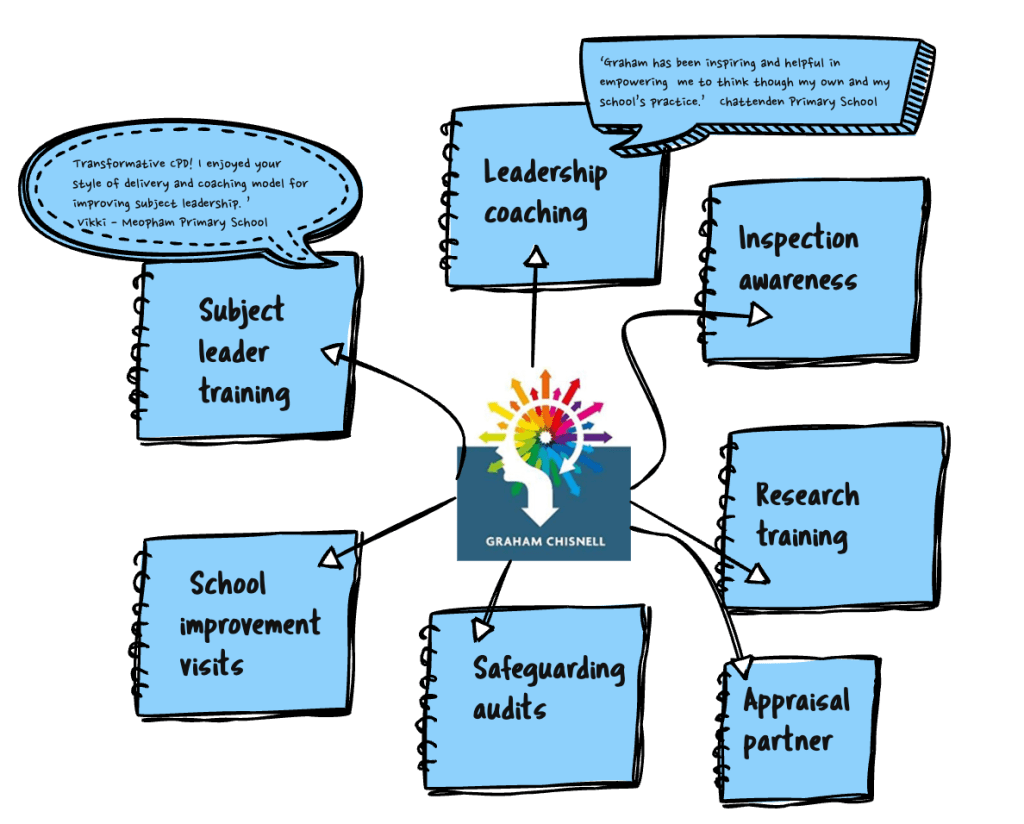
If you would like me to work with you then do get in touch. We can have a coffee and a chat. The graphic below shares some of the ways that school and trust leaders have used me in the past year. As always, happy to engage in bespoke work that suits your needs.
Here is a flavour of the support I give:
- Safeguarding reviews
- Pupil Premium reviews (very pertinent with the focus on disadvantaged in the new framework)
- Attendance reviews (this involves coaching for action planning and new practice)
- Independent investigations for capability and complaints
- Initial Ofsted call coaching
- Website reviews
- Trust reviews (aligned to the Ofsted Trust Summary Evaluation Framework)
- New framework training for subject leaders / senior leaders (many options available including live coaching of learning walks).
- Twilight staff training for research practice
- Twilight staff training for inclusion and adaptive practice for subject leaders
My work is gained by word of mouth so my final humble plea is that if you have valued my work then please share this with colleagues.