December 2025

Hello and welcome to my latest Chisnell Chatter.
As the dust settles from the Chancellor’s budget and Christmas trees appear in our hallways, I bring you festive greetings.
In this edition I explore the importance of achievement though Ofsted’s new Inspection framework and provide practical steps in how to embed a lens of achievement when reviewing pupils’ work. I reflect on great edu-reads such as Essential Motivation in the Classroom by Ian Gilbert. The blog also reflects on the key messaging for school leaders from the DfE’s National Behaviour Survey. Enjoy (Ho Ho Ho!).
Achievement – evaluating work

As an Ofsted inspector (I know!) I am always keen to use the inspection framework as a guide to my practice in school. This helps to focus school leaders on the language and methodology in the framework while remaining centred on student outcomes.
I have devised a monitoring pro forma that focuses on the achievement section of the 2025 Ofsted framework. So, let’s start with a clarification of what Ofsted mean when they speak about achievement.
In its broadest sense, achievement takes into account the student’s starting point, their progress from this to key attainment points. So, achievement is a balance of both attainment and progress.
The form below guides leaders in selecting a few key pupils who may not be achieving as well as they could or should in a given subject or across subjects. The document has helpful prompts for leaders and asks them to RAG (Red-not met Amber-partially met and Green-fully met) each area in order to define where strengths and areas for development may be seated.
When undertaking a work scrutiny, select a few students and this form can guide a pupil conference with them or their teachers alongside their workbooks. This can be used alongside governors as a format for monitoring, ensuring that governors remain knowledgeable about the rigour of your evaluative thinking as a leader.
Have a go at using the form and I would love to hear back from you about how helpful this is as a tool.
DfE publishes the National Behaviour Survey

The National Behaviour Survey (NBS) 2024–25 was published in November 2025. The NBS finds that while schools are seeing improved leader and teacher perceptions of behaviour, and pupils feel safer and more included, significant work remains in ensuring fairness in rule-application, sustaining pupil motivation and translating behaviour culture into consistently positive pupil experiences. Here is a helpful summary of the key points:
Purpose and Approach
The survey covers four main areas: behaviour culture & policy; behaviour management; school environment & experience; frequency & impact of misbehaviour. Key Findings
1. Behaviour culture & policy
- Only 18% of year 7–13 pupils thought school rules were applied fairly to all pupils all of the time.
- 84% of parents agreed they support their school’s behaviour rules (consistent with prior year) — primary parents’ support (89%) higher than secondary (79%).
- On mobile phones: 53% of school leaders said pupils can bring phones but must leave them in secure place (May 2025). Compliance: 96% of secondary leaders vs 63% of pupils said rules are followed at least some of the time.
2. Behaviour management
- 95% of teachers said they felt confident managing misbehaviour (32% ‘very confident’, 63% ‘fairly confident’). School leaders higher (99%).
- Access to training/support has increased: 54% of teachers in Feb 2025 said they could access behaviour-management training (up from 40% in May 2023).
- In March 2025, 86% of parents said the school communicates about their child’s behaviour (34% regularly, 52% when issues). Teachers: 84% felt confident communicating with parents about behaviour.
3. School environment & student experience
- In May 2025, 88% of school leaders, 63% of teachers, and 57% of year 7–13 pupils said their school was calm and orderly ‘every day’ or ‘most days’.
- Pupils feeling safe ‘every day’ or ‘most days’ rose to 80% (May 2025), up from 73% the previous year.
- Pupils feeling they belonged ‘every day’ or ‘most days’ rose to 69% (May 2025), up from 57% in May 2024.
- However, motivation to learn among year 7–13 pupils dropped to 70% in May 2025 (from 75% in April 2024).
4. Frequency & impact of misbehaviour
- School leaders reporting behaviour as ‘very good’ or ‘good’: 88% (May 2025), up from 72% in May 2024. Teachers: 65% (May 2025), up from 46% in May 2024.
- Teachers reported 7 minutes lost per 30 minutes of lesson time due to misbehaviour (May 2025), consistent with May 2024.
- The proportion of year 7–13 pupils reporting that misbehaviour interrupted at least some lessons: 62% (May 2025), down from 73% in May 2024.
- 21% of year 7–13 pupils said they had been victims of bullying in the past 12 months (May 2025), down from 24% in April 2024.
Implications for Leadership
- Although confidence in behaviour management is high, consistent and fair application of policy (especially from pupils’ view) remains weak.
- Increased calm/orderly environment and belonging are positives, but the stagnation in learning time lost and drop in pupil motivation suggest further focus needed on engagement and culture.
- Mobile phone policy compliance and parental awareness/support of policy are improving, but there remains a significant gap between adults’ and pupils’ views. This remains an educational hot potato, with the ban in Australia on social media for children and schools in the UK banning mobile phones, this is an issue worthy of careful consideration in your strategic planning and discussions, particularly where byullying and safeguarding concerns relate to the use of mobile devices.
- The drop in pupil motivation is a key warning sign: schools may need to focus more on student engagement, sense of belonging, and meaningful behaviour culture rather than only sanctions/structure.
- The full document is available here.
Fluency – getting reading right
Chancellor Rachel Reeves announced a £5,000,000 spend on books in schools (whoop whoop), Ofsted emphasise the importance of foundational knowledge in reading at the core of their new framework. So, from every lens, there is an urgency in ensuring that our schools have a focus on our students’ reading fluency.
Matthew Dix from the Fluency Factory has written a really helpful blog on the importance of reading fluency.
He emphasises the elements of fluency (it is not just about reading speed) Fluency = accuracy + automaticity + appropriate pace + prosody (Rasinski, 2010).
Real fluency teaching is simple: prepare the text, model it, rehearse it, and repeat it. Dix suggests that small tweaks in daily routines lead to smoother reading, better comprehension, and more confident learners (Rasinski, 2010; Shanahan, 2012; National Reading Panel, 2000).
It develops through:
- Prepared vocabulary
- Background knowledge
- Teacher modelling
- Echo reading
- Choral reading
- Repeated reading
Even small tweaks (shorter, scaffolded texts, modelling, repeated oral practice) produce measurable improvement in fluency and confidence.
So, what are the common pitfalls in developing fluency? In his article, Dix suggests the following points that emphasise what fluency isn’t:
- Giving pupils a long, unseen extract and saying ‘read this’
- Round robin, popcorn or turn taking
- Reading as fast as possible
- Silent reading
- Something that you finish
So, in your setting; how do you ensure that your staff really understand fluency and how to teach this to their students?
Ofsted – achievement
In the next few Chisnell Chatters, I will focus on the new evaluation areas in the Ofsted Framework. Last edition focussed on curriculum and teaching so let’s move onto achievement. The first point to make is that progress is back. In your school IDSR you will notice that progress measures have returned. This evaluation area assesses:
- whether the school provides a high-quality education for all pupils (the impact), that gives them the necessary knowledge, skills and qualifications to succeed in life, and equips them for the next stage of their education, training or employment
- pupils’ attainment and progress over time in national tests and examinations
- the progress that pupils make across the curriculum from their starting points, so that they know more, remember more and are able to do more
Implications for School Leadership & Strategic Priorities
1. Embed equity-centred curriculum design
- Audit and document the curriculum to ensure all pupils (particularly those who are disadvantaged, SEND and pupils who have been supported by a social worker.) have access to a broad, ambitious offer.
- Monitor that foundational skills (reading, communication, numeracy, oracy) are explicitly built in — not assumed — so all pupils can access the full curriculum.
- Ensure differentiation and scaffolding are effective, and that standards are high for all pupils.
2. Track progress holistically, not just via exam outcomes
- Use internal data and progress tracking from individual starting points, especially where cohort size or complexity makes external data unreliable.
- Ensure pupil work (books, projects, tasks) evidences “knowing more, remembering more, doing more” — across subjects, not just core ones
- Develop internal quality assurance (work scrutiny, moderated assessment, curriculum sampling) to evidence progress and depth (take a peek at the work scrutiny monitoring form above in this blog).
3. Prioritise inclusion and support for vulnerable groups
- Demonstrate equitable access and outcomes for disadvantaged pupils, pupils with SEND, those know to social care, EAL learners, etc. — building systems of support, scaffolding, tracking, and review.
- Ensure interventions and additional support are high-quality and consistently implemented; inclusion is not siloed but embedded across the school.
4. Build a culture of high expectations, ambition and continuous improvement
- Set clear, shared standards and expectations for teaching, curriculum delivery, challenge and outcomes — across all staff.
- Encourage professional reflection, peer review and collaborative planning to sustain high-quality teaching and curriculum implementation.
- Use the new framework’s expectations to support whole-school improvement planning, self-evaluation cycles and strategic ambition (this includes a highly refined and purposeful Pupil Premium strategy).
5. Prepare robust evidence base for inspection and stakeholder accountability
- Maintain a broad “portfolio” of evidence: curriculum maps, internal assessment data, progress tracking, work scrutiny, attendance, inclusion metrics, interventions, pastoral support — show a holistic picture, not simply exam results. This is for your internal systems of accountability but remember there is a multiple audience; governors, senior leaders, subject leaders, outside agencies and then… Ofsted. Don’t prepare this for Ofsted!
- Engage governors/trustees in understanding the new framework and securing leadership oversight of Achievement, Inclusion, Curriculum, Teaching — integrated, not separate.
- Foster transparency and communication with parents/carers: articulate how the school supports all learners, especially those with additional needs or starting points below national norms.
✅ Conclusion
The 2025 Ofsted framework reframes “Achievement” from a narrow outcome-driven measure to a broad, inclusive judgement of educational quality, equity and progress for all pupils. For school leaders, this means redoubling focus on curriculum structure, teaching quality, inclusion and evidencing impact, rather than relying on headline exam metrics alone.
The shift presents both a challenge and an opportunity: by embedding equity, rigorous curriculum and robust self-evaluation, schools can demonstrate a deep commitment to every pupil’s success — not just in grades, but in real learning, growth and life-long potential.
For more details take a look at the Ofsted Toolkit here. If you would like further support with this with training or coaching, then do get in touch.
Essential Motivation in the Classroom – Ian Gilbert

Ian Gilbert’s book, Essential Motivation, provides a really interesting perspective on the importance of motivation in schools. Ian suggests that motivation isn’t something we do to pupils; it’s something we design for them. He argues that students are more likely to work hard when learning feels meaningful, agency-rich, achievable, and a bit irresistible (oh I love that word!). Our job is to engineer the conditions—curriculum, pedagogy, climate, and adult behaviours—that make effort feel worthwhile.
Big ideas
- Meaning before method: Start with “why this, why now?” Pupils (and staff) invest when purpose is explicit and authentic.
- Autonomy with guardrails: Choice (task, process, grouping, product) boosts ownership when framed by crystal-clear success criteria.
- Competence loops: Frequent, low-stakes success builds self-efficacy; struggle is motivating when the next step is visible and doable.
- Relationships first: Credible, caring adults are the gateway to motivation; tone and trust are curriculum.
- Curiosity & novelty: Well-placed puzzles, controversy, storytelling, and cognitive dissonance trigger attention and recall.
- Metacognition matters: Teach pupils how motivation works (habits, routines, self-talk), not just what to learn.
- Environment signals: Displays, routines, language, timings, and transitions should all say “effort is normal here.”
What this means for SLT
- Vision & narrative: Make “motivation by design” part of the school story—purpose, autonomy, agency, and feedback as cultural pillars.
- Consistency over charisma: Don’t rely on “inspirational” moments. Build common routines (e.g., Do Now, success criteria, exit tickets) that create momentum in every room.
- Data you can feel: Track motivation through behaviour signals (try Ratio from my proviso blog), not just sanctions.
- Adult culture: Staff motivation mirrors pupil motivation—clarity, autonomy, recognition, and growth pathways for teachers.
Practical strategies (whole-school playbook)
Curriculum & lesson design
- Start topics with a hook + why (story, problem, artefact linked to real audiences).
- Build choice architecture: two routes to mastery, alternative products, or role options.
- Use tiered success criteria (“must/should/could”) to scaffold competence.
- Plan frequent wins (retrieval, mini-tasks) and visible next steps.
Feedback & assessment
- Switch some marking to feed-forward: one action that improves the next piece.
- Make progress public and specific (learning walls, progress trackers, micro-badges).
Climate & routines
- Embed entry/exit routines that start fast and end with reflection.
- Coach teachers to use warm-strict language; narrate desired behaviours.
Pupil agency & metacognition
- Teach a simple motivation toolkit: goal → plan → do → review → celebrate.
- Use reflection protocols (e.g., “What made me try today?” “What will I change next time?”).
Finally, Ian suggests caution and shares what to watch out for:
- Choice overload (too many options kills momentum). Keep choices bounded.
- Novelty without learning (whizz-bang activities must serve the objective).
- Inconsistent routines (motivation dips if expectations vary room-to-room).
- Extrinsic trap (over-reliance on points/prizes can crowd out intrinsic purpose).
Leadership reflection questions
- Where in our curriculum is the purpose least obvious to pupils? What will we change first?
- Which routines guarantee early success in every lesson?
- How do our recognition systems reinforce process and persistence, not just performance?
- Where do teachers have permission to adapt tasks for agency without losing clarity?
Chisnell Chatter Live
The last Chisnell Chatter Live school leader briefing took place in November and focussed on attendance top tips. A recording of the session can be found here.
The next Chisnell Chatter Live session will take place in cyberspace on December 4 2026 and will focus on Pitch Perfect Pupil Premium (I do love a bit of alliteration). With the focus on disadvantaged pupils in the Ofsted framework, this is an essential listen to all school leaders.
Here are the joining instructions:
Join Zoom Meeting
https://us06web.zoom.us/j/87985588794?pwd=vVdniiFqLfob0Wbw8srKF879ucFOGr.1
Meeting ID: 879 8558 8794
Passcode: 290990

And finally…

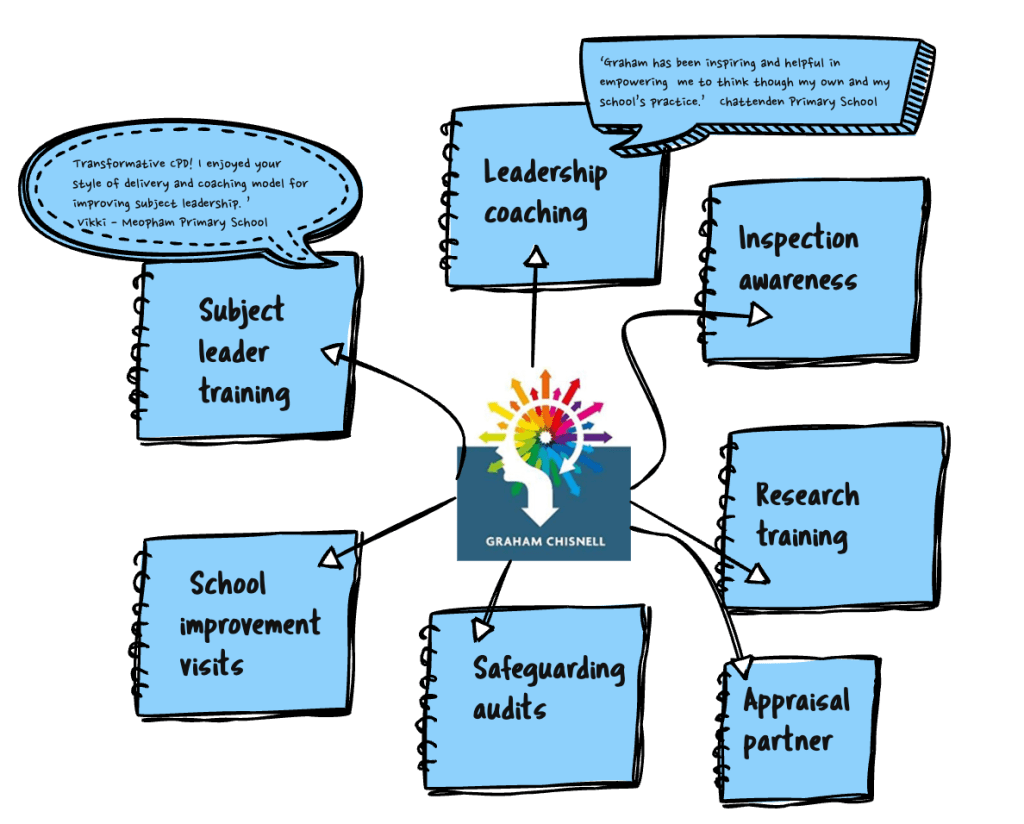
If you would like me to work with you then do get in touch. We can have a coffee and a chat. The graphic below shares some of the ways that school and trust leaders have used me in the past year. As always, happy to engage in bespoke work that suits your needs.
For those who have undertaken my professional training programme for subject leaders and senior leaders in the past, you may be interested in my updated programme that aligns to the new 2025 Ofsted Inspection Framework. This will empower your subject leaders to attune their practice to the inspection framework while strengthening their own professional knowledge and impact on pupil outcomes.
 Irresistible Learning