September 2025

Welcome back!
As the weather turns autumnal and the fresh paint in the corridors dries, I hope this edition of Chisnell Chatter finds you well. I have been refining my training and support programmes during the summer recess.
In this edition I reflect on top tips for classroom practice including the 3-2-1 reflection and whether to stream students. Reflect on the DfE’s AI training modules and wider thoughts on schools using Alternative Provision. Have a read and do share with any colleagues who would benefit from the content. Wishing you all a wonderful term.
3-2-1 reflection

I came across the 3-2-1 reflection when reading an article by Zipporah Murugi Muli. This provides a simple yet powerful reflection strategy. It’s quick, effective and works across subjects and grade levels. This can be used as an exit ticket in the classroom to check in on the depth of learning and understanding within a lesson. The three steps are to ask students to think about:
📍 3 things they learned
📍 2 questions they still have
📍 1 thing they want to remember
This strategy shifts the focus from teaching to learning. It tells the teacher not just what content has stuck but also where curiosity lies and what deserves revisiting. Even more, it empowers learners to take ownership of their thinking.
Zipporah also shares a worksheet to record the student’s thinking and this also can provide a helpful reference tool for students as they look back over their work.

DFE release guidance on Alternative Provision
As a lead inspector, I often come across schools using Alternative Provision for their students. Alternative Provision provides a valuable resource for our schools for students who need specialised support. I have also had the privilege of recently supporting an Alternative Provision provider to register to become an independent school.
As the range of Alternative Providers grow, the DfE have recognised that many are unregistered and the oversight by Local Authorities differs. The DfE has overhauled its guidance for Alternative Provision (AP)—replacing the 2013 version—with a strong emphasis on clarity, accountability, and outcomes. This update reflects changes in legislation and policy, and highlights key improvements in how AP should be structured and delivered.
** What You Need to Know:**
- Clear Legal Duties: Reinforces local authority responsibilities under Section 19 of the Education Act 1996 for children who can’t access mainstream education—due to exclusion, illness, or other reasons.
- Improved Funding Transparency: Clarifies funding streams, such as high needs budgets, top-up funding, and school contributions, and stresses the importance of sustainable, high-quality AP.
- Early Intervention & Reintegration: Encourages collaborative planning among AP providers, schools, and local authorities to support pupils’ return to mainstream education—or transition into post-16 pathways.
- Flexible, Inclusive Delivery: Recognises a broader range of AP settings—including PRUs, FE colleges, vocational training, remote education, and unregistered providers—with an expectation of full-time education wherever possible, or well-justified part-time alternatives.
Why It Matters
This refreshed guidance provides clarity and practical direction for all stakeholders involved in delivering AP. By advocating early intervention, transparent funding, reintegration pathways, and diverse delivery mechanisms, it aims to ensure pupils receive a tailored, safe, and consistent education—regardless of their circumstances. For school leaders, you need to be clear about the close liaison and engagement with the AP, if these elements are not in place then you will be open to some tricky discussions with an inspection team:
- Ensure that you have visited the AP to assess the safety and curriculum and that you are clear about the oversight of safeguarding from the Local Authority and that you have a Risk Assessment in place.
- Have a clearly defined curriculum that you can monitor and review regularly with the AP.
- Remain responsible for attendance to ensure that your student attends and you keep a record of attendance.
- Maintain clear liaison with the AP to ensure any safeguarding issues are raised and acted on.
- Build in regular reviews with the AP and ensure that the parent/carer remains informed.
- Have a clearly defined reintegration plan that is time limited with clear milestones of success to this point.
The complete DfE document on AP is available here.
AI training modules

The DfE has released modules for teachers and school leaders on the use of AI in schools and colleges. These provide helpful guidance as this emerging technology takes purchase.
Originally published on 10 June 2025, the DfE’s leadership presentation—“Using AI in Education”— offers school and college leaders a strategic toolkit for integrating AI safely and effectively into education settings.
The suite of training modules cover:
- The opportunities AI brings, such as reducing teacher workload and enhancing personalisation.
- Safety considerations, including risks like hallucinations, bias, data protection, and child safeguarding.
- Self-audit tools to assess current AI use and identify gaps or areas for development.
- Guidance on strategic planning, including how to embed AI into your institution’s digital strategy.
The presentation for leaders supports internal discussions among senior leaders and governors, helping frame key questions such as:
- How do we ensure AI tools comply with GDPR, IP law, and school safeguarding policies?
- How do we prepare staff to respond to AI-related safeguarding concerns?
- How can AI enhance personalised support—especially for SEND or EAL learners?
- What should we include in our AI risk assessment and CPD plans?
Why It Matters?
- Strategically Positioned: It equips leaders—from SLT to governors—with structured, scalable tools to approach AI integration.
- Safety First: The presentation stresses critical oversight: AI should support teachers, not replace them.
- Practical & Reflective: It includes tools to audit current AI usage, guide planning, and embed AI within wider digital priorities.
Bottom Line for School Leaders
The DfE’s leadership presentation is your entry point into confidently and safely integrating AI in your setting. It frames AI not merely as a technical tool, but as a strategic opportunity—best harnessed through thoughtful planning, human oversight, and staff development.
Here are the links to the training modules for Teachers:
Understanding AI in education – Module 1
Interacting with generative AI – Module 2
Safe use of generative AI – Module 3
Use cases of generative AI – Module 4
For schools and college leaders:
Using AI in education – Leadership support
Teaching One Pagers
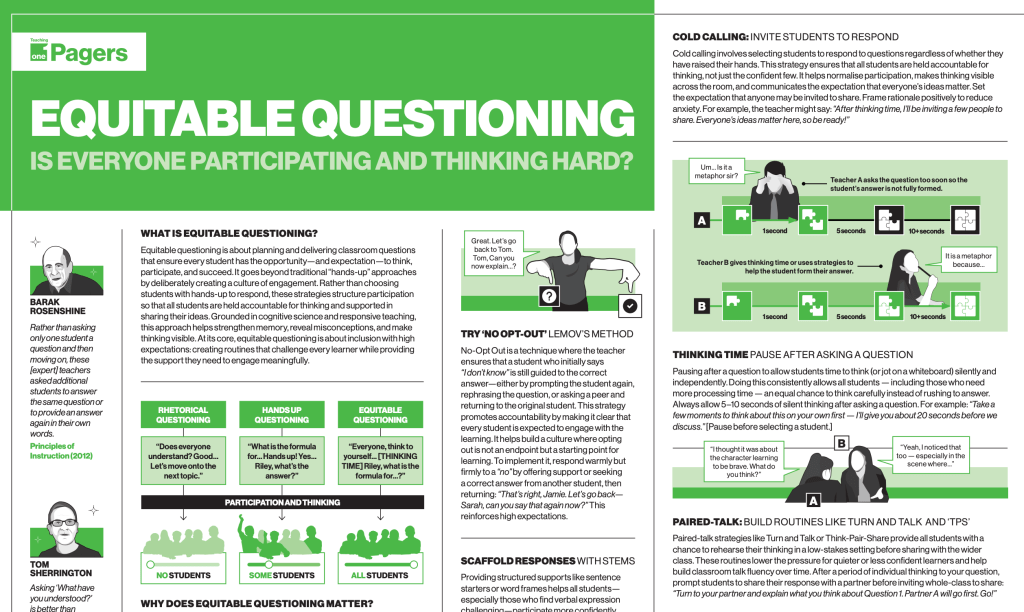
Jamiee Clark has produced a super book called One Pagers. This provides a one page synopsis of key educational theories and ideas. He has produced a range of posters that also accompany this and these are available here. An example of a poster available on his site is here:
To set or not to set? That is the question.

Schools engage in a range of grouping strategies for students. Whether primary or secondary schools, the research in the effectiveness of streaming or setting is always in hot debate. Here is an article by Joe Mason that unpacks the issues around setting, streaming and mixed ability learning. A worthy read to stimulate a fresh lens on your own practice.
The key points he makes in the article are:
There is no definitive answer as to whether to set, stream or operate mixed ability learning. Ultimately, the decision depends on your context, your teachers, your students, your resources. Good setting works. Good mixed-ability works. Bad versions of either widen gaps and leave students behind.
Joe asserts that The implementation—the people, the systems, the culture—matters more than the grouping itself.
If you’re leading a school or department, or your own classroom, the best advice is:
- Know your students (not just their scores).
- Make grouping flexible and humane.
- Invest in your weakest sets (in teaching, resources, and expectations).
- Watch out for bias—gender, ethnicity, relative age.
- And never, ever let a student (or teacher) believe a low set means a low ceiling.
DFE releases outcome of its review on RSHE
New Guidance Becomes Statutory (Sept 2026)
The revised statutory guidance for Relationships Education, Relationships and Sex Education (RSE), and Health Education will come into force from 1 September 2026. Schools must update their curriculum and policies accordingly and consult parents in advance.
Key Principles Remain Central
The updated guidance reaffirms essential principles:
- Preparing young people for a complex modern world—supporting their safety, wellbeing, and ability to form respectful relationships.
- The critical role of parents and carers as primary educators.
- Ensuring content is age-appropriate, inclusive, and sensitive to community values.
- Allowing schools the flexibility to tailor content to their specific pupil needs.
Schools Must Engage Parents and Be Transparent
Schools are reminded to:
- Involve parents in policy development and revisions.
- Clearly publish their RSHE policy, outlining content, delivery timelines, responsible staff (including external providers), and parental withdrawal protocols.
Addressing Emerging Threats and Social Issues
The new guidance strengthens or introduces content on:
- Sexual harassment and violence.
- Developing age-appropriate responses, such as teaching about deepfakes, incel culture, and the impact of online misogyny.
- Topics like financial sexual exploitation, strategies for personal safety in public spaces, and framing positive gender identities and consent.
Mental Health and Wellbeing
Reflecting extensive feedback (with 79% support), updates include:
- Clarification that not all negative feelings indicate mental health issues.
- Enhanced focus on building resilience and coping strategies.
- Requirement for secondary schools to have suicide prevention plans in collaboration with mental health professionals.
Respecting Inclusivity and Legal Clarity
- Schools retain the flexibility to teach sensitive or “contested” topics (e.g., LGBTQ+ and gender identity), without endorsing any particular viewpoints. They must teach the facts and law.
- Sensitivity to parental and community values remains a guide, not a restriction.
Why it matters for leaders?
This revised RSHE framework equips schools to better safeguard pupils against modern threats—particularly online harms and societal pressures. It offers clearer communication with parents and supports the mental health of children. Crucially, it balances statutory requirement with flexibility and inclusion.
And finally…

I would love to hear from you about your thoughts on any of the elements of this blog.
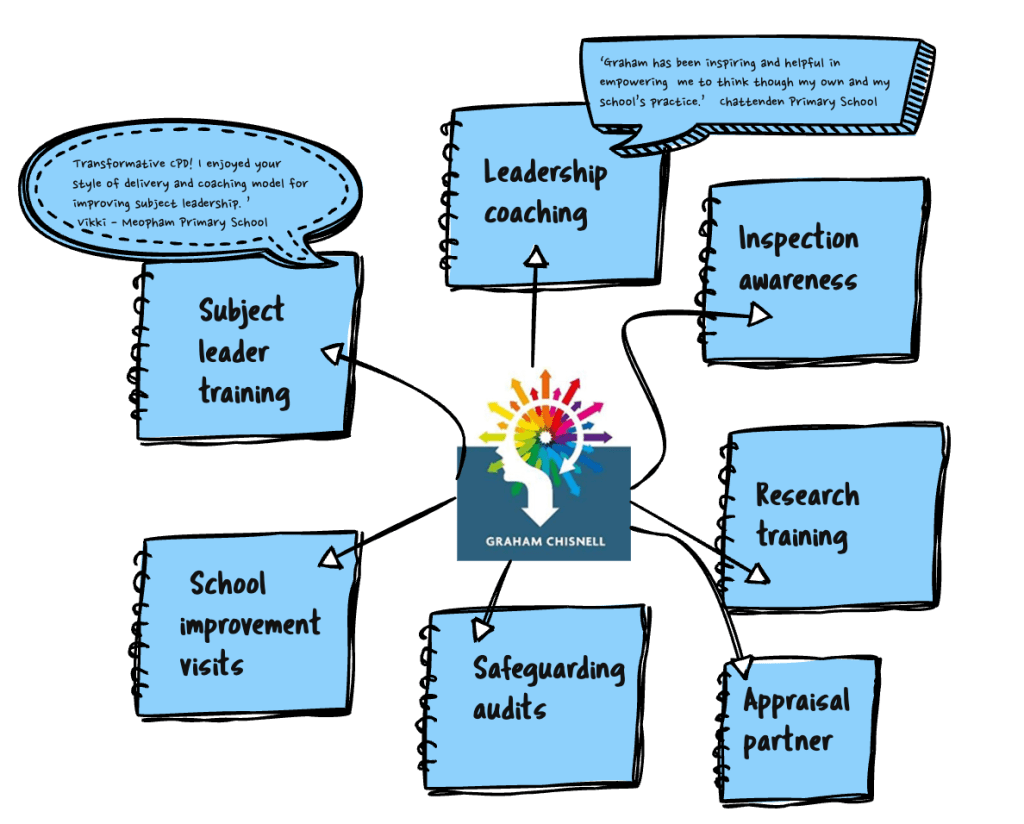
If you would like me to work with you in the coming year then do get in touch. We can have a coffee and a chat. The graphic below shares some of the ways that school and trust leaders have used me in the past year. As always, happy to engage in bespoke work that suits your needs.
For those who have undertaken my professional training programme for subject leaders and senior leaders in the past, you may be interested in my updated programme that aligns to the new Ofsted Inspection Framework. This will empower your subject leaders to attune their practice to the inspection framework while strengthening their own professional knowledge and impact on pupil outcomes.
 Irresistible Learning