July 2025

Well you are nearly there! I hope you are navigating the myriad of school productions, residential trips and end of term shenanigans. As we charge towards the final days in the school year I bring you the 29th edition of Chisnell Chatter. Thank you for being with me on my journey into education consultancy. I continue to be humbled by the amazing work and stories I encounter in your schools.
It has been a while since my last blog and as always, there have been many publications and policy shifts. Take a peek at what has piqued my educational interest below.
Early Years One Stop Shop

The DfE released a document that outlines the online and face-to-face support for the Early Years. The full document can be found here. The offer is fully funded by the DfE. Here is a synopsis:
Aim of this document:To improve early language, literacy, and mathematics outcomes in Reception classes through evidence-informed, sustainable teaching practices. In particular this is helpful for schools grappling with outcomes or serving disadvantaged communities.
Key Features of the Offer:
Expert Support:Schools receive tailored support from experienced early years professionals (usually through Teaching School Hubs or local system leaders).
Focus Areas:
High-quality adult-child interactions
Early language and vocabulary development
Early reading and phonics foundations
Early number and mathematical understanding
Effective use of the Early Years Foundation Stage (EYFS) framework
Sustained Support Model: Typically delivered over 2–3 terms, allowing time for development, reflection, and refinement.
Professional Development: Includes CPD sessions, in-class coaching, and access to evidence-based materials (such as those from the Education Endowment Foundation and DfE-approved phonics schemes).
Leadership Involvement: Senior leaders are engaged throughout to ensure changes are embedded and aligned with wider school priorities.
The intended Outcomes are stronger foundations in language, communication, literacy, and maths and ultimately greater preparedness for Key Stage 1.
Chunking in the classroom

In a helpful article by Evidence Education, Kate Jones shares some top tips in chunking. Chunking involves breaking information into smaller, manageable segments to support learning, particularly in early stages when working memory is limited.
Why use chunking?
- Reduces cognitive overload.
- Aids both retention and transfer of knowledge.
- Supports learners of all ages and subjects.
Classroom applications of chunking:
- Instructions
- Break instructions into clear, sequential steps.
- Display them visibly to aid memory and reduce reliance on verbal recall and cognitive overload.
- Explanations
- Avoid long, uninterrupted teacher talk.
- Segment explanations and interleave with tasks or questions to consolidate learning.
- Chunk. Check. Correct.
- Scaffold self and peer assessment by chunking the focus (e.g., check spelling first, then facts).
- Encourages accurate reflection and reduces overwhelm.
- Note Taking – Cornell Notes Method
- Structured note format divided into sections (e.g., keywords, notes, questions, summary).
- Encourages organised, segmented processing of key learning.
Chunking supports attention, understanding, and memory. By applying it purposefully in explanations, instructions, assessment, and note taking, teachers can optimise cognitive load and deepen learning.
You may want to share these strategies with your subject leaders to consider how a pedagogical approach of chunking can support pupils to manage their cognitive load when learning. For the full article follow this link.
Cognitive science principles when curriculum planning – Teacher Toolkit
In his article on cognitive science and planning, Ross Morrison McGill provides some sage advice. As we look towards curriculum planning refinements for September, this is worth a look. Here are some key points Ross makes in the article:
Apply these three memory-informed steps when building schemes of work:
- Prioritise core knowledge – Define what must be remembered, not just what must be covered. Highlight threshold concepts. Imagine these key knowledge components as the anchor/ bridge threads of a spiderweb; the frame which forms the outer boundary. Without these pillars (of knowledge), there is no solid foundation to build upon.
- Plan for forgetting – Integrate retrieval opportunities across lessons. Build in spaced practice from previous units. Think of this like a misconception in class where students forget information or develop the wrong knowledge. These key parts being reshaped are very similar to the radius spokes on a spiderweb.
- Leave space to adapt – Schemes should offer direction, not scripts. Allow space for reteaching, questioning and challenge.
Anchor everything around: encode, store, retrieve.
- Encode = What must be taught and committed to memory?
- Store = How will the knowledge stick? What resources and methods will you use?
- Retrieve = When and how will students recall this information? Today, next lesson, next week, next month?
Finally, ross provides a helpful checklist of key questions to ask subject leaders when considering their approach to curriculum design:
CPD questions for teachers:
- Does your scheme of work prioritise knowledge over content coverage?
- Are retrieval opportunities clearly mapped across the term or year?
- Is cognitive overload considered in how topics are sequenced?
- Do you know when to revisit and reinforce core concepts?
- How are SEND and EAL needs built into your curriculum structure?
- Is your scheme flexible enough for reteaching?
- What misconceptions are likely to occur, and are they flagged?
- Does each unit identify prior knowledge and future links?
- How often is the scheme reviewed and updated?
- Could another teacher pick it up and teach with clarity?
AI – the biggest risk is doing nothing

The DfE has published an interesting document entitled The biggest risk is doing nothing’: insights from early adopters of artificial intelligence in schools and further education colleges. Here is a summary of the paper.
AI adoption is still early-stage and varied
- Only a minority of schools and FE colleges are implementing AI, despite high curiosity among teachers and students.
- Usage ranges widely—from administrative automation to interactive classroom tools—depending on resources, infrastructure, and readiness .
Leadership, structure & governance matter
- Early adopters often form cross-functional AI leadership teams, including IT, data managers, and curriculum leads .
- Ethical governance is a priority: most adopters set clear policies around data protection, safeguarding, bias, and intellectual property .
Workload reduction is a key driver for AI
- The primary motivation cited by school leaders is using AI to alleviate teacher workload—especially for lesson planning, resources, marking, and administrative tasks .
AI champions build confidence
- Nearly all settings had a designated “AI champion” (usually a tech-savvy teacher) who promotes AI tools, supports colleagues, and helps build trust .
Unclear pedagogical integration & impact
- Most leaders are still exploring how AI aligns with pedagogy, without systematic strategies or clear success metrics in place .
- There is limited robust evidence demonstrating AI’s impact on learning outcomes—much of the usage remains experimental and short-term ().
Infrastructure & equity challenges
- A persistent digital divide—in terms of access to devices, broadband, and AI tools—risks exacerbating educational inequality ().
- Without equitable infrastructure, some pupils may miss out on AI benefits.
Need for professional development
- Staff concerns around ethics, data safety, and trustworthiness make structured AI-focused CPD essential .
- Technical and pedagogical training is needed so teachers can critically evaluate AI outputs and integrate tools effectively .
Inspection and regulatory stance
- Ofsted will not directly evaluate AI use, but will consider how it influences learning experiences and outcomes .
- The report has informed new inspection training, ensuring inspectors are equipped to observe and evaluate AI integration .
Overall Takeaways
- Risk of inaction: Not engaging with AI could leave schools behind.
- Adopt thoughtfully: Building leadership capacity, governance frameworks, and staff expertise is crucial.
- Prioritise equity: Closing the tech-access gap ensures all students benefit.
- Focus on evidence: More long-term, rigorous research is needed to understand AI’s effect on learning.
Wherever you are with the use of AI, there is no doubt that it is a tool that will continue to grow in our schools and trust. Using AI to benefit without diminishing our professionalism and student learning is key as we navigate this new pathway. a wider document Generative AI in Education is also worthy of a careful read.
ADHD – lessons from Sweeden
In a Linkedin post, Chris Benson outlines research from Sweden and considers what this suggests for our approach to supporting students with ADHD in the UK. Here is a summary of the post.
🔍 Key Findings:
- ADHD ability is often underestimated—students perform better in external tests than in teacher assessments.
- School culture matters—some schools reduce the impact of ADHD, others make it worse.
- Discrimination persists, especially in private school admissions.
- Secondary school years are hardest—relationships and extracurricular roles help.
🌍 Global Relevance:
- These patterns mirror issues seen in the UK and worldwide: inconsistent support, misunderstood behaviour, and poor transition planning.
✅ What Schools Can Do:
- See ADHD as a difference, not a deficit.
- Train all staff, not just SENCOs.
- Use verbal, active, and structured learning.
- Build strong relationships and support transitions.
Pedagogical approaches
Ofsted often ask leaders to define their pedagogical approaches to delivering the curriculum. This can sometimes blindside some subject leaders. As a helpful guide, here are five approaches that are used by Shazia Iqbal a medical education consultant. While this is relevant for the medical profession, this resonates with our work in schools:
Five Key Pedagogical Approaches in Teaching
1. Constructivist Approach
– Learning is an active process where students construct knowledge through engagement.
– Emphasises student-centered learning over passive information reception.
– Learners build meaning through experiences and critical thinking.
2. Collaborative Approach
– Involves group learning where participants share knowledge and skills.
– Encourages interaction, peer feedback, and cooperative problem-solving.
– Knowledge is co-created through teamwork and diverse perspectives.
3. Inquiry-Based Approach
– Begins with questions, problems, or scenarios to stimulate exploration.
– Students research, analyze, and develop solutions independently or in groups.
– Enhances critical thinking, problem-solving, and research skills.
4. Integrative Approach
– Connects multiple disciplines to deepen understanding.
– Promotes interdisciplinary learning (e.g., combining science and literacy).
– Improves engagement and comprehension across subjects.
5. Reflective Approach
– Teachers evaluate and refine their instructional methods.
– Focuses on improving teaching strategies based on student outcomes.
– Used for self-assessment, skill enhancement, and addressing learning challenges.
It is a worth activity to consider which of these pedagogical approaches drive your curriculum or individual subjects. Once you define which, or a combination of these are used, check that this is delivered consistently in order to get the best from your curriculum implementation.
And finally…

I would love to hear from you about your thoughts on any of the elements of this blog.
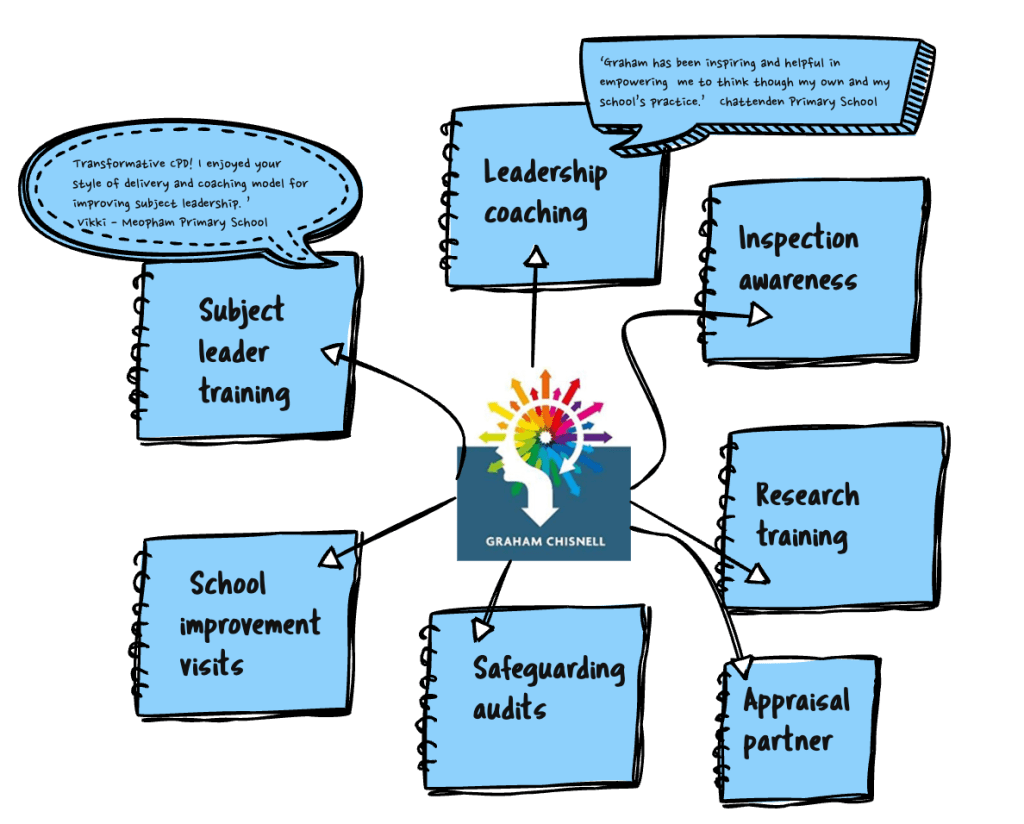
If you would like me to work with you in the coming year then do get in touch. We can have a coffee and a chat. The graphic below shares some of the ways that school and trust leaders have used me in the past year. As always, happy to engage in bespoke work that suits your needs.