March 2026

Welcome to my next edu-blog post. In this post I explore the challenges posed in the Personal development and Wellbeing evaluation area in the new Ofsted framework. This is a single focus in this Chisnell Chatter as the article is a 5 minute read. I hope you find this useful to your role.
Ofsted – Personal Development and Wellbeing

As the 2025 Ofsted framework begins to unfold, school leaders are increasingly asking how personal development and wellbeing will feature in inspection. I recently delivered a briefing for school leaders on Personal Development and Wellbeing and thought the key points are worthy of sharing with you.
While wellbeing is not a discrete judgement area, the direction of travel is clear: inspectors are increasingly interested in the culture of schools — how pupils grow as people and how leaders create sustainable environments for staff and pupils to thrive. In other words, personal development is no longer an “add-on”. It is a central part of what makes a school successful.
Personal Development: Beyond the Classroom
Ofsted’s expectations continue to emphasise how schools prepare pupils for life beyond academic outcomes.
Inspectors will typically explore how schools develop pupils’:
- confidence and character
- sense of responsibility
- understanding of society
- readiness for the next stage of education or employment
This includes opportunities for pupils to develop leadership, resilience and independence through meaningful experiences.
Strong schools ensure pupils (particularly disadvantaged, SEND and pupils who have been in social care) can access:
- leadership opportunities
- debating and public speaking
- creative and cultural experiences
- community engagement
- sport and outdoor education
Crucially, inspectors will look at who participates, not just the offer you provide.
The key question is often:
Do all pupils benefit, or only the most confident?
Inclusion and Belonging
A growing theme in inspection conversations is belonging.
Leaders should ensure that personal development opportunities are accessible to every pupil, particularly:
- disadvantaged pupils
- pupils with SEND
- pupils with poor attendance
- pupils who may feel marginalised
In strong schools, enrichment and personal development are carefully designed so that no group is left behind.
Wellbeing: A Cultural Indicator
Although Ofsted does not formally inspect staff wellbeing, the culture created by leadership is increasingly part of inspection dialogue.
Inspectors may explore how leaders support sustainable working practices through:
- sensible approaches to workload
- meaningful professional development
- collaborative cultures
- support for early career teachers
Schools that prioritise professional growth and psychological safety often find that staff confidence and pupil outcomes improve together.
The Link Between Wellbeing and Achievement
The emerging narrative within inspection is that engagement, belonging and wellbeing influence learning.
Pupils who feel:
- safe
- known
- supported
are more likely to attend regularly, participate in learning and achieve well.
Personal development therefore contributes directly to the broader inspection focus on achievement and engagement.
Questions for School Leaders
As leaders prepare for the evolving framework, a few questions are worth asking:
- Do all pupils access meaningful enrichment opportunities?
- Are disadvantaged pupils fully included in wider experiences?
- Do pupils develop leadership, confidence and character?
- Does the culture support staff growth and sustainable working practices?
- Is personal development woven through the life of the school rather than confined to isolated programmes?
The Leadership Challenge
The most successful schools understand that personal development is not a programme — it is a culture.
When leaders create schools where pupils experience belonging, opportunity and purpose, academic success tends to follow.
In the evolving Ofsted landscape, the challenge is not simply to demonstrate provision, but to show that young people are genuinely growing into confident, capable citizens.
And that, ultimately, is the purpose of education.
Finally, here are some common strengths in schools I have led and worked with:
1) leaders have deliberately planned and sequenced the personal development programme in line with statutory guidance; its elements are taught throughout the school, and reflected in its ethos and values
2) leaders are ambitious for pupils in all elements of personal development; pupils are clear about these expectations and value both the programme and the support and guidance they receive from staff
3) leaders have clear aims for personal development and understand what it means for pupils to get better in a particular aspect (this is often articulated in the school’s equality objectives).
4) subjects are led and taught by subject specialists who place an emphasis on wider opportunities within their curriculum design
5) systems are in place to assess whether pupils have gained from what they have learned or experienced so that no child falls behind
6) systems are in place to monitor the quality of teaching in PSHE with a lens on personal development
7) pupils have rich and varied opportunities to gain the knowledge and skills they need to keep themselves safe, prepare them for life in modern Britain (pupils know, name and apply the fundamental British Values), and develop their talents, interests and character
8) leaders have considered the different needs of their pupils, particularly disadvantaged pupils and pupils with SEND, and planned the programme to meet those needs.
And finally…

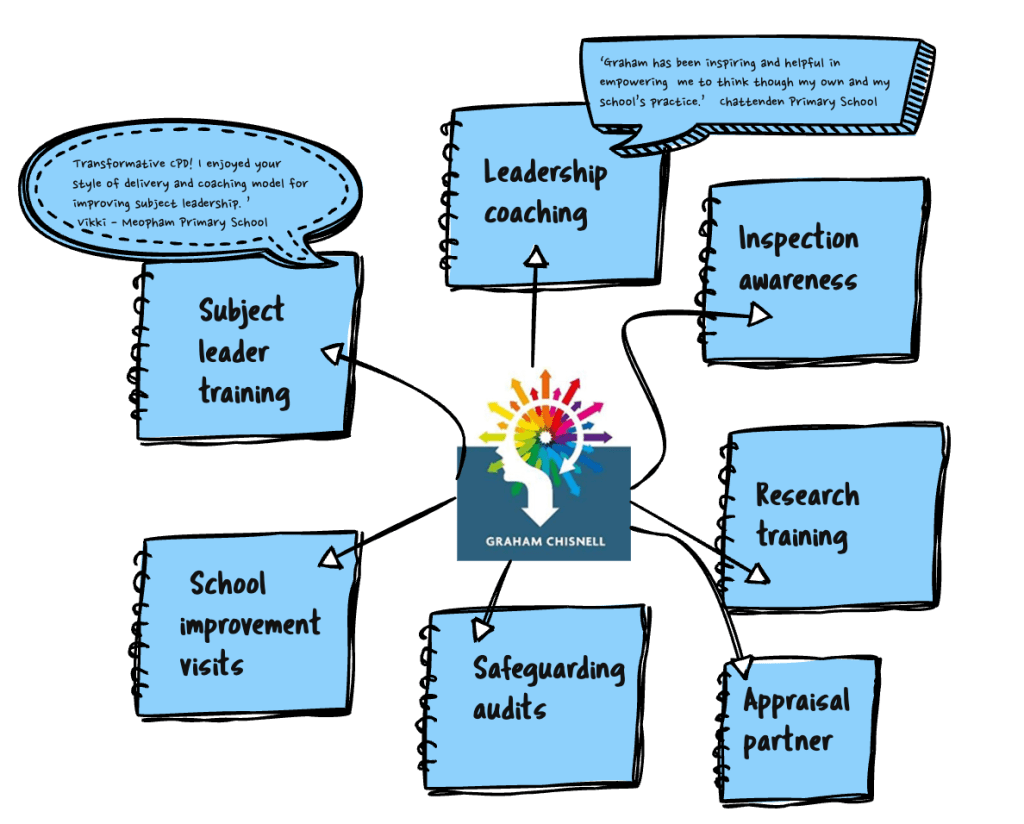
If you would like me to work with you then do get in touch. We can have a coffee and a chat. The graphic below shares some of the ways that school and trust leaders have used me in the past year. As always, happy to engage in bespoke work that suits your needs.
Here is a flavour of the support I give:
- Safeguarding reviews
- Pupil Premium reviews (very pertinent with the focus on disadvantaged in the new framework)
- Attendance reviews (this involves coaching for action planning and new practice)
- Independent investigations for capability and complaints
- Initial Ofsted call coaching
- Website reviews
- Trust reviews (aligned to the Ofsted Trust Summary Evaluation Framework)
- New framework training for subject leaders / senior leaders (many options available including live coaching of learning walks).
- Twilight staff training for research practice
- Twilight staff training for inclusion and adaptive practice for subject leaders
My work is gained by word of mouth so my final humble plea is that if you have valued my work then please share this with colleagues.
 Irresistible Learning