January 2026

Happy new Year!
As the decorations find their home in the loft and the strain of Christmas lunch abates, welcome to my latest Chisnell Chatter.
In this edition I explore the role of governance in quality assuring the school’s approach to safeguarding, the new Ofsted inspection framework’s lens on leadership and governance, dealing with bereavement in school, the DfE’s new guidance on use of reasonable force and much more.
My next Chisnell Chatter Live session will take place in cyberspace on Wednesday January 14 2026 at 8:00am and will focus on Talent Pathways – great ideas for professional development for staff. With the focus on the quality of teaching and curriculum, in the Ofsted framework, this is an essential listen to all school leaders.
Here are the Zoom joining instructions:
Meeting ID: 879 8558 8794
Passcode: 290990
As ever, do get in touch if you would like any support, training or coaching for you or your teams. I have dates available in the coming weeks and months – get in early.
DfE releases: Use of reasonable force in schools
The Department for Education has published updated guidance on restrictive interventions, including the use of reasonable force in schools, which will replace the previous Use of Reasonable Force document from 1 April 2026. This is a significant shift in how schools should approach behaviour, safety, and safeguarding in practice.
Here’s what school leaders need to know:
🔹 Broader Scope than Before: The new guidance covers not only the use of reasonable force but also other restrictive interventions — including restraint and seclusion — and emphasises the full range of practices that may restrict pupil movement.
🔹 Statutory Recording & Reporting Duties: For the first time, schools will have a legal duty to record and report all significant incidents involving restrictive interventions (including seclusion and force) and to notify parents/carers as soon as practicable after an incident. This elevates transparency and accountability.
🔹 A Stronger Emphasis on Prevention: The guidance places a clear focus on early support, de-escalation and prevention, encouraging schools to minimise the need for restrictive interventions before they become necessary.
🔹 SEND Considerations: There is detailed advice on how to support pupils with special educational needs and disabilities (SEND) so restrictive approaches are used only when absolutely necessary and appropriate, and always with context-specific sensitivity.
🔹 Clear Expectations for Policy and Practice: Leaders are expected to review and update behaviour policies to:
• explicitly include restrictive intervention procedures
• set out criteria for appropriate use
• outline consistent, transparent recording and reporting processes
• embed evaluation and improvement planning
• support staff training and pupil wellbeing.
🔹 Focus on Reflection & Continuous Improvement: The new guidance encourages analysis of incidents with the whole school community to learn from critical events, refine behaviour support plans, and reduce future reliance on restrictive practices.
👉 In practical terms, this update signals a shift from reactive response to prevention, reflection and accountability, aligning safeguarding practice with broader culture, SEND support and partnership with families.
✔️ Leadership action points
• Review and update behaviour and restrictive intervention policies
• Establish clear recording and reporting systems ahead of April 2026
• Invest in de-escalation training for all staff working with students
• Ensure SEND plans explicitly address risk and prevention
• Communicate practices clearly with staff, pupils and parents
Supporting girls with ADHD
Here is a link to the full article.
Here’s a summary of a super little article written by Vlad Glăveanu Professor of Psychology, Business School, Dublin City University. In the article, Vlad explores the challenges of identifying the needs of girls with ADHD symptoms.
New research highlights a critical issue for educators: ADHD in girls is frequently overlooked because it doesn’t fit outdated stereotypes. Traditionally, ADHD has been understood through a lens shaped by hyperactive, disruptive behaviours most common in boys. Teachers and professionals often look for these visible signs — but girls with ADHD tend to present differently.
🧠 Girls may show symptoms that are subtler and internalised, such as:
- daydreaming
- inattention
- quiet distractibility
- being disorganised rather than disruptive
- emotional reactivity rather than physical impulsivity
Because these behaviours are often interpreted as personality traits, anxiety or simply “trying hard”, many girls go undiagnosed until their late teens or adulthood — sometimes with long-lasting impacts on self-esteem and wellbeing.
What this means for schools:
✔ Recognise that ADHD looks different across genders.
✔ Train staff to identify non-stereotypical presentations.
✔ Support early identification and meaningful accommodations rather than waiting for disruptive behaviour to occur.
✔ Foster awareness that hidden struggles can be as significant as visible ones.
Early recognition and support don’t just improve academic outcomes — they can also transform how young people see themselves. When we broaden our understanding beyond stereotypes, we unlock potential that may otherwise be overlooked.
Supporting Children Through Bereavement: A Quiet Lesson for Schools
The winter period can bring bereavement to many families. One of the most humane and quietly powerful books I’ve revisited recently is The Little Book of Bereavement for Schools by Ian Gilbert.
Written with his three children, the book is grounded not in theory, but in lived experience. It captures what schools did well, what they tried but missed, and what they sometimes avoided altogether when supporting a child after loss.
Its central message is disarmingly simple:
👉 bereavement doesn’t need fixing — it needs acknowledging.
The book offers practical, compassionate guidance for schools:
- be honest and open rather than euphemistic
- listen to the child rather than assume what they need
- support classmates to respond with empathy
- think carefully about curriculum triggers
- remember that grief doesn’t follow a timetable
Perhaps its most important reminder is this: support must be sustained. Grief doesn’t end after the funeral or the first few weeks back at school.
For school leaders, teachers and pastoral teams, this is a powerful reminder that sometimes the most impactful thing we can do is be present, be human, and be brave enough to talk about loss.
A small book — but one with lessons that stay with you.
Kubler-Ross Change Curve
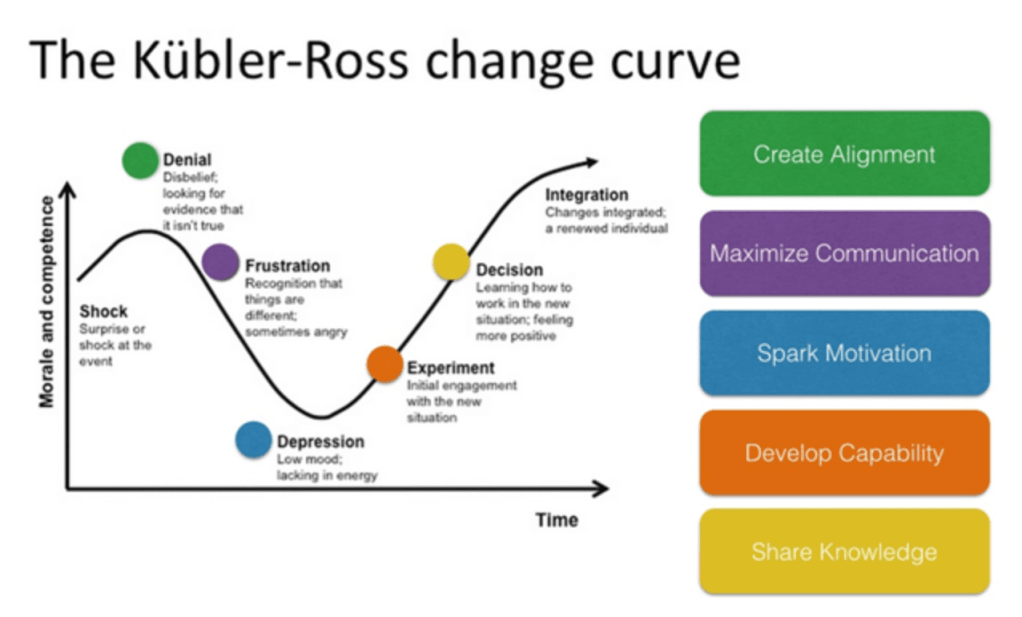
As we head to a new year, our leadership thoughts move to the challenge of change. I recently worked with a fab headteacher in Dartford on The Kübler-Ross Change Curve.
Change in schools is rarely resisted because it’s wrong.
It’s resisted because it’s felt.
The Kübler-Ross Change Curve, developed by Elisabeth Kübler-Ross, helps school leaders understand the emotional journey staff often experience during change.
🔹 Shock – “I didn’t see this coming.” People need clarity, calm communication, and time to process.
🔹 Denial – “This won’t really happen.” A natural coping response. Repetition and reassurance matter more than urgency.
🔹 Frustration / Anger – “Why are we doing this?” This is the dip. Listen hard. Validate emotions without backing away from purpose.
🔹 Depression / Low Mood – “I can’t do this.” Confidence is fragile. Support, coaching and visible leadership are crucial here.
🔹 Experimentation – “Let me try…” Momentum builds when leaders model, encourage risk-taking, and celebrate small wins.
🔹 Acceptance & Commitment – “This works.” New practices embed. Collective efficacy returns.
💡 The leadership truth: Resistance isn’t defiance — it’s information.
Effective school leaders:
• Diagnose where individuals and teams are on the curve
• Adjust leadership style accordingly (directive early, coaching later)
• Hold purpose steady while compassion stays high
If you’re leading change right now, ask yourself:
👉 Am I managing the plan — or am I leading the people through the curve?
Remembering the emotion of change can guide you to support your staff to navigate change and empower them to reach your vision of the future.
The graphic below also outlines how leaders can counter the negative stages of change.
Safeguarding and Governance
Do you or your governors monitor safeguarding as a theme across your school or trust? Here is a solution. 👇
I have been working with a range of schools on safeguarding audits and this is an area that can often lack precision. Sometimes governors and trustees are diligent but aren’t clear about what key questions to ask when monitoring the quality of safeguarding provision in their schools.
I have devised a governance monitoring pro forma for safeguarding. While this does not cover every element of the school’s obligation for safeguarding, it does provide key prompt questions to start a wider discussion when reviewing practice. Give it a go and see where the conversation takes you.
Ofsted – Leadership & Governance
The new Ofsted framework is now in full swing. In this edition, I focus on leadership and governance. The first point to note is that governance is now up front and centre in this evaluation area.
Under the new system:
- Leadership and Governance is a distinct evaluation area on the report card, graded on a five-point scale (urgent improvement → expected standard → strong → exceptional).
- Inspectors will consider leaders’ roles in creating inclusive culture, promoting well-being, and responding to pupils’ and staff needs. Well-being and workload considerations are now explicitly part of inspection evaluation areas.
- The framework recognises contextual factors (e.g., local challenges, intake profiles, SEND complexity) when judging leadership effectiveness.
- Leadership performance is evaluated through evidence, narrative and dialogue, not just outcomes data — supporting a more transparent and balanced inspection experience.
Top Tips for School Leaders Under the 2025 Framework
1. Know Your Report Card Criteria
Understand how Leadership and Governance will be graded and what inspectors will evidence. Leadership is not just about outcomes but also about:
- strategic clarity
- embedding inclusion and well-being
- demonstrating sustained improvement
- evidence of effective governanceand a sharp safeguarding culture.
➡️ Tip: Work with your governance team to map evidence against the new criteria well before inspection readiness.
2. Lead With Clear Vision and Purpose
Inspectors will expect leaders to articulate:
- a clear strategic direction
- self-evaluation rooted in realistic evidence
- meaningful action plans with measurable impact
Clarity of vision that is shared and understood across the school strengthens leadership narratives and reinforces trust.
➡️ Tip: Revisit and refresh your school’s improvement plan regularly and ensure it aligns with current context and priorities.
3. Prioritise Inclusion and Well-Being
The updated framework places well-being and inclusion alongside core areas like curriculum, behaviour and safeguarding. Leaders must demonstrate how policies translate into practice that supports learners, staff and families.
➡️ Tip: Regularly review staff workload, pupil support systems, and well-being strategies, and keep evidence of impact.
4. Strengthen Governance Roles
Leadership and governance are now intricately linked in evaluation. Governors and trustees should:
- know their statutory roles
- challenge effectively
- demonstrate impact on school improvement
- engage with data in meaningful ways as part of collective leadership accountability.
- for trusts: know and enact the trust scheme of delegation so that governance at every level is effective
➡️ Tip: Build structured evidence of governance impact throughout the year.
5. Use Narrative, Not Just Data
The new report card gives inspectors room for contextual narrative. Leaders should be prepared to explain not just what you do, but why and how it impacts pupils — especially in your context.
➡️ Tip: Develop short, evidence-linked narratives for evaluation areas that reflect school priorities and outcomes. See my lesson visit and work scrutiny monitoring proformas as an idea of how to record the narrative of improvement.
6. Cultivate Shared Leadership
Ofsted’s renewed approach values distributed leadership — where leadership is evident at all levels (senior leaders, middle leaders, classroom practice). This shows sustainable leadership practice beyond the headteacher alone.
➡️ Tip: Build leadership capacity through coaching, mentoring and professional growth opportunities.
7. Evidence Safeguarding With Confidence
Safeguarding is a standalone judgement of “met” or “not met,” separate from other leadership assessments. Leaders must ensure safeguarding practice is clearly evidenced and understood at all levels.
➡️ Tip: Keep regular audits, training records and impact evaluations ready as a transparent evidence base. Ensure that safeguarding forms part of every relevant monitoring activity. See my governance safeguarding monitoring forms.
8. Prepare for Contextual Inspection Dialogue
Inspectors are encouraged to engage in professional dialogue and understand each school’s unique context — strengths, challenges, community needs — as part of the evidence gathering process.
➡️ Tip: Create opportunities for constructive dialogue within the school community that positions leadership as reflective, responsive and contextual. The more you do this in the course of your work, the more natural this will feel when inspected.
Quick Leader Checklist: 2025 Ofsted
✔ Understand report card structure and toolkit grading
✔ Align improvement plans with core evaluation areas
✔ Evidence inclusion, well-being and leadership impact
✔ Strengthen governance evidence
✔ Prepare clear narratives, not just data
✔ Build leadership capacity school-wide
✔ Demonstrate robust safeguarding practice
✔ Engage in reflective, evidence-driven dialogue
Chisnell Chatter Live
The first Chisnell Chatter Live school leader briefing took place in November and focussed on attendance top tips. A recording of the session can be found here. Chisnell Chatter Live in December focussed on Pitch Perfect Pupil Premium and a recording of this can be found here.
The next Chisnell Chatter Live session will take place in cyberspace on Wednesday January 14 2026 at 8:00am and will focus on Talent Pathways – great ideas for professional development for staff. With the focus on the quality of teaching and curriculum, in the Ofsted framework, this is an essential listen to all school leaders.
Here are the Zoom joining instructions:
Meeting ID: 879 8558 8794
Passcode: 290990
And finally…

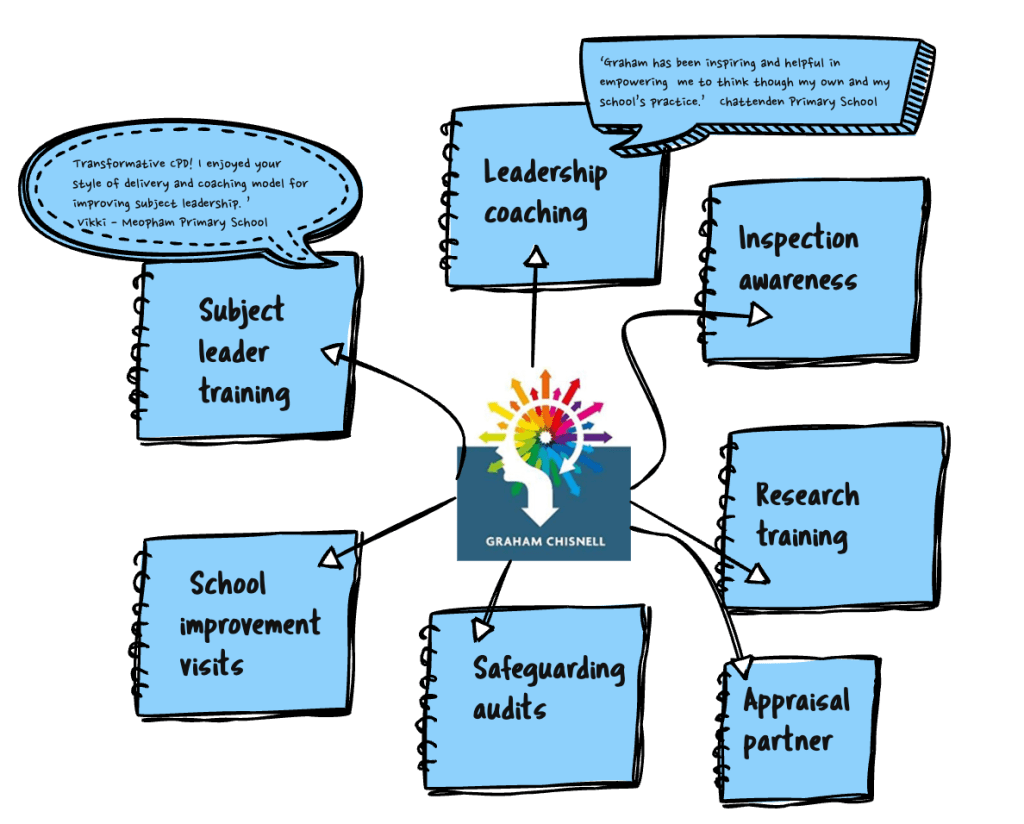
If you would like me to work with you then do get in touch. We can have a coffee and a chat. The graphic below shares some of the ways that school and trust leaders have used me in the past year. As always, happy to engage in bespoke work that suits your needs.
For those who have undertaken my professional training programme for subject leaders and senior leaders in the past, you may be interested in my updated programme that aligns to the new 2025 Ofsted Inspection Framework. This will empower your subject leaders to attune their practice to the inspection framework while strengthening their own professional knowledge and impact on pupil outcomes.
 Irresistible Learning