November 2025

Hello and welcome to my latest Chisnell Chatter.
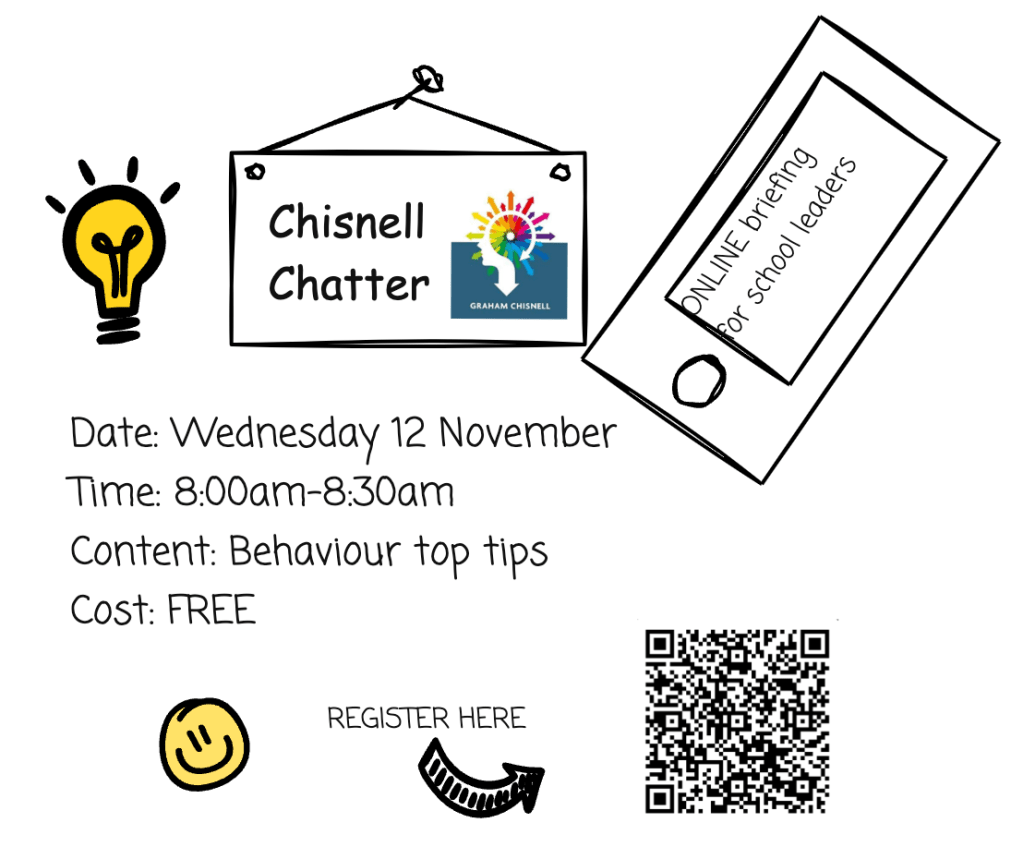
I delivered my first session of Chisnell Chatter Live in October and it was a delight to meet face to face with school leaders across the primary and secondary phase. My next Chisnell Chatter Live event will take place on Wednesday 12 November (details below) and I hope to see you there.
In this edition I reflect on tips for heading off behaviour with upstream thinking, DfE documents on Sports funding and Martyn’s Law and updates on Ofsted’s new toolkit relating to curriculum and teaching.
Behaviour – Upstream thinking

I read a super little post by Peps Mccrea from Steplab on LinkedIn. He speaks about the concept of upstream thinking when considering an approach to behaviour management.
He starts with a quick parable:
You and a friend are relaxing by a river. Suddenly, there’s a shout from the water—a child is drowning. Without thinking, you both dive in, grab the child, and swim to safety. BUT…
Before you can recover, you hear another cry for help. You and your friend jump back into the river to rescue the next struggling child.
Then another drifts into sight…
and another…
and another…
The two of you can barely keep up. Suddenly, your friend wades out of the water, seemingly giving up.
“WHERE ARE YOU GOING?” you yell.
Your friend turns: “I’m going upstream to stop these kids falling in”.
There are times when we can get trapped in this kind of ‘downstream’ thinking. When we invest huge amounts of effort trying to deal with problems as they occur. However, our efforts can sometimes be better directed at tackling problems before they occur… towards prevention.
This is ‘upstream thinking’.
The further upstream we intervene, the closer we get to the cause, and the more leverage we gain over any outcome. If we look, we can see upstream thinking in lots of places…
→ Hospitals save more lives when they focus on smoking cessation alongside cancer treatment.
→ Fire services reduce casualties when they invest in fitting smoke alarms alongside improving fire truck response times.
Behaviour for learning is no exception.
When schools invest in upstream interventions—like culture, motivation, and systems—they are less likely to see undesirable behaviours manifest. The most effective schools are those which take steps to influence behaviour BEFORE it happens, as well as putting in place strategies for addressing it AFTER it has occurred.
Peps makes a valuable point here, we so often see behaviours and respond to them with sanctions and at best, restorative practices. In order to make a deep change in the culture of behaviour in our school, we need to go upstream to meet pupil behaviour at the point before it manifests into misbehaviour. Whether this is a focus on the clarity of vision and values, the PSHE curriculum, opportunities for pupil voice or training for staff; heading upstream can provide a lasting improvement in the behaviour of your pupils.
So.. what can your school do to move things further upstream?
DfE PE and Sport Funding Guidance

The DfE has released its latest PE and Sports Funding guidance for primary schools. Here is a synopsis of the key points in the document.
The 5 Key Indicators
Schools should plan impact around these indicators:
1️⃣ Engagement of all pupils in regular physical activity.
2️⃣ Raised profile of PE/sport as a tool for whole‑school improvement.
3️⃣ Increased staff confidence, knowledge, and skills.
4️⃣ Broader experience of sports/activities for all pupils.
5️⃣ Increased participation in competitive sport.
Smart Use of Funding – What Works
✔️ Professional development for teachers and subject leaders.
✔️ Embedding activity into the school day (active travel, active lessons).
✔️ Inclusive initiatives targeting least‑active pupils, girls, SEND, or disadvantaged.
✔️ Sustained partnerships with sports networks or clusters.
✔️ Top‑up swimming lessons for pupils below national curriculum standard.
Avoid Using It For:
❌ New building projects or fixed play equipment.
❌ Staffing core PE lessons or standard curriculum provision.
❌ One‑off events or coach hire with no long‑term impact.
❌ Substituting existing school budget commitments.
Accountability & Reporting
• Publish a detailed impact report by 31 July 2026 on your website.
• Complete the DfE digital expenditure return (including swimming data).
• Demonstrate how improvements will be sustained beyond this funding year.
• MATs must publish individual school reports – not one joint return.
Leadership Tips for Impact
⭐ Link PE spend to school priorities: wellbeing, behaviour, attendance, readiness to learn.
⭐ Build sustainability: invest in staff skills and systems, not just resources.
⭐ Track who benefits – especially least‑active and disadvantaged pupils.
⭐ Engage governors: encourage them to ask impact and sustainability questions.
⭐ Showcase success: PE should be visible in school culture, not hidden in timetables.
The full document can be found here.
Martin’s Law and education settings

Martyn’s Law (Terrorism (Protection of Premises) Act 2025) introduces new legal duties to help keep pupils, staff, and visitors safe from the risk of terrorism. It requires schools and education settings to assess risk and implement proportionate protective measures. Although there is a 24-month implementation period, the document is worthy of early consideration and adoption.
Who It Applies To
• Maintained schools, academies, free schools, independent schools, early years settings, FE colleges and universities.
• Applies in full to settings with 200+ people on site (staff and pupils combined).
• Smaller settings are encouraged to prepare voluntarily.
Core Leadership Requirements
1️⃣ Conduct a terrorism risk assessment for your premises.
2️⃣ Implement proportionate protective security measures.
3️⃣ Review site access, visitor management, and emergency procedures.
4️⃣ Plan and rehearse evacuation and lockdown responses.
5️⃣ Liaise with local security partners and emergency services.
6️⃣ Embed awareness into safeguarding, staff training and induction.
Timeline
• Act published 2025, full implementation expected by 2027.
• DfE guidance available now; statutory guidance to follow.
• Schools should begin preparatory work in 2025–26.
Key Questions for Leaders & Governors
✔️ Have we completed or scheduled a terrorism risk assessment?
✔️ How do our site access controls, perimeter, and visitor management protect pupils?
✔️ Are staff confident in lockdown and evacuation procedures?
✔️ How is security integrated into safeguarding and wellbeing policies?
✔️ What communication plans exist for parents and the wider community?
✔️ Do governors receive assurance on compliance and readiness?
✔️ How will we review, train, and update measures annually?
The full document can be read here.
Ofsted’s new toolkit – A focus on Curriculum and Teaching.

In the next few Chisnell Chatters, I will focus on the new evaluation areas in the Ofsted Framework. Last edition focussed on inclusion so let’s move onto curriculum and teaching.
The first point to make is that teaching is back. After a focus on the quality of education in the previous framework, the quality of teaching has returned in this evaluation area. This evaluation area assesses how effectively school leaders design, implement, and monitor a high-quality curriculum and teaching that secures knowledge, vocabulary, and foundational skills for all pupils. Inspectors consider both intent and implementation, focusing on equality of access and the impact of teaching.
What Inspectors Look For
1️⃣ Strategic Leadership of Curriculum & Teaching
• Leaders (including governors) understand the quality of curriculum and teaching across subjects.
• The curriculum covers statutory requirements and is at least as ambitious as the national curriculum.
• The school equips all pupils, particularly disadvantaged and SEND pupils, for success in later life.
• Leaders ensure teachers have strong subject knowledge and access to professional learning.
• Barriers to learning are identified and reduced through curriculum design and adaptive teaching.
2️⃣ Securing Strong Foundations for All Pupils
• Reading, spelling, handwriting, and maths are prioritised.
• ‘Keeping up, not catching up’—gaps are addressed swiftly through early identification.
• Vocabulary, oracy, and reading competency are developed across all subjects.
• Pupils are explicitly taught to communicate effectively through spoken language.
3️⃣ Early Foundations (EYFS and KS1)
• Early curriculum defines foundational knowledge for later learning.
• Daily story time, phonics, and dialogue strengthen language development.
• Repeated practice builds fluency in number, handwriting, and vocabulary.
4️⃣ Older Pupils (KS2 and Beyond)
• Assessment identifies gaps in literacy, language, and maths.
• Targeted teaching ensures pupils catch up rapidly.
• Teachers are supported to adapt instruction based on evidence of learning.
Leadership Implications
⭐ Align curriculum intent, teaching quality, and outcomes.
⭐ Prioritise professional learning that deepens subject and pedagogical expertise.
⭐ Use assessment intelligently—inform teaching, not workload.
⭐ Communicate curriculum ambition clearly to staff, pupils, and governors.
⭐ Model high expectations for all pupils, avoiding lowered standards in the name of inclusion.
Governor & SLT Discussion Questions
✔️ How do we know our curriculum is as ambitious as the national curriculum for all pupils?
✔️ What systems ensure teachers have the expertise and subject knowledge to deliver effectively?
✔️ How are reading, vocabulary, and oracy embedded across the curriculum?
✔️ Where are we prioritising ‘keeping up’ interventions—and what’s the evidence of impact?
✔️ How do we evaluate teaching quality without overloading staff?
For more details take a look at the Ofsted Toolkit here. If you would like further support with this with training or coaching, then do get in touch.
Chisnell Chatter Live
The first Chisnell Chatter Live school leader briefing took place in October. The session provides school leaders with a 30 minute micro briefing on a range of topics plucked from my Chisnell Chatter edu-blog. The first live session focussed on Ofsted’s new framework and how to use this to strengthen monitoring in your school.
The next Chisnell Chatter Live session will take place in cyberspace on Wednesday 12 November 2026. Sign up for the session here.
And finally…

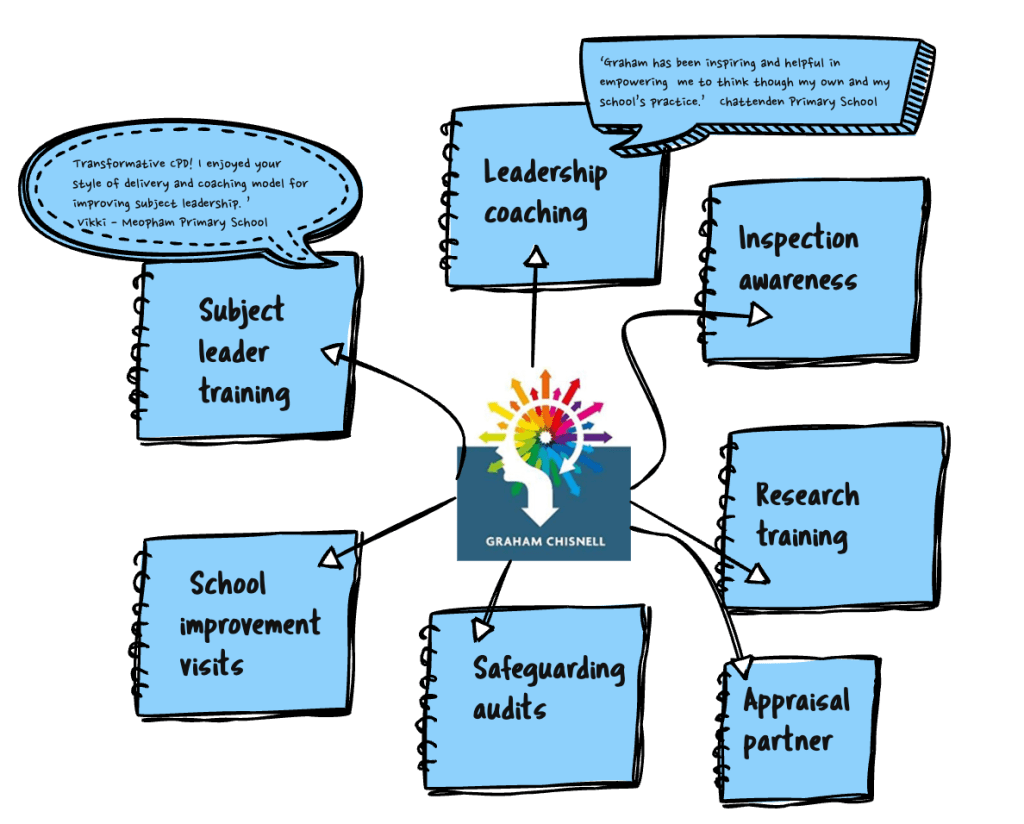
If you would like me to work with you then do get in touch. We can have a coffee and a chat. The graphic below shares some of the ways that school and trust leaders have used me in the past year. As always, happy to engage in bespoke work that suits your needs.
For those who have undertaken my professional training programme for subject leaders and senior leaders in the past, you may be interested in my updated programme that aligns to the new 2025 Ofsted Inspection Framework. This will empower your subject leaders to attune their practice to the inspection framework while strengthening their own professional knowledge and impact on pupil outcomes.
 Irresistible Learning