October 2025

Brace yourself, more change afoot!
We have more educational and political change afoot, we await the White Paper on SEND amongst clarity on how the new Ofsted inspection framework will unfold from November 10th 2025. Dip into my latest Chisnell Chatter (I can’t believe this is edition 31) and pick up on some nuggets of inspiration and information.
In this edition I reflect on School’s Minister Georgina Gould’s perspective on SEND; the Children Commissioner’s report into children and pornography and Ofsted’s new Toolkit.
SEND
The schools minister, Georgina Gould, has hinted at the forthcoming reforms to SEND education. Here is an article published in Schools Week that reflects on Georgina’s comments.
The key messages are:
Four Principles for SEND Reform:
• Children, families, teachers, and support staff must be at the forefront of reform.
• Early intervention is critical – support must be given as soon as issues appear.
• Provision should be local – children shouldn’t travel long distances for support.
• Collaboration beyond schools – include health services, youth clubs, play, and workplaces that embrace neurodiversity.
Legal Rights to Support
• The government is committed to maintaining a legal right to additional support for children and young people with SEND.
• The minister also gave a commitment that no child will be left behind in education reforms.
• Government adviser Dame Christine Lenehan previously suggested EHCPs could be narrowed or limited to special school pupils as part of reforms under consideration.
What are the implications for school leaders?
• Expect a continued emphasis on early identification and intervention – schools must strengthen their graduated response.
• Local partnerships will be critical – build stronger links with health, community services, and families.
• Prepare for reforms to EHCPs – ensure robust evidence and inclusive practice in anticipation of system changes.
• Leadership voice matters – ensure staff, pupils, and family experiences are fed into consultation and reform discussions.
It is clear that SEND reforms are imminent. As school leaders, we must prioritise early intervention, strengthen local provision, and engage with families to safeguard the rights and support of children with SEND. This echoes the heightened focus on inclusion in the new Ofsted framework for 2025 where inclusion has its own judgement area in the toolkit.
Children’s commissioner report into children and pornography
The Children’s Commissioner released a new report into children and pornography during the summer. This may have been lost in the myriad of publications during the summer months. Nonetheless, there are some important points that have implications on how we design and deliver our PSHE programmes and undertake our safeguarding of children.
Key messages include:
🔟 Key Points
- Early exposure – Children are exposed to pornography young, often by age 11, sometimes as early as 6 years of age.
- Accidental access – Most first encounters happen unintentionally via social media algorithms or poor platform design.
- Extreme content – Many children report exposure to violent or degrading acts, including strangulation and non-consensual sex.
- Normalisation risk – Pornography is shaping young people’s beliefs about what “normal” sex looks like.
- Links to harmful behaviour – Pornography is cited in cases of child-on-child sexual abuse and harmful sexual behaviours.
- Consent confusion – Some young people believe harmful myths regarding consent.
- Vulnerable groups at higher risk – Children with disabilities, those on free school meals, or with social workers are more likely to be exposed early.
- Safeguarding gap – Online Safety Act measures are not enough; children can bypass protections.
- Platform responsibility – Algorithms and design choices actively push harmful content towards children.
- Call to action – Stronger regulation, closing loopholes, and equipping schools to address the impact are urgently needed.
As school leaders we need to be aware of this document (full report here). We need to ensure that our PSHE or SRE curriculum addresses the points in order to safeguard our children. Also, that our filters in school swiftly alert us of pupils who may search for pornography and minimise the risks for our children in accessing inappropriate information when online. Finally, that our staff and families are alerted to the potential risks and that our safeguarding teams are knowledgeable of the signs and symptoms posed by these risks.
Ofsted’s new toolkit – A focus on inclusion.

In the next few Chisnell Chatters, I will focus on the new judgement areas in the Ofsted Framework. Let’s get started on inclusion.
Inclusion is the first judgement area in the toolkit after safeguarding. This gives an important message of the priority the framework places on the importance of inclusion.
So what is inclusion? Let’s not get trapped into thinking inclusion is just pupils with SEND. The toolkit defines inclusion as:
- Socioeconomically disadvantaged pupils (those eligible for the pupil premium)
2. Pupils with SEND; this means pupils receiving special educational needs (SEN) support, and those with an education, health and care (EHC) plan
3. Pupils who are known (LAC) or previously known (PLAC) to children’s social care, such as children in need and looked-after children
4. Pupils who may face other barriers to their learning and/or well-being, which may include pupils who share a protected characteristic.
For more details take a look at the Ofsted Toolkit here. Get your SEND team to read through pages 10-16 and become familiar with the language and content and use this to reframe their strategic thinking, their monitoring and evaluation. If you would like further support with this with training or coaching, then do get in touch.
Behaviour – consistency is key
Simon Currigan, writing in linkedIn challenges us to think why school behaviour policies may not work.
He suggests that it’s not because policies are badly written but rather because they’re applied inconsistently.
➡️ One teacher gives a warning when a child breaks the rules.
➡️ Another jumps straight to a sanction.
➡️ A third ignores it completely.
Same behaviour. Three responses.
As a result, pupils learn that the adults are unpredictable and that rules aren’t really rules.
And for pupils with SEMH needs, that unpredictability fuels anxiety, stress, and dysregulation. As a result, pupils feel unsafe. As Dylan Williams would say, the adults need to change.
Unpredictable adults = unsafe pupils.
Currigan suggests the solution is simple and that consistency is key. It means creating predictable, calm adult behaviour that students can trust. Also, having clear procedures your whole team follows, while still using their professional judgement.
There’s a formula that explains why some staff stick to the policy… and others don’t.
⭐️ It’s called The Change Equation.
Understanding it is the key to winning hearts, overcoming resistance, and getting your team pulling in the same direction.
Because consistency isn’t just a strategy – it’s the foundation of a strong school culture.
✔️ When adults are predictable, pupils feel safe.
✔️ When pupils feel safe, they learn.
✔️ That’s why consistency matters more than any poster, policy, or reward chart.
You’ll see the payoff in calmer pupils, less stress for staff and a more focused classroom.
Here is the link to Simon Currican’s site for more details.
Top tips for engaging CPD
I recently led a training session for an NPQ cohort of middle leaders on highly effective CPD. Here is a short video of some of the tips taken from Shaun Allison’s book Perfect Teacher-Led CPD. You will need a LinkedIn account to view this, if you haven’t got one, just get one; this is a great place for professional dialogue.
And finally…

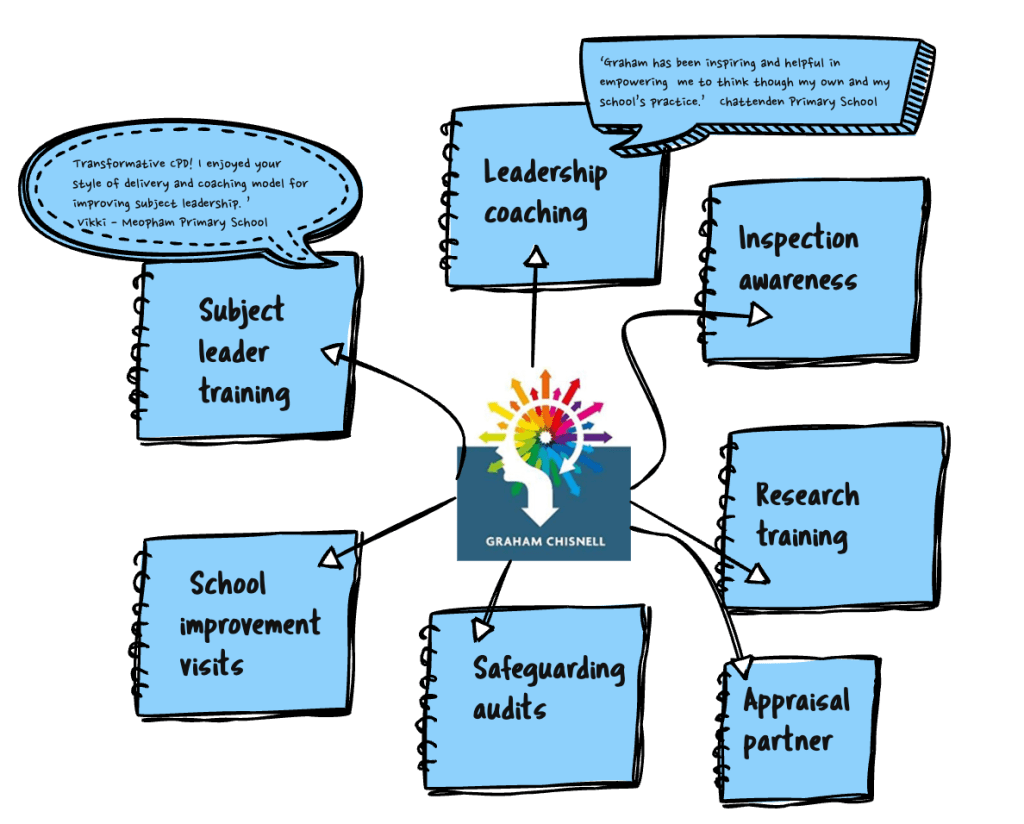
If you would like me to work with you then do get in touch. We can have a coffee and a chat. The graphic below shares some of the ways that school and trust leaders have used me in the past year. As always, happy to engage in bespoke work that suits your needs.
For those who have undertaken my professional training programme for subject leaders and senior leaders in the past, you may be interested in my updated programme that aligns to the new 2025 Ofsted Inspection Framework. This will empower your subject leaders to attune their practice to the inspection framework while strengthening their own professional knowledge and impact on pupil outcomes.
 Irresistible Learning