Festive greetings for the December Chisnell Chatter. This is the fourth edition of Chisnell Chatter for the academic year 2024-25.
In this edition, I explore Ofsted’s annual report, top tips on supporting pupils with SEND, ensuring validity in assessments and how to assure great behaviour in your classroom. Intrigued? Then read on….
Supporting SEND and Diversity

I had the pleasure of delivering a keynote and workshops with the inspirational Audrey Pantellis of Elevation Coaching this month for Concordia Alliance in Canterbury. My keynote focused on being the SEND subject leader superhero. This was followed up with a workshop on refining the adaptive practices used in a range of subject disciplines. Here are some key points from the presentation if you are thinking about developing a culture of high engagement and achievement for pupils with SEND.
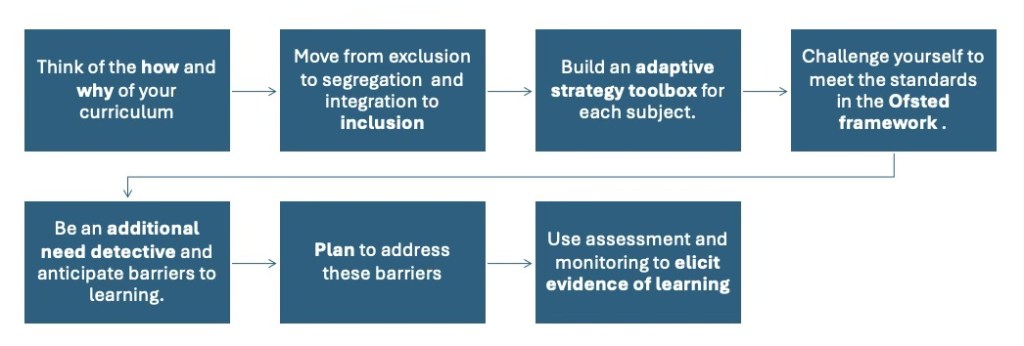
If you are thinking about powering up your approach to inclusion and diversity then get in touch to talk to Audrey and me about a bespoke training day for your organisation.
OFSTED publishes its annual report
Ofsted released its annual report in December 2024. The report provides an interesting narrative of key findings from Ofsted’s inspection work over the past year. The report outlines these key messages:
- Education and care providers struggling to recruit and retain skilled staff, which impacts on children’s learning and well-being.
- School absence rate remains higher than before the pandemic and more children experiencing unorthodox patterns of education.
- SEND system is under huge strain as number of children with an identified need continues to grow.
- The report also highlights the following:
- In schools, the absence rate has risen since the pandemic, with disadvantaged and vulnerable children more likely to be persistently or severely absent.
- A growing number of children are now on part-time timetables, while a mix of online and in-person education is increasingly being used for children with SEND and behaviour or health needs. A small number of schools also now allow flexi-schooling, where parents home educate their children for part of the week. Along with a growth in home–schooling and an unknown number of children attending unregistered schools, this means a very significant number are experiencing unorthodox patterns of education.
- So, what does this mean for our schools? There is a continued focus on tackling low attendance of pupils, especially our pupils with SEND and disadvantage. Along with this, it would appear that there is a growing interest in decisions around part time timetables. We need to be really clear about the decision making process and how to best support pupils on part time timetables. Co-production in the decision making with families and agencies and a keen desire to move back to full time education.
Four Pillars of Assessment – Validity

In my earlier Chisnell Chatter, I outlined the EBE’s four pillars of assessment. Namely; purpose, validity, reliability and value. The EBE has published a useful description of the approach to gaining validity in assessment.
The EBE states that there is no such thing as a valid assessment. Quite a claim! They state that validity is a word which, in assessment, refers to two things:
- The ability of the assessment to test what it intends to measure;
- The ability of the assessment to provide information which is both valuable and appropriate for the intended purpose.
- There are two key questions to ask regarding validity of assessment:
- Is the test or assessment activity any good as a measure of the students progress towards their learning end points?
- Should the test be used for its present purpose?
They go on to state that there are two key reasons that assessments end up not quite hitting their target:
Construct under-representation: is where the assessment fails to capture important aspects of the the target of the assessment.
Construct-irrelevant variance: the assessment outcomes are influenced by things other than just the construct.
In short, when thinking about the validity of assessments undertaken, we need to be clear that our assessments capture the steps in learning (component knowledge) that lead to our curriculum end points (composite knowledge).
Click here for the full article.
What is good behaviour and how can teachers encourage it – EBE

Here is a second reference in this edition to an article by Evidenced Based Education. The article outlines the importance of activating ‘hard thinking’. The article outlines four key steps to strengthening the behaviour of students:
- Understand the content – being clear about what you are teaching, having fluent knowledge and flexible understanding of the content of the subject and clarity on the misconceptions that may appear.
- Creating a supportive environment – where students can thrive, feel positive within a culture of mutual respect and emotional warmth.
- Maximise opportunities to learn – by managing time and resources and ensuring rules and routines are established and consequences are explicitly known.
- Activating hard thinking – by structuring, explaining and questioning in order to engage students in the activity whilst providing the adaptations needed for them to access their learning. Finally by interacting (engaging with students and providing helpful and plentiful feedback), embedding (providing tasks that enable the student to apply their learning) and activating learning (helping students to plan, regulate and monitor their own learning).
The full article can be found here.
Get in touch

If you would like any bespoke support with coaching, leadership training, safeguarding reviews, research practice then do get in touch for a chat. Here is a synopsis of my consultancy offer and contact details.
 Irresistible Learning