Welcome to the third edition of Chisnell Chatter for the academic year 2024-25. Life in education continues to move at a sterling pace, as such here is the second edition this month!
In this edition, I will explore changes to Ofsted’s ungraded inspections, how to produce a purposeful Pupil Premium document, the four pillars of assessment and how to provide ambition for pupils with SEND. Interested? Then read on….
Pupil Premium – an EEF guide

The Department for Education (DfE) requires every school to review and publish an updated Pupil Premium strategy statement every academic year before 31 December.
The Education Endowment Agency (EEF) has released a suite of evidence informed documents related to the Pupil Premium. The guidance includes:
- The EEF Guide to the Pupil Premium
- Evidence brief: Using research evidence to support your spending decisions
- Discussion prompts for governors and trustees
- Poster: The tiered model and ‘menu of approaches’.
The documents provide a really helpful set of questions for oversight and scrutiny by governors. Share this with them to power up their oversight of the impact of your document.
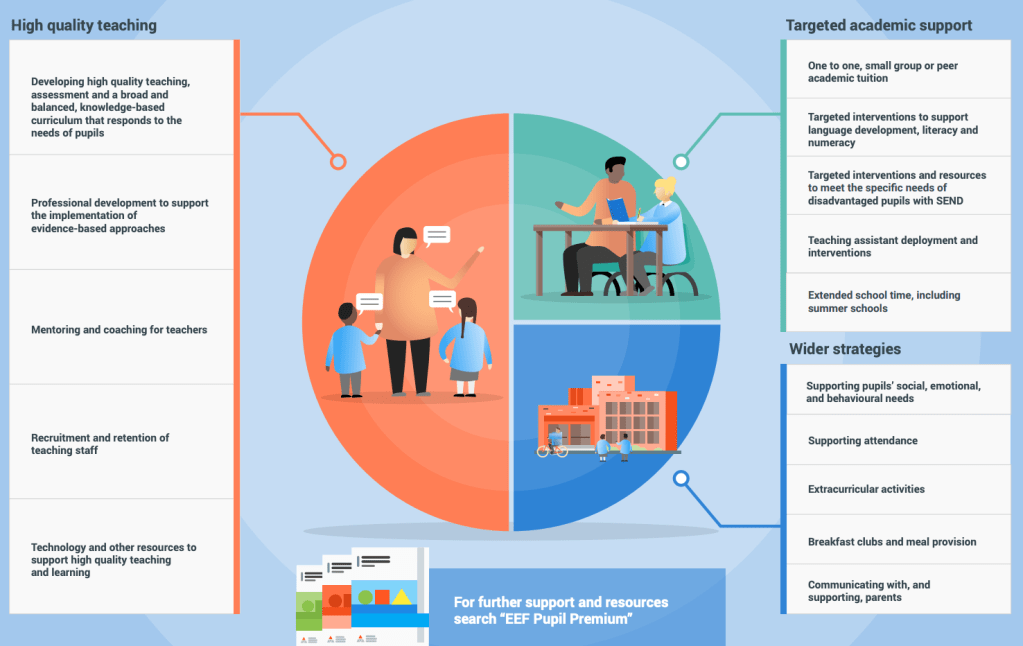
The tiered model is outlined below and can be downloaded here. The model focuses on the importance of high quality teaching, targeted academic support and wider strategies such as a focus on the attendance of disadvantaged pupils.
Four Pillars of Assessment

Evidence Based Education (EBE) provide a useful synopsis of the four pillars of assessment, in this article they focus on the pillar of purpose. The full article can be found here.
The four pillars of assessment are purpose, validity, reliability and value. The Chartered College of Teaching explain the four pillars of assessment as:
Purpose: What function do we want this assessment to serve? Has it been planned in a way which elicits the highest-quality information possible towards the intended end use?
Validity: To what extent does this assessment measure what we intended it to? How relevant and appropriate are the inferences made from the assessment outcomes, towards our purpose?
Reliability: How precise and consistent are the measurements we generate from this assessment? How precise and consistent are the inferences we make from these?
Value: Is the outlay of time and resources (for both pupil and teacher) justified in relation to the quality of information gained from this assessment? Is it being used to improve pupil learning and progress?
These are important starting points to a discussion with subject leaders when thinking about assessment in their subject.
Research clips from the Research Schools Network
The Research Schools Network has released a series of short video research clips. The clips explore a range of exemplar practice in how differing pedagogical approaches have been enacted in schools. Here is a link to a clip on how a primary school has introduced and used retrieval practice in science.
For further clips for literacy, maths and science, follow this link.
Taking the theme of retrieval practice further, here is a link to an interesting video by Teacher Toolkit on the power of retrieval practice in secondary schools.
Ofsted Updates Ungraded inspection methodology
Ofsted has updated the Education Inspection Framework handbook. This outlines key changes to the process of inspecting schools, in particular relating to the removal of the overall effectiveness judgement and the manner in which schools will be inspected for ungraded inspections, also known as Section 8 inspections. A key change to the methodology in an ungraded inspection is that deep dives in individual subjects will no longer take place. This releases the pressure and focus on subject leaders with the intensity of a full sub-judgement graded inspection. Rather than deep dive areas, inspections will have up to four focus areas. The first two focus areas will look at the quality of education and the remainder will consider relevant focus that may include areas such as behaviour and attendance.
The first focus area in primary schools will focus on English and maths and the lead inspector will also consider a lens through which to consider these subjects. For example,. the lens could include a look at disadvantaged boys, EAL or provision for SEND pupils within the subjects. The lens will be decided upon by the lead inspector being guided by the evidence presented in the preparatory work and initial call to the school.
The second focus area will consider a cluster of subjects and again, will consider a lens appropriate for the school. For example, the lead inspector may want to consider science, history and music as three subjects with a lens of considering how effectively the school adapts learning for pupils with SEND in these subjects.
Ofsted – Curriculum and subject leadership
Here is a link to a recording of Ofsted’s webinar on curriculum and subject leadership. In the video, Lee Owston HMI shares the approach to deep dives in forming judgements about the quality of education and reflects on current research reviews and how these can inform practice.
Special Educational Needs in mainstream schools – EEF
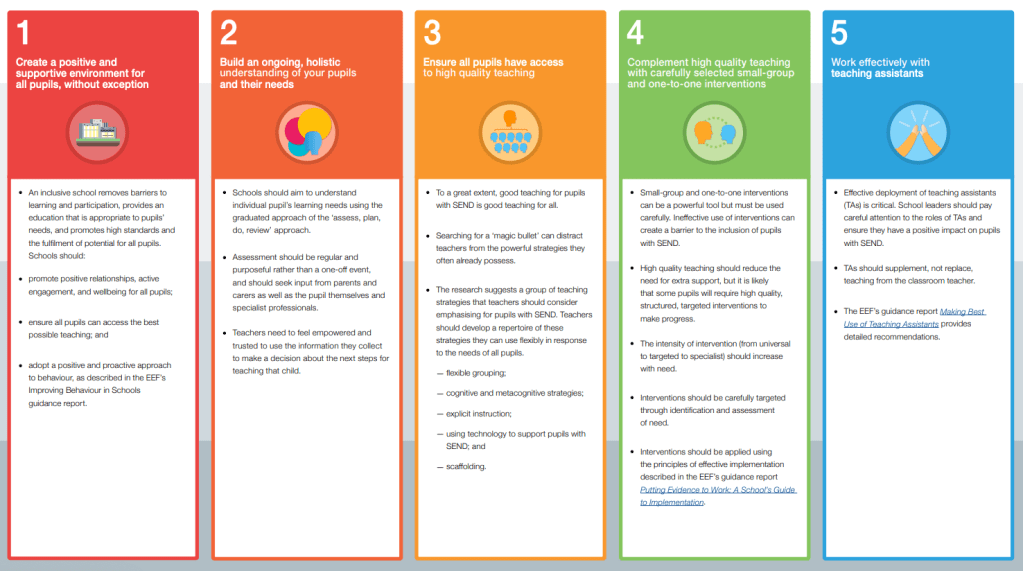
The EEF have published a guidance report on how to assure a positive learning environment for pupils with SEND in mainstream schools.
The report outlines five key elements to effective practice:
- 1 Create a positive and supportive environment for all pupils, without exception.
- 2. Build an ongoing, holistic understanding of your pupils and their needs.
- 3. Ensure all pupils have access to high quality teaching.
- 4. Complement high quality teaching with carefully selected small-group and one-to-one interventions.
- 5. Work effectively with teaching assistants.
Here is a link to the poster shown below. In addition there are some super tools available, one considers how to consider overlapping needs relating to cognition and learning, sensory/physical needs communication and interaction and SEMH needs.
Get in touch
If you would like any bespoke support with coaching, leadership training, safeguarding reviews, research practice then do get in touch for a chat. Here is a synopsis of my consultancy offer and contact details.
 Irresistible Learning