Welcome to the first edition of Chisnell Chatter for the academic year 2024-25. I hope this finds you well-rested after the summer break. As we return to life in school, our education landscape continues to undulate under our feet. One change of note has been the key announcements from Ofsted about the single word outcome judgement removal, time will tell as to the impact of this on our profession.
In this edition, I will explore the implications of the Ofsted Big Listen, socratic thinking and exit tickets.
Ofsted – a new direction
In my last edition, I shared a link to Ofsted’s new direction for ungraded inspections. Their article can be found here. As we move forward, Ofsted’s trial runs of this new format of inspection during the summer term appear to have confirmed that the shift from deep dive methodology for ungraded inspections have been received well by schools. For further details on how ungraded inspections will look like, read my previous blog here.
Sir Martin Oliver has published the outcome of his Big Listen project. The full response is available here. Here is a link to his brief statement about the outcome. Here are some key takeaways from the response:
In order to reset the relationship with schools:
We will consult on creating a reformed inspection framework for schools, early years and FE and skills. This will take the best of the current approach (such as the curriculum focus) but account for lessons we have learned through the Big Listen.
We will work with the government to remove the overall effectiveness grade (often referred to as the ‘single-word judgement’). We will replace it with a report card, or a similar tool, across all the sectors we inspect.
We will consult on introducing a new inspection criterion for inclusion. This will increase our focus on, and scrutiny of, how education providers support vulnerable children and young people, such as those who are disadvantaged or who have SEND.
We will work with the government to make sure children are kept safe and learning wherever they receive their education or care. We will do this by using safeguarding, attendance and off-rolling reviews for schools, enhancing social care regulation and area SEND inspection, tackling illegal schools and children’s homes, and calling for unregistered alternative provision to be regulated.
In order to foster a culture of integrity where the inspectorate treat people with professionalism, courtesy, empathy and respect:
We will launch the Ofsted Academy. This will be the single place that draws together all of our induction, training, learning, development and good practice work.
We have delivered mental health training to every inspector. This now forms part of our regular core training for all inspectors.
We will set up an inspection welfare, support and guidance hub to make sure our inspectors and providers have access to supportive information, and to offer any other assistance during inspection.
In order to develop transparency:
We will improve how we engage with children, learners, parents and carers, across all the areas we inspect. We will build on Parent View and our other engagement tools, learning from what we heard.
We are centralising Ofsted’s processes and practices to create greater consistency in how we work.
We will have a culture of transparency across all our work. This will include being clear about what we look at on inspection, making our training materials openly available, allowing Big Listen data to be accessible to researchers, and sharing more of our data, evidence and insights.
We are further improving our complaints investigations. Inspectors assessing complaints will always be from a different region to the one from which the complaint originated.
So, what does this all mean in practice for our schools?
It is clear that change is afoot in the inspectorate and that we will be seeing a new framework emerge by the end of this academic year. It also suggests that there will continue to be a tenacious focus on the quality of education, provision for pupils with disadvantage and SEND. As the development of a report card is clarified, the lens that the inspection takes may also evolve.
Socratic Thinking

As a mentor-coach, I often use Socratic questioning as a tool to engage my clients in deepening their thinking and self-reflection. I have also used the techniques in the classroom with students to encourage philosophical thinking. Here is a great little video explaining what Socratic thinking is and how to use this to encourage dialogue, debate and critical thinking.
Exit Tickets

I delivered a training session for a fabulous infant school in Kent this week. I always enjoy delivering training at the start of the school year as there is often a sense of anticipation and aspiration as we embark on new possibilities that are presented. The training focussed on the science of learning and I shared a range of theories related to how students learn and the strategies that we can use to support their working memory and transference of knowledge to long-term memory.
During the session, I was asked what an exit ticket was? Here is a synopsis of a super article by Peps Mccrea, Director of Education at Steplab:
Effective teaching is underpinned by effective assessment. The teacher needs to regularly check for understanding. The more often the teacher checks for understanding, the greater clarity they have of student knowledge and understanding; leading to clarity in the adaptations needed to best support further learning.
As student understanding is always in flux and the more often we check for understanding, the less time we make available for learning; the teacher needs to check for understanding diligently at the most critical points during the lesson.
Some of the most obvious critical points are during explanations or just before we set our students off on independent practice. But another equally important point is at the end of the lesson.
The teacher may well have covered everything, and their students may well have been working hard but these proxies don’t always help the teacher to confidently infer what has been learned.
Checks for understanding at the end of a lesson are can be called ‘exit tickets’.
Exit tickets can take a wide variety of forms, but typically they:
→ Attempt to assess the main learning intentions of the lesson
→ Reasonably quickly
→ In a way that provides useful data for making course-corrections to future lessons.
EXAMPLE
The teacher might give my students two minutes to answer 3 multi-choice questions (or a single open-ended question), on their own, on a sticky note which they hand to me as they walk out of the classroom.
Compared to in-lesson assessment, exit tickets give the teacher more time to analyse answers.
Eg: When the teacher plans their next lesson, exit tickets are then grouped from the previous lesson into various piles (such as correct vs mistakes vs misconceptions)… and then future lessons are informed by the results.
It is worth noting that exit tickets don’t need to be marked and returned. If everyone answers correctly, the teacher can move on. If there were some common mistakes or misconceptions, these can be tackled with the whole class, with groups or individuals.
BONUS
Designing an exit ticket as part of your planning is a great way to get crystal clarity on the most important things you want your students to learn.
There is a CAVEAT to the use of exit tickets:
Exit tickets often check in on short term or working memory. They confirm what students have learned in the lesson, not what they recall over time. As such, they are not great for summative assessment.
They cannot tell us if students have learned in ways they will be able to remember and transfer to their long-term memory. As such, we just need to be careful not to over-extend the reach of exit tickets.
SUMMARY
• A critical point to check for understanding is the end of a lesson is an ‘exit ticket’.
• This works best when we assess core learning intentions, within a set timeframe.
• Exit tickets also help drive clarity about what you want to teach.
Slow Thinking – seizing the power of cognitive bias
Many years ago, I read the wonderful book Thinking Fast, Thinking Slow by Daniel Kahnamann. This led me to write a blog on the journey to become increasingly aware of cognitive bias as a school leader. Here is a link to the blog, Slow Leadership, I hope it resonates with your role in school leadership.
I deliver a full training session on cognitive bias and how to harness its power and spot its perils as a school leader. If you are interested in this, lets talk!
Get in touch
If you are interested in booking me for a keynote, training event, twilight training or leadership coaching then let’s talk. I can deliver my tried and trusted programmes or work with you to create a bespoke package to enhance your organisation and strengthen your leadership.
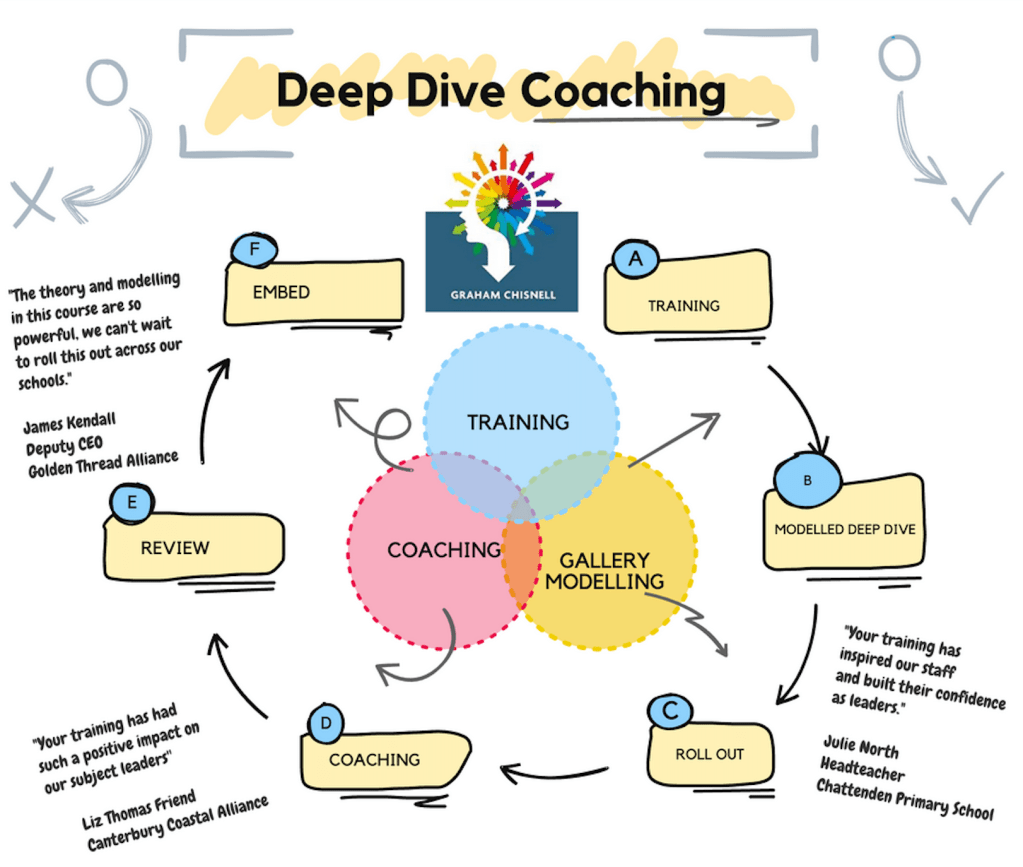
As an example, here is a synopsis of my deep dive coaching package
 Irresistible Learning