Welcome to my latest edition of Chisnell Chatter. Here we are at the point of a general election. As the political landscape unfolds, there is no doubt that our education system will once more be put under pressure for change. Change can be both inspiring and challenging with equal poise. Let’s do this together to ensure our political and departmental leads hear a clear and resounding voice from school leaders!
Memory – an Evidence Based Education guide
Here is a link to the EBE guide on memory and learning.
The guide reflects on the Evidence Based Education’s guide to great teaching. The guide outlines the following key steps:
- Understand the content of what you teach, how this is sequenced to build knowledge and schema, how and what to assess that is essential to knowledge, and a clarity on student misconceptions.
- Create a supportive environment where positive relationships and behaviours are constructed in a climate of high expectations. (this links to strategies such as dialogic teaching – see my article in Impact Journal here.)
- Maximise the opportunity to learn by managing time and resources, clarity of expectations and consequences for behaviour and reinforcing positive behaviours in your class.
- Activating hard thinking through structuring and scaffolding learning, explaining new ideas with clarity and purpose, using highly effective questioning, interacting with pupils to provide powerful feedback about their understanding, providing task that embed learning and helping pupils regulate and monitor their own learning.
The guide offers a really helpful theoretical basis to these points. In particular the guide explores the two forms of long-term memory:
Declarative memory is memory of facts, events, and concepts; they’re the items in our memory we can explicitly declare or say that we know. We can further divide declarative memory into episodic memory and semantic memory. The former refers to our ability to remembers specific events or episodes. Semantic memory describes general knowledge—that is, concepts, facts, or ideas that can be explicitly communicated.
Nondeclarative, or implicit, memory is knowledge that is based on prior experiences: procedures and processes that we can draw on without the relevant information entering our consciousness. In fact, one significant type of nondeclarative memory is procedural memory: knowing how to do things.
Headspace – a time to reflect and re-connect
I was delighted to host the Headspace conference with Gary Edwards this year. Delegates met and deepened their knowledge of research informed practice, engaged in a journal club, and heard Nadia Hewstone talk about strategies for effective school leadership. All with the backdrop of the beautiful Hythe Imperial Hotel. Providing time and space to reflect, reconnect and re-energise.
If you are a school or trust leader and would like to hear more about our plans for Headspace 2025, message me.
Learn how to fail
Dr Ourania M Ventista has written an interesting article on the concept of student failure. She draws on Carol Dweck’s growth mindset and Malcolm Gladwell’s book, ‘Outliers: The Story of Success’.
The article offers two suggestions to creating a safe space for failure in our classrooms.
1. Feedback (including use of praise) in a classroom can be one of the most powerful tools to support the learning process. Teacher feedback can suggest that learning is a continuum; it can be an opportunity to introduce the growth mindset in a classroom, and to help students become resilient. Interpretation of assessment results should not facilitate the perception of failure as permanent, but it should use failure as a learning event.
2. Always focus on making one thing clear to your students: assessments and feedback can help you to become better. There is no such a thing as a failure. Only a ‘not yet’ mindset.
EEF – Behaviour
Here is a link to the EEF guide to improving behaviour in school. The guide outlines six key steps to this end, and while some may appear obvious, a truthful and objective appraisal of these in the light of your current practice may be helpful. Here they are:
- Know and understand your pupils and their influence.
- Teach learning behaviours alongside managing misbehaviour.
- Use classroom management strategies to support classroom behaviour.
- Use simple approaches as part of your regular routine.
- Use targeted approaches to meet the needs of individuals in your school.
- Consistency is key.
There is a really helpful poster giving a summary of these points here.
Leadership through the lens of Inside Out
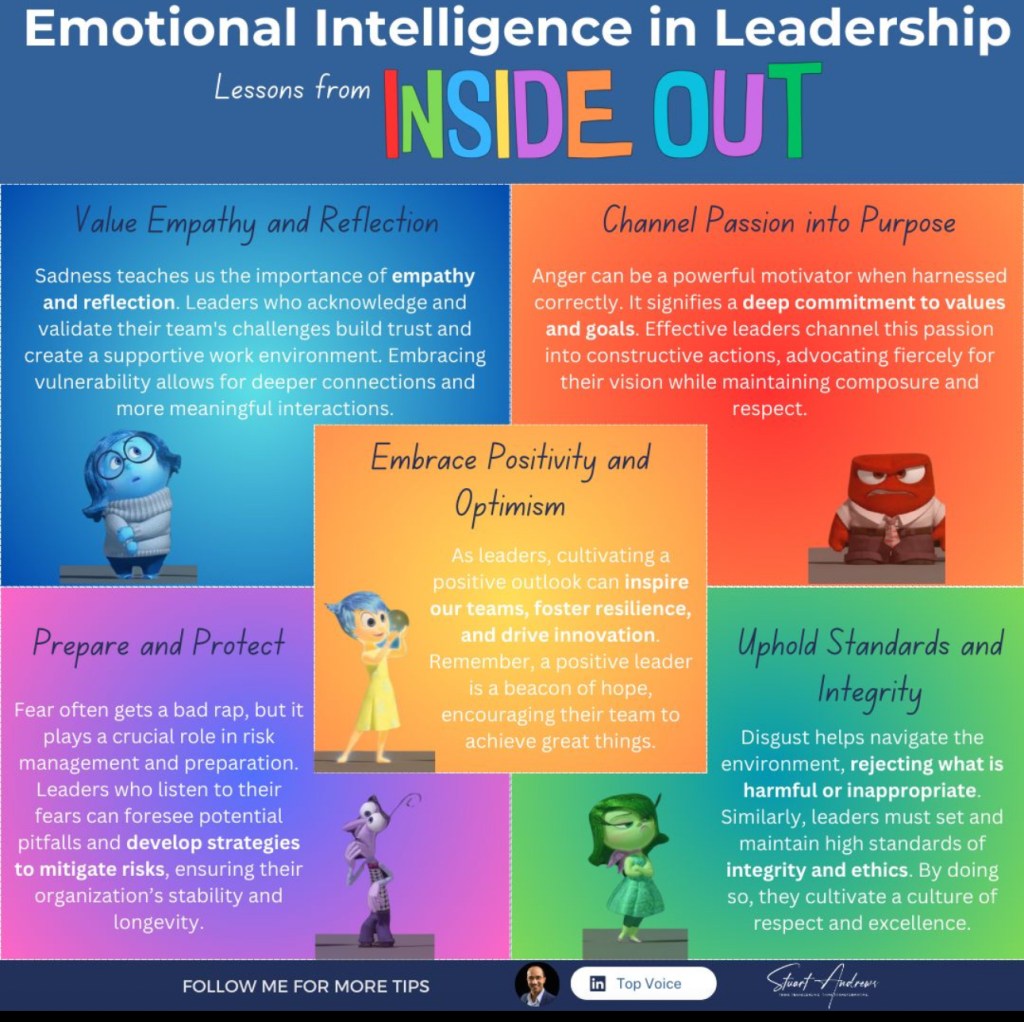
Stuart Andrews, a leadership coach, has devised an interesting lens on leadership using the children’s animated film Inside Out. I have seen schools use this to support pupil behaviour regulation but this is the first time I have seen this applied to leadership.
Here’s how each character from “Inside Out” can guide us in our leadership journey:
1. Joy: Embrace Positivity and Optimism – As leaders, cultivating a positive outlook can inspire our teams, foster resilience, and drive innovation. Remember, a positive leader is a beacon of hope, encouraging their team to achieve great things.
2. Sadness: Value Empathy and Reflection – Sadness teaches us the importance of empathy and reflection. Leaders who acknowledge and validate their team’s challenges build trust and create a supportive work environment. Embracing vulnerability allows for deeper connections and more meaningful interactions.
3. Anger: Channel Passion into Purpose – Anger can be a powerful motivator when harnessed correctly. It signifies a deep commitment to values and goals. Effective leaders channel this passion into constructive actions, advocating fiercely for their vision while maintaining composure and respect.
4. Fear: Prepare and Protect – Fear often gets a bad rap, but it plays a crucial role in risk management and preparation. Leaders who listen to their fears can foresee potential pitfalls and develop strategies to mitigate risks, ensuring their organization’s stability and longevity.
5. Disgust: Uphold Standards and Integrity – Disgust helps navigate the environment, rejecting what is harmful or inappropriate. Similarly, leaders must set and maintain high standards of integrity and ethics. By doing so, they cultivate a culture of respect and excellence.
“Inside Out” reminds us that all emotions are essential and that emotional intelligence is key to effective leadership. By understanding and integrating these diverse emotional insights, leaders can create a balanced, empathetic, and dynamic approach to leading their teams.
Stuart then asks how do you see these characters showing up in your leadership style or the leadership styles of your team?
See you on the other side of the General Election!
For more information about my consultancy offer, please visit my website here. My latest consultancy offer includes Coaching for Appraisal, a course that prepares leaders and staff for impactful appraisals. This course is co-facilitated with HR expert Gary Edwards.
Do get in touch if you are interested in training, consultancy or coaching support.
 Irresistible Learning